
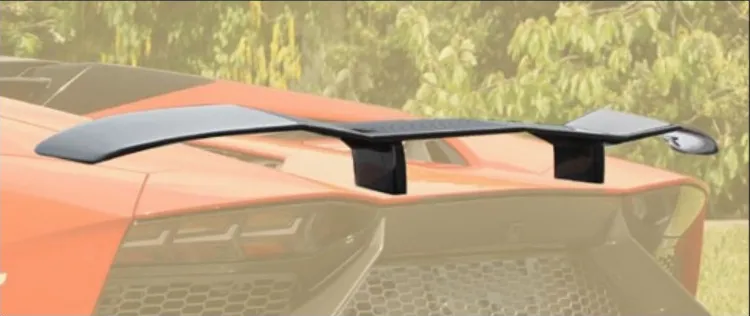
Rear performance wing Mansory Carbon for Lamborghini Aventador Competition


Mansory Carbon Rear Performance Wing for Lamborghini Aventador Competition
This single-plane rear performance wing sits at the centre of the Mansory Competition wing family, slotted purposefully between the discreet ducktail spoiler and the showpiece largest-format aerofoil. It is the all-rounder of the trio: a swan-neck-stayed carbon element that injects honest, measurable downforce over the rear axle while preserving the silhouette an LP750 SV or SVJ owner actually wants to live with on the road. Specified as part of the broader Mansory Carbon Body Kit for Lamborghini Aventador Competition programme, the wing respects the Aventador's naturally aspirated 6.5-litre V12 architecture, the scissor-door cut-line above the C-pillar, the rear-wheel-steering bandwidth, and — on SVJ trim — the ALA 2.0 central channel that must remain unblocked for the active-aero stall logic to function.
Construction & Materials
The aerofoil is laid up from aerospace-grade prepreg, cured in a heated autoclave under pressure cycle so the resin matrix arrives at full glass-transition temperature without micro-voids. The visible surface is 3K twill on a body-coloured or raw-weave option; the structural core uses unidirectional plies oriented to soak up bending across the span. Mansory's recipe is built for repeatability — every wing in this batch leaves the jig within a tight dimensional band so airflow attachment is predictable run after run.
- Skin: 3K 2x2 twill, optional 1K fine-weave or forged-look upgrade
- Core: unidirectional CFRP biased along the chord, with a localised reinforcement at the swan-neck stay roots
- Cure: autoclave prepreg, ramped cycle, post-cure stabilisation
- Wall thickness: 2.4–3.0 mm in skin zones, 5–7 mm at stay junctions
- Element mass: roughly 4.6–5.2 kg complete with stays and end plates
- Hardware: stainless studs into reinforced thread inserts, gel-anchored backing washers
- Optional gurney lip: 12 mm bonded carbon strip for additional aft-edge load when track use dominates
- Finish: 2K UV-stable lacquer or satin matte, both with anti-yellowing additive
Design & Visual Function
The defining choice with the rear performance wing is the single-plane geometry. Where the biplane variant stacks two chord elements for higher peak coefficient at the cost of straight-line drag and a busier silhouette, this wing leans on one well-shaped element with a moderately aggressive angle of attack. The leading edge picks up clean air aft of the engine cover, the chord follows the Aventador's tapered tail shoulders, and the trailing edge sits high enough to pick up energised flow without crowding the central exhaust plume on SVJ cars or the side outlets on LP and S variants.
Mounting is via a swan-neck stay arrangement rather than the older pedestal-from-below approach. The advantage is straightforward: keeping the under-wing surface uninterrupted preserves the high-pressure underside flow, which is where most of the downforce coefficient actually comes from on a single-element aerofoil. End plates are scaled to suit — taller than the ducktail spoiler's vestigial fences but markedly more compact than the largest wing's full track-day-style plates. They carry vortex-trim cuts that bleed tip vortices in a controlled way at autobahn speeds.
On SVJ, the wing sits over and around the ALA 2.0 central channel without obstructing the slot. The active-aero butterfly valve still feeds the central spar slot, and the wing's centreline is jigged with that channel as a hard constraint. On pre-SVJ Aventadors there is no ALA logic, so the wing simply mounts to the reinforced anchor zones in the engine-cover frame; the visual outcome is the same, but the aero job is purely passive there.
Compatibility & Fitment
Designed for the full Aventador family inside the Competition kit envelope: LP700-4, LP750-4 SV, S, SVJ, and Ultimae, in both coupé and Roadster body styles. The mounting plate kit ships with two pattern interfaces — pre-SVJ engine-cover deck pattern, and the revised SVJ deck which carries the ALA 2.0 routing — so the same wing skin fits across the lineup. Rear-wheel-steering operation is unaffected since the wing loads the body, not the suspension; ride-height calibration on SVJ adaptive dampers may be re-baselined after install for owners who run the car frequently above 200 km/h.
Installation & Reversibility
Plan on six to nine hours for a clean install on a lift with the rear engine cover removed and properly supported on a foam-topped trolley. The crew drills no new holes — the wing uses Mansory's templated stud pattern that drops onto factory threaded points or supplied insert nuts bonded with a methacrylate-compatible adhesive system. The CFRP monocoque deck panels around the engine bay use methacrylate bonding from the factory, so any structural adhesive used at the periphery must be chemically compatible with that substrate; Mansory ships the correct primer pen with the kit. Removal is non-destructive: torque off the studs, lift the wing, plug the witness holes with the supplied carbon caps, and the car returns to factory geometry. Recommended fitter is a Lamborghini-certified body shop or a Mansory-trained installer; this is not a driveway DIY job because alignment tolerance to the centre channel on SVJ is tight.
Pairing within the Mansory Aventador Competition programme
The rear performance wing is the middle option in a family of three rear aero choices, and the right cross-shop reading is across that whole family. The most subtle of the three is the rear spoiler ducktail, which adds a hint of trailing-edge lift management with almost no visual footprint — ideal for owners who want body-fitting carbon without an aerofoil at all. One step further toward racetrack character lives the biplane performance wing, a twin-tier element that delivers a higher peak downforce coefficient and a much more dramatic rear graphic, with the trade-off of greater drag at autobahn cruise and a busier line in profile. At the top of the ladder sits the rear high-performance wing, the largest of the three — built around a wider chord and full-height end plates for owners pushing serious track sessions. The single-plane performance wing reviewed here threads between those poles: meaningfully more downforce than the ducktail, less drag and visual mass than the biplane, more road-friendly than the largest wing. If you intend to drive the car publicly, this is usually the right entry into the Mansory wing line.
Maintenance & Durability
Lacquered carbon hates two things: alkaline cleaners and abrasive sponges. Stick with pH-neutral shampoo, soft microfibre mitts, and rinse from the leading edge backward so grit travels off the trailing edge rather than into it. A modern ceramic coating outperforms carnauba on this surface — it resists UV chalking far better and makes bug residue lift off the leading edge with minimal contact. Inspect the swan-neck stay junctions annually for any micro-stress whitening; the autoclave cure makes that uncommon, but a heavily tracked car that sees thermal cycling deserves a closer look. The wing sits aft of the V12's hot zone but is not directly bathed in exhaust plume on either pre-SVJ side outlets or SVJ central twin-exhaust geometry, so engine-bay heat shielding is not a wing-specific concern. Stone chips on the leading edge can be repaired by a competent carbon-trim specialist using a tinted UV resin and a re-clear; full panel replacement is rarely warranted.
Lead Time & Warranty
Lead time runs four to eight weeks, in line with Mansory's bespoke production cadence — the wing is laid up to order with the customer's chosen weave and finish. Expect a 12-month manufacturing-defect warranty covering delamination, void migration, and hardware failure under normal use; track abuse and stone-strike cosmetic damage are not covered, as is standard across high-performance carbon aero.
FAQ
Q: How does the single-plane wing compare aerodynamically to the biplane on the same chassis?
A: The biplane reaches a higher peak downforce coefficient because two stacked elements produce more pressure differential, but it pays for that with substantially more drag and a more strident look. The single-plane element here gives roughly 60–70 percent of the biplane's downforce at noticeably less drag and a quieter visual signature — the right pick if you balance road and occasional track use.
Q: Will it interfere with ALA 2.0 on an SVJ?
A: No. The mounting jig and centreline are explicitly designed around the ALA central channel. The active-aero butterfly valve and the central spar slot remain unobstructed, so the stall-on-demand logic continues to function as Lamborghini intended.
Q: Pedestal mount or swan-neck stay — what's the difference and which does this wing use?
A: This wing uses swan-neck stays mounted from above the element. That keeps the high-pressure underside surface clean of pylon interference, which is where most of the lift-to-drag advantage on a single-plane wing comes from. Pedestal mounts from below are simpler to engineer but compromise the underside boundary layer and you can see the difference in real-world data.
Q: Is the gurney lip option worth specifying?
A: For owners who do regular trackdays, yes — the 12 mm gurney adds a small but useful pitching moment at the rear, sharpens turn-in stability under heavy braking, and is a low-cost way to recover a chunk of the biplane's higher peak figure. For a car that lives on road only, the standard trailing edge is preferable for cleaner attached flow at cruise.
Q: Can the wing be removed without damaging the engine cover?
A: Yes. The fixing pattern uses templated studs into reinforced anchor points; removal leaves no visible scarring, and the supplied carbon plug caps close the witness holes cleanly. The original Lamborghini engine cover is unmodified.
Q: Does it fit a Roadster the same way as a coupé?
A: Yes. The mounting plane is the engine-cover deck, which is shared between coupé and Roadster bodywork. Soft-top stowage operation is unaffected because the wing sits aft of the targa-stow envelope.
For an Aventador Competition that needs more than a ducktail but less than the largest aerofoil, this single-plane swan-neck wing is the honest middle answer. Pair it with a carbon engine bonnet and the rear bumper air outtake covers for a coherent rear graphic. Speak to the team on WhatsApp +44 7488 818 747 or write to [email protected] to lock in build slot, weave, and finish.