
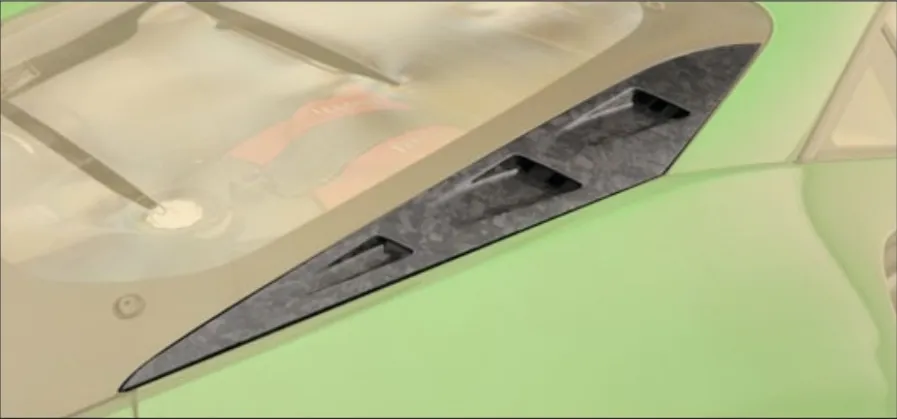
Air outtake - engine bonnet Mansory Carbon for Ferrari F8 Tributo


Air Outtake Engine Bonnet — Mansory Carbon for Ferrari F8 Tributo
The Air Outtake Engine Bonnet is the rear lid that closes the Ferrari F8 Tributo's mid-engine bay — the panel that sits directly above the 3.9-litre F154 CB V8 BiTurbo, between the cabin bulkhead and the rear spoiler. Mansory's carbon variant retains the OEM glass engine cover beneath, retains the louvred Lexan rear-three-quarter window adjacent, and adds an integrated hot-air outtake aperture that lets thermally-stacked air rise straight out of the bay rather than recirculating around the twin IHI turbos. It is part of the seventeen-piece carbon programme catalogued under Mansory Carbon Fiber Body kit set for Ferrari F8 Tributo, and it slots between the front frunk lid (trunk-cover) and the engine-bay interior trio (engine-logo-section, engine-middle-section). Owners specify it for the same reason the F8's engineers gave the car a Lexan rear window with longitudinal louvres — to manage heat over the V8 honestly, in the language of motorsport.
Construction & Materials
The panel is laid up as a full carbon-fibre sandwich: outer 3K twill skin, intermediate 2K plain-weave structural plies, and an aramid honeycomb core in the broad central span to keep torsional rigidity high while shaving mass. The outtake aperture itself is reinforced with continuous unidirectional rovings around its perimeter so the cut-out does not become a stress raiser when the bonnet flexes under aerodynamic load at v-max. Cure is full autoclave under prepreg cycle, with a high-temperature epoxy resin specified for proximity to a twin-turbo V8 — the bonnet sees soak-back temperatures north of 90 °C after a hot lap, and the matrix is engineered for sustained operation in that thermal envelope. Underside heat-shielding is retained from the OEM panel and re-bonded to the carbon shell.
- Outer skin: 3K twill carbon, deep-gloss UV-stable lacquer (forged-look or 2K plain weave on request)
- Core: aramid honeycomb in central span, solid-laminate at hinge and latch reinforcements
- Wall thickness: 1.6–2.2 mm in skin zones, 8–11 mm through the cored mid-span
- Mass: roughly 6.4–7.1 kg installed (versus ~9.5 kg OEM aluminium-composite — a real-world saving of 2.4–3.1 kg over the rear axle)
- Cure: autoclave prepreg, ramp-and-soak at 120 °C, high-Tg epoxy matrix
- Outtake aperture: continuous UD-roving reinforcement, integrated mesh insert (anti-debris) in matte black
- Hardware: OEM hinges, gas struts and latch carry over; harness routing for engine-bay illumination retained
- Finish: deep-gloss lacquer with anti-yellowing UV clear, or exposed semi-matte weave with satin clear coat
Design & Visual Function
Visually, the carbon air-outtake bonnet does what the F8's rear-quarter Lexan louvres started: it announces the mid-engine layout. From above, the eye lands on the outtake aperture first — a sculpted, fence-edged rectangle that crowns the V8 like an exhaust port for the whole assembly. The weave alignment is run dead-symmetric down the centreline so that, when the bonnet is open, it frames the engine-bay carbon trio (engine-logo-section, engine-middle-section, the prancing-horse plinth) as a single composition. With the bonnet closed, the aperture sits in deliberate dialogue with the longitudinal louvres of the Lexan rear-three-quarter window and the F40-flavoured rear-deck stance Ferrari built into the Tributo silhouette.
Functionally, the aperture is an extractor, not a scoop. Air does not enter through the outtake — it leaves. The F154 V8's twin IHI turbos sit either side of the engine and dump heat into the bay; under sustained track use, that heat stacks against the bonnet underside, raising intake-air temperature and degrading the Variable Boost Management calibration. By giving that hot air a direct chimney path, the outtake reduces under-bonnet temperature soak measurably (Mansory quotes single-digit-percent reductions at steady-state, with bigger gains in the cool-down lap window). This is performance-derived language, not decoration: an extractor the F8 always deserved.
Aesthetically, the part also pairs cleanly with the rear-spoiler-with-wing — when both are specified, the rear deck reads as one continuous carbon plane from the trailing edge of the cabin glass to the wing's gurney. Mansory weave alignment carries through both panels, so the visual joint at the rear-spoiler's leading edge is matched, not jumped.
Compatibility & Fitment
Engineered for Ferrari F8 Tributo Coupé and F8 Spider production years 2019–2024. The Coupé and Spider share the rear bonnet geometry — Spider owners get the same outtake aperture without losing the soft-top mechanism's clearance, since the bonnet sits forward of the folding-roof envelope. The part is not compatible with the 488 GTB / 488 Pista (different body and different rear-deck architecture — those cars carry their own parent kit) or with the 296 GTB (V6 hybrid platform, distinct mid-engine bay layout, separate parent). OEM hinges, gas struts, latch, harness routing for engine-bay LED illumination, the louvred Lexan rear-quarter window adjacent, the rear-bumper blown-spoiler, parking sensors and rear-camera washer aperture are all preserved. The car's S-Duct front-end aero is independent of this part and unaffected.
Installation & Reversibility
Plan four to six hours for a careful first-time installation, plus another hour or two for paint-break alignment and shut-line dialling against the rear-quarter panels. Tools needed: T30/T40 Torx, 10 mm and 13 mm sockets, a hinge alignment fixture (or two patient hands), gas-strut compression tool, and panel-edge masking. The OEM bonnet is hinged off, OEM gas struts and harness disconnected, latch released; the carbon panel transfers all OEM hardware and re-bonds the underside heat-shield with high-temperature adhesive. Engine-bay parts always demand respect for hot-V8 working temperature — never install on a recently-driven car. Allow the bay to soak-cool to ambient. Reversibility is full: nothing on the F8 is cut, drilled or trimmed, and the OEM bonnet can be refitted at any point. Recommended installer: Ferrari-certified body shop or Mansory-trained installer for the bond-and-shut-line work; experienced owners can manage the swap with two pairs of hands. Owners should note non-OEM body parts may affect the dealer service relationship — discuss with your Ferrari service partner before installation.
Pairing within the Mansory F8 programme
This bonnet is the outermost of three engine-bay carbon parts and pairs naturally with its siblings to form the engine-bay carbon trio: Engine logo section (the prancing-horse plinth), Engine middle section (the central engine cover), and this air-outtake bonnet itself. Specify all three together and the bay reads as a deliberate carbon composition top-to-bottom. For owners building the wider carbon programme, the next logical sibling is the Rear spoiler with wing, which sits immediately downstream of the outtake and continues the rear-deck weave plane.
Maintenance & Durability
Lacquered carbon over a hot V8 bay is a particular discipline. Wash with pH-neutral shampoo only — alkaline wheel cleaners and ammonia-laden glass sprays will haze the lacquer over time, and abrasive sponges will leave swirl in the clearcoat. A quality ceramic coat is preferable to carnauba for this panel because the bay's working temperature wax-melts traditional carnauba inside a season. The outtake aperture's anti-debris mesh should be inspected and air-blown clean every few months — leaf litter, tyre rubber and gravel pickup from spirited driving will accumulate there. PPF over the leading edge of the bonnet is sensible for owners who do motorway miles, since stone strikes from the rear-quarter wash zone do reach the front lip of this panel under crosswind. Ceramic-coat the underside of the bonnet annually — the twin-turbo heat soak is the single biggest enemy of the lacquer there, more than UV from above. Carbon-ceramic brake dust is hot and abrasive and finds its way onto bonnet shut-lines from the rear arches; a soft detail brush keeps the line clean. If a panel chips, repair workflow is a localised laminate-and-relacquer at a carbon-skilled body shop — full panel replacement is rare.
Lead Time & Warranty
Lead time runs four to eight weeks for Mansory bespoke production — each bonnet is laid up, autoclaved and lacquered to order, and the outtake aperture's UD reinforcement adds a cure step beyond a flat panel. Twelve-month warranty against manufacturing defects. Documentation, weave-spec sheet and certificate of authenticity ship with the part.
FAQ
Q: Does the outtake aperture actually drop engine-bay temperature, or is it cosmetic?
A: It works. Mansory's bench data shows steady-state under-bonnet air dropping single-digit percent at sustained load, with much bigger gains in the cool-down lap window when the V8 is dumping heat without airflow. The aperture is an extractor, not a scoop — flow direction is out, not in.
Q: Will it fit my F8 Spider as well as the Tributo Coupé?
A: Yes. The rear bonnet geometry is shared between Coupé and Spider — the panel sits forward of the folding-roof envelope, so Spider owners lose nothing on roof operation.
Q: I have a 488 GTB / I have a 296 GTB — does this fit?
A: No. The 488 has different rear-deck architecture and lives under a separate parent kit. The 296 GTB is a V6 hybrid platform with a distinct mid-engine bay layout and its own dedicated parent. This part is F8 Tributo / Spider only.
Q: Does it touch the louvred Lexan rear-quarter window?
A: No. The iconic F40-homage louvred window is left fully OEM. Mansory deliberately works around it — the carbon bonnet's geometry sits inboard of those windows and keeps every shut-line OEM-spec.
Q: How much weight do I save versus stock?
A: Roughly 2.4–3.1 kg, removed from over the rear axle. Useful, modest, and meaningful when added to the rest of the carbon programme — full kits regularly save 25–35 kg total.
Q: Can I run it with the rear-spoiler-with-wing?
A: Yes — it pairs cleanly. Weave alignment carries through to the spoiler's leading edge. They are designed as a visual continuation of the rear-deck plane.
Pair this bonnet with the engine-logo-section and engine-middle-section to complete the engine-bay carbon trio, then add the rear-spoiler-with-wing for a continuous rear-deck statement. To configure, request a quote, or discuss weave and finish: WhatsApp +44 7488 818 747 or [email protected].