
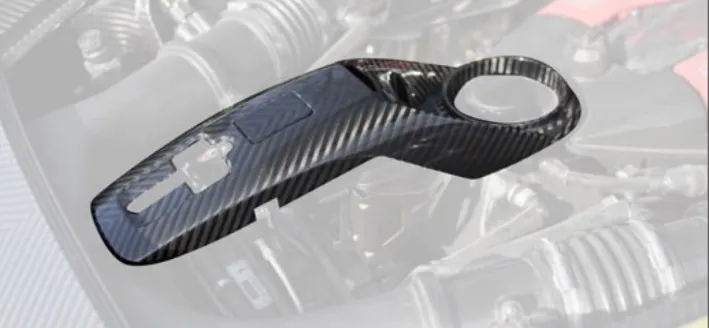
Engine middle section Mansory Carbon for Ferrari F8 Tributo


Engine middle section Mansory Carbon for Ferrari F8 Tributo
The Mansory engine middle section is the central carbon panel of the F8 Tributo's mid-engine bay theatre, sitting between the engine-logo-section and the outer trim that frames the 3.9 litre F154 V8 BiTurbo. As part of the wider Mansory Carbon Fiber Body kit set for Ferrari F8 Tributo, this piece converts the OEM injection-moulded mid-bay cover into a tailored prepreg composite that holds its geometry through 720 PS of flat-plane crank thermal cycles. On the Coupe the panel is read directly through the glass engine cover; on the Spider it sits in open air when the soft-top is stowed. Either way, it is the focal piece of the bay aesthetic and the visual hinge between the cylinder vee and the outer carbon ring.
Construction & Materials
Mansory builds the engine middle section from aerospace-grade prepreg carbon laminated over a heat-stabilised core. The lay-up is sequenced so that the visible outer ply runs in continuous, unbroken tow lines, while the inner structural plies are oriented to absorb the alternating hot/cold cycles of the F8's twin-turbo bay. Because this panel sits within line-of-sight of the turbocharger housings and exhaust manifold heat shields, the resin system is selected for elevated glass-transition temperature rather than purely cosmetic clarity.
The result is a piece that behaves like an OEM thermal component visually, but reads as a Mansory-grade carbon surface under the glass cover. Each panel is demoulded, trimmed, edge-sealed and individually inspected before the matte UV clear is applied. Where customers prefer raw weave for maximum heat tolerance, that option is offered without a topcoat.
- Material: aerospace prepreg carbon, 2x2 twill outer ply, multi-axial structural plies beneath.
- Cure: autoclave with high-Tg epoxy resin tuned for sustained engine-bay temperatures.
- Wall thickness: typically 1.6 to 2.2 mm depending on contour zone.
- Weight: approximately 0.7 to 1.1 kg net of fasteners, comfortably below the OEM moulded part.
- Mounting: heat-resistant stainless fasteners and OEM-spec clips, no plastic studs in heat zones.
- Finish: matte UV clear lacquer as standard, raw weave on request for maximum heat tolerance.
- Edge treatment: hand-finished, sealed against oil and brake-cleaner contact at service.
- Quality control: per-piece dimensional check against the F8 Tributo OEM datum points before shipment.
Design & Visual Function
The F8 Tributo bay is designed to be looked at. The Coupe's tempered-glass engine cover frames the V8 like a watch movement, and the middle section is the dial of that movement. Mansory's panel keeps the OEM's negative-space discipline but trades the painted plastic surround for woven carbon, so the eye now reads carbon-to-engine-block instead of plastic-to-engine-block. Under direct sun the twill pattern animates as you move around the car; under garage light it sits quietly and lets the red cam covers carry the colour story.
Heat zones dictate the design language here as much as styling does. The turbocharger housings, exhaust manifolds and intercooler outlets all sit within close radius of this panel, so the surface is not over-glossed. A high-shine clear would haze under sustained heat cycling and trap polishing residue in the bay. Mansory's matte UV clear, or the raw-weave option, sidesteps both problems while still presenting a finished carbon look. The weave is set up to align with the engine-logo-section above it, so the centre badge reads as the keystone of one continuous carbon arch rather than as an isolated plaque.
The third design vector is harmony with the air-outtake-engine-bonnet that vents the bay heat. Because all three pieces are produced in the same lay-up sequence, weave direction and matte level match across the trio, regardless of whether the customer specifies the full set in one batch or stages the build over several services. The end result is an engine bay that reads as one designed environment instead of three retrofitted parts sitting next to each other.
Compatibility & Fitment
This middle section is engineered specifically for the Ferrari F8 Tributo, both Coupe and Spider, in the 2019 through 2024 production window. It is not compatible with the 488 GTB, the 488 Pista or the 296 GTB. The 488 generation uses a different bay topology and mounting datum, while the 296 GTB is a hybrid V6 platform with an entirely different cover architecture and is explicitly out of scope for this part. Within the F8 family, the Spider's slightly different glass coverage does not affect the middle-section footprint: the panel fits both body styles using the OEM brackets, and Mansory does not split the part number between Coupe and Spider.
OEM heat shields, ECU brackets and wiring routing are retained. The panel is designed to install over the existing thermal management hardware, not to replace it. This is important for warranty-friendly installations: nothing in the Ferrari thermal protection chain is modified or removed.
Installation & Reversibility
Installation is reversible. A trained technician will lift the OEM mid-bay panel by releasing its factory clips and fasteners, transfer the OEM brackets to the carbon piece, then seat the Mansory panel onto the same datum points. Typical bench time is two to four hours, including bay clean-down and a final torque check. Tools required are standard Ferrari workshop kit: torque drivers, plastic trim picks for clip release, and lint-free cloths for handling the carbon during the dry-fit step.
No paint, no drilling, no irreversible work is needed for the middle section itself. The original part can be refitted at any time, which is the preferred protocol when the car is sent to a Ferrari main dealer for major service, particularly anything involving turbo removal. Because the part sits in a heat-cycling area, we strongly recommend a specialist installer who is comfortable working inside an F8 bay rather than a general bodyshop. The cost saving of a non-specialist install is rarely worth the risk of a misaligned heat shield or a torqued-down clip on the wrong axis.
Pairing within the Mansory F8 programme
The middle section is one piece of a three-part bay set and is best ordered alongside its neighbours rather than in isolation. The natural companion is the engine-logo-section directly above, which carries the Ferrari script and frames the upper edge of the middle panel. Above that, the air-outtake-engine-bonnet caps the bay and exhausts the heat that the middle section visually contains. To extend the carbon language rearward, the trunk-cover ties the bay theatre into the rear deck so the F8 reads as one continuous Mansory composition from windshield to tail.
Maintenance & Durability
Engine-bay carbon lives a different life from exterior carbon. It is not exposed to UV every day, but it is exposed to heat cycles every drive, plus the occasional oil mist or coolant residue at service intervals. The Mansory middle section is built for that environment, but it still benefits from sensible care. Wipe with a damp lint-free cloth and a pH-neutral cleaner when the bay is fully cool. Avoid acetone, brake cleaner, and aggressive degreasers on the visible carbon surface; they will cloud the matte clear and can lift edge sealing over time.
If oil splash occurs, address it within a few hours rather than letting it bake on across the next heat cycle. At each main service, a quick visual inspection of the panel edges and fastener seats is enough to confirm the part is still seated correctly. Treated this way, the panel will outlast typical ownership cycles without visible degradation.
Lead Time & Warranty
Standard Mansory production lead time on the engine middle section runs from four to eight weeks depending on current programme load and finish choice. Raw-weave and matte UV clear share the same lead time band; bespoke sub-finishes can extend it. The part ships with a 12-month manufacturing warranty covering laminate integrity and finish defects under normal engine-bay use. Heat-cycle wear at the published operating range of the F154 V8 BiTurbo is explicitly within scope of normal use and does not affect the warranty.
FAQ
Q: How does the carbon hold up to engine-bay heat?
A: The lay-up uses a high-Tg epoxy resin cured in autoclave specifically for sustained engine-bay temperatures, with the matte UV clear (or raw-weave option) chosen to avoid the hazing that high-gloss finishes show under repeated heat cycles.
Q: Will it look right under the Coupe's glass engine cover?
A: Yes. The weave direction is set to align with the engine-logo-section above, so when you look down through the glass cover you read one continuous carbon surface around the V8 rather than three disconnected pieces.
Q: Does it fit the Spider as well?
A: Yes. The Spider's glass coverage differs slightly, but the middle-section footprint and mounting datum are the same on both body styles, so a single part number serves Coupe and Spider.
Q: Will it fit a 488 GTB or 488 Pista?
A: No. The 488 generation uses a different bay topology and mounting points, and the Mansory middle section is engineered exclusively for the F8 Tributo platform.
Q: What about the 296 GTB?
A: No. The 296 GTB is a hybrid V6 with an entirely different engine cover architecture and is not within the compatibility scope of this part.
Q: Raw weave or lacquered for the engine bay?
A: For maximum heat tolerance and lowest maintenance overhead, raw weave is the more forgiving choice. The matte UV clear remains the most popular for owners who prefer a finished, slightly deeper carbon look under the glass cover.
Q: What if it gets oil-stained at a service?
A: Light oil mist wipes off cleanly with a pH-neutral cleaner on a cool bay. If a stain bakes on, the panel can usually be refinished rather than replaced; we will quote against the photos before any work is committed.
Pair the middle section with the engine-logo-section and air-outtake-engine-bonnet to complete the F8 bay theatre, then extend the carbon language rearward with the trunk-cover. To confirm finish, lead time and pairing pricing, message us on WhatsApp +44 7488 818 747 or write to [email protected].