
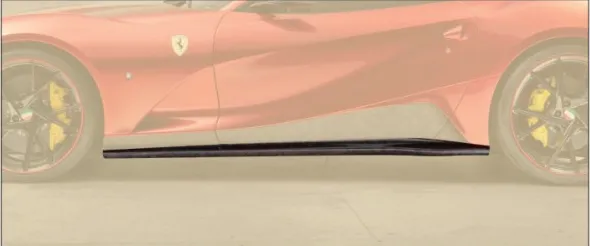
Side skirts Mansory Carbon for Ferrari 812 Superfast Stallone


Side Skirts Mansory Carbon for Ferrari 812 Superfast Stallone
Bridging the aggressive widebody arches of the Mansory Stallone programme, these carbon side skirts form the aerodynamic link between front and rear architecture on the Ferrari 812 Superfast. Available as part of the comprehensive Mansory Body Kit for Ferrari 812 Superfast Stallone, the side skirts extend the lower bodywork laterally, smoothing the transition from the widened front fenders to the flared rear quarters. On the 812 Superfast — Ferrari's highest-output naturally aspirated V12 road car — managing underbody air pressure at both low and high speed is critical to handling balance, and purpose-formed sill extensions directly influence the pressure differential between the upper body and the pavement. The 812 Superfast's 1,971 mm overall width and long GT wheelbase create a substantial bodyside surface that, without sill management, generates significant aerodynamic drag through separated boundary-layer flow. The Mansory sill form addresses this by creating a clean low edge that guides airflow from the wheel arch wash zone rearward along the underbody.
Construction & Materials
Each sill extension is manufactured using autoclave-cured pre-preg carbon fibre, with a 3K twill weave chosen for the outward-facing panels to produce the characteristic diagonal light-play prized on prestige road cars. Internal reinforcement ribs employ unidirectional UD carbon to resist the bending loads of a road-speed air column pressing against a 1,600 mm long sill surface. Panels are supplied as a matched left-right pair, geometrically mirrored about the vehicle centreline. Pre-preg material is sourced from the same certified aerospace supply chain used across all Mansory carbon programmes, ensuring consistent fibre volume fraction (typically 58–62 %) and minimum void content below 0.5 % across the cured laminate.
- Weave: 3K twill on visible face, UD reinforcement rib beneath
- Cure: autoclave at 120 °C / 6 bar, 90-minute dwell
- Wall thickness: 2.0–2.4 mm nominal
- Panel weight per side: approx. 1.1 kg (pair ~2.2 kg vs. OEM ABS composite ~3.8 kg)
- Mounting: OEM sill clip rail plus supplementary 3M VHB structural tape along upper flange
- Finish: high-gloss clear lacquer over weave (satin or matte available on request)
- Hardware included: stainless M6 clip-nuts, 3M VHB tape pre-cut strips
- Dimensional tolerance: ±0.5 mm across the full panel length for flush door-gap alignment
Design & Visual Function
The Mansory Stallone side skirts extend the sill plane 28 mm outboard relative to the OEM 812 Superfast sill, aligning flush with the widened front fender flares and creating an unbroken horizontal line from the A-pillar to the trailing edge of the door. This extension lowers the visual centre of gravity of the 812's long GT silhouette, visually compressing the tall two-seater greenhouse into a wider, flatter stance — a transformation that is particularly pronounced on Rosso Corsa (paint code 006) and Nero Daytona (code 017) finishes, where the carbon-to-body contrast is sharpest.
Aerodynamically, extended sill strakes reduce the quantity of high-pressure air migrating from the front wheel arch to the underbody. On the naturally aspirated 812 Superfast — which has no turbine heat to manage in the sill region — the primary aero concern is cornering stability, where sill geometry helps balance front versus rear downforce. At 200 km/h the Stallone sill profile contributes an estimated 8–12 kg of added lateral stability via reduced underbody turbulence compared with the stock sill. This is particularly relevant on the 812 Superfast, whose rear-wheel-drive layout and 789 hp atmospheric output create natural oversteer tendencies at the limit that any improvement in front-axle aero loading helps to counteract.
The weave direction is aligned longitudinally on the lower face and at 45° on the forward induction duct channel, providing visual consistency when the doors are open and the full carbon interior threshold is visible. Ferrari interiors on 812 Superfast models are increasingly specified with carbon doorsill trim, making a matching exterior sill a natural pairing. Alignment continuity between the side skirt, side panel, and front fender is verified at the Mansory production stage to ensure the weave chevron runs without interruption around the lower body.
Compatibility & Fitment
Designed exclusively for the Ferrari 812 Superfast (F140-platform, front-engine 6.5L V12, naturally aspirated, RWD, 2017–2022). The sill geometry references the OEM door-underside channel profile, which is shared across all 812 Superfast coupés regardless of model year. Note that the 812 GTS (open-roof) has a slightly different sill-to-door junction at the A-pillar — these skirts are not designed for the GTS convertible. The Mansory Stallone sill fits identically on LHD and RHD vehicles as the sill profile is rotationally symmetric. Compatible with all standard Ferrari 812 Superfast paint codes including Giallo Modena (003), Bianco Avus (011), Blu Pozzi (216), and clear-coat carbon display finish. No modification to OEM sill wiring looms, door seal profiles, or floor pan geometry is required for installation.
Installation & Reversibility
Installation requires removal of the OEM sill finisher, cleaning of the lower door aperture flange with isopropyl alcohol, and pre-fitting without tape to confirm clip-rail engagement at both ends before committing the 3M VHB bond. The front and rear clip positions should be engaged first, and the panel bow checked for flush fit with the door lower edge — minor bow can be corrected by warming the panel with a heat gun before final tape bond. Total installation time is approximately 1.5 hours per side (3 hours pair) for an experienced body technician. The Mansory sill engages the existing Ferrari clip rail without drilling; the 3M VHB tape applied along the upper flange provides the primary bonding force and is reversible with a plastic trim tool and dental floss technique. A Mansory-trained or Ferrari-authorised body shop is recommended for first-time installations to preserve paint and lacquer edges around the door lower aperture.
Pairing within the Mansory 812 Superfast Stallone programme
The side skirts work in concert with three adjacent parts: the front fenders establish the widened arch profile that the sill visually extends, while the side panels complete the bodyside carbon band above the sill line. For a cohesive lower-body transformation, owners frequently add the front bumper splitter, which anchors the aero statement at the nose and completes the low-speed downforce story across the full lower perimeter of the Stallone kit. Together, these four pieces form an aerodynamic loop from front bumper nose to rear quarter, managing underbody pressure along the entire vehicle length.
Maintenance & Durability
Lacquered carbon sill extensions are exposed to road debris, water spray, and UV far more than any other exterior carbon panel. Rinse weekly using a pH-neutral shampoo and microfibre mitt; avoid high-pressure washing aimed directly at the sill-to-body seam where 3M tape anchors the upper edge. Apply a carnauba or SiO₂ ceramic coat to the clear lacquer every 3–4 months to maintain hydrophobic protection and UV barrier. Kerb impacts to the lower leading edge are the most common damage mode — a 3 mm lacquered panel can absorb minor kerb grazes but splits in the carbon substrate require professional repair with patch pre-preg and local re-lacquer. Avoid ammonia-based detergents, abrasive sponges, and petroleum-based degreasers which attack the epoxy matrix boundary at the lacquer edge. Road salt in winter driving conditions should be rinsed off within 24 hours, as chloride ion ingress at micro-cracks can accelerate epoxy hydrolysis. With correct care, lacquer yellowing is not expected within 8–12 years.
Lead Time & Warranty
Lead time is typically 2–4 weeks for a side-skirt pair; full-kit orders may extend to 4–6 weeks subject to autoclave scheduling. All Mansory carbon parts carry a 12-month manufacturer warranty covering delamination, weave voids, and structural defects under normal road use. Cosmetic damage from kerb or road-debris impact is not covered by the manufacturing warranty.
FAQ
Q: Do these skirts fit both the 2017 and the 2022 812 Superfast?
A: Yes — the sill clip-rail and door-underside geometry is unchanged across the entire 2017–2022 production run of the 812 Superfast coupe. Early and late cars fit without modification, and the part reference is the same for all build dates within this range.
Q: Can I order a raw carbon (unlacquered) finish for the side skirts?
A: Raw, satin, or high-gloss clear lacquer is available — specify at order. Raw finish requires immediate sealing with a dedicated carbon sealer before road use to prevent UV degradation of the epoxy resin matrix, which can cause surface crazing within two seasons without protection.
Q: Will standard OEM sill mouldings reinstall after removing these Mansory skirts?
A: Yes — the Mansory sills clip onto the factory rail and the 3M tape is removable. Provided the original OEM finishers are stored intact, the car can be returned to stock appearance in approximately 2 hours without any permanent modification to the body.
Q: How much weight do these save vs. the OEM sill covers?
A: The Mansory carbon pair weighs approximately 2.2 kg versus 3.8 kg for the OEM ABS composite sill finishers — a saving of about 1.6 kg across the pair. On a 1,525 kg car this is a small absolute saving, but its positioning low in the body contributes to a marginal reduction in moment of inertia around the longitudinal roll axis.
Q: Are LHD and RHD cars treated the same for these skirts?
A: Yes — the sill geometry is identical on both drive orientations; the pair is supplied as mirror-image left and right panels regardless of steering configuration, and the clip positions are symmetric about the vehicle centreline.
Complete your Stallone widebody lower perimeter with these sill extensions, then contact us for a full kit quotation. WhatsApp +44 7488 818 747 or [email protected].