Roof spoiler I Mansory Carbon for Audi RS Q8


Roof Spoiler I Mansory Carbon for Audi RS Q8
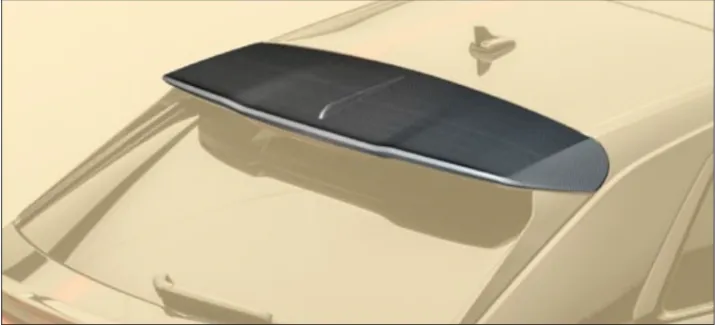
The Roof Spoiler I sits at the very top of the RS Q8 silhouette — bonded to the trailing edge of the roof panel, directly above the rear hatch glass. Within the wider Mansory Carbon Fiber Body kit set for Audi RS Q8 programme, this is the upper of two roof-spoiler options Mansory offers, and the subtler of the pair. Type I is a low-profile blade — it tightens the roofline visually, contributes a measured downforce increment at autobahn speeds, and balances aerodynamically against the rear-decklid spoiler underneath. For owners of the 4.0 TFSI biturbo V8 RS Q8 with its 2,315 kg curb mass, that aero balance matters: a 305 km/h car wants every horizontal surface working in concert, not against itself.
Construction & Materials
The Type I roof spoiler is laid up by Mansory from prepreg carbon fibre and cured under heat and pressure in autoclave. The result is a part with consistent fibre-to-resin ratio, no porosity, and the deep three-dimensional weave clarity that distinguishes genuine Mansory bodywork from cold-laid replicas. The blade is hollow-cored — internal mandrel layup keeps the wall thickness uniform and the part light enough that you do not feel it loading the rear hatch hinges.
Surface finish is selectable. Most owners specify the lacquered carbon look — exposed 3K twill under high-build clear, polished to mirror — but body-colour paint match is supported and is a common choice for owners who already wear extensive carbon lower on the car and want the roofline to read as a single graphic block of paint.
- Material: 100% prepreg carbon fibre, autoclave-cured
- Weave: 3K twill (2x2), Mansory standard orientation
- Wall thickness: ~2.0–2.4 mm across the blade, slightly thicker at the bonded base
- Weight: ~0.8 kg fully trimmed
- Mounting: structural automotive bond (Sika or 3M) with locating clips along the roof trailing edge
- Finish options: lacquered exposed weave (gloss or matte) or full body-colour paint
- UV-stable clear coat, automotive grade, paintable for body-colour finishing
- Dry-fit jig included for installer alignment
Design & Visual Function
Visually, the Type I blade is about restraint. It picks up the curve of the OEM Audi roofline and continues it for a few additional centimetres before the eye runs off the back of the car. From three-quarter rear it does not announce itself — what it does is tighten the rear graphic, giving the C-pillar to rear-glass transition a more deliberate horizontal terminator. Where Type II is read as a statement, Type I is read as a refinement. Owners who want the roofline edited without the car shouting tend to specify Type I; owners who want the spoiler to be visible from behind specify Type II.
Aerodynamically the contribution is real but modest. The blade redirects the flow leaving the roof skin a few degrees downward before it meets the rear-glass shear layer, helping to lock the wake closer to the body and reducing the upwash that fights the rear-decklid spoiler underneath. On a 2.3-tonne SUV at 250 km/h the figure is small in absolute terms — a few kilograms of additional rear-axle load — but it is a coherent contribution to the rear-axle aero balance, and it pairs cleanly with the rear-decklid spoiler so that the two surfaces split the work rather than cancel each other out.
The Type I profile preserves the Audi OEM third (high-mount) brake light without modification. The brake light lives in the rear hatch glass, lower in the spoiler shadow, and the Type I blade does not eclipse the light cone for traffic following at any reasonable distance. No re-wiring, no OEM relocation, no MOT issues.
Compatibility & Fitment
Audi RS Q8 4M chassis, model years 2020 and onward. The roof panel geometry is shared between the pre-facelift (2020–2023) and the facelift Performance (2024+), so the Type I roof spoiler fits both production runs without revision. Roof bonding surfaces are scuff-sanded and primed before the structural adhesive is applied; locating clips align the part to the roof trailing-edge channel so that the bond cures in the correct geometry. OEM rear glass, OEM third brake light, OEM hatch hinges and gas-strut behaviour are all retained.
Mansory parts retain the OEM Audi feature set across the whole RS Q8 — parking sensors, ACC radar housing, headlight washers, drive-mode bumper-flap actuators on the front, side cameras on mirrors. The roof spoiler interfaces only with the roof skin and does not touch any sensor or electrical pathway.
Installation & Reversibility
The Type I blade is a body-shop install. Plan two hours of bench time for prep — degrease the bond zone with isopropanol, scuff-sand the lacquer, mask the surrounding paint, and dry-fit the spoiler with the supplied jig. The structural adhesive is applied as a continuous bead along the bond face; the part is pressed home, the locating clips engage the roof channel to set geometry, and the bond cures over 24 hours undisturbed. Air-suspension lift mode helps the installer reach the roof comfortably without a wheeled platform.
Reversibility: the bond is a structural adhesive, so removal involves slow-cutting the bond line with a fishing-line cutter and refinishing the roof skin. Plan for paint correction on the roof if the spoiler is later removed. For owners who anticipate keeping the car long-term and want to commit to the look, this is not an obstacle; for owners who lease, the Type I should be specified knowing it is a permanent installation.
Pairing within the Mansory RS Q8 programme
The Type I roof spoiler pairs naturally with three other genuine Mansory carbon parts in the same Section A line. The first is its sibling — the larger Type II profile at Roof spoiler II. Type II reads with more presence from behind and is the choice for owners who want the spoiler to be a visible feature; Type I is the choice for owners who want the roofline edited without the spoiler dominating the car's rear graphic. The two are mutually exclusive — you specify one or the other, never both.
The second pairing is the carbon extension blade — Roof spoiler extension. The extension is a secondary blade that bolts onto the trailing edge of either the Type I or Type II spoiler, adding a further chord of carbon at the roofline. On Type I it adds visual length without converting the spoiler into a Type II; on Type II it pushes the profile further still. Owners who specify Type I for restraint sometimes leave the extension off; owners who specify Type I and want a touch more rear-axle aero load specify both together.
The third pairing is the rear-decklid spoiler underneath — Rear decklid spoiler. The two work together as an aero pair: the Type I blade at the top of the roof manages the wake leaving the roof skin; the decklid spoiler manages the flow leaving the rear glass and trunk panel. Specifying both produces a coherent rear-axle aero balance, and the visual graphic — two carbon horizons one above the other — is a defining cue of a fully optioned Mansory RS Q8.
Maintenance & Durability
Lacquered carbon at the roofline lives in direct UV exposure year-round, which makes the choice of clear coat and the choice of post-purchase protection more important than for parts lower on the car. A high-quality automotive ceramic coating applied within the first month dramatically extends the life of the lacquer; carnauba waxes give a softer reflection but need re-application every two to three months and offer less UV protection. Avoid alkaline wheel cleaners drifting up onto the roof during a wash, ammonia-based glass cleaners, and aggressive solvents — all of these will haze the clear coat over time.
Stone chips are rare on a roof spoiler — debris does not generally reach that height — but if a chip propagates, treat it early. Carbon is itself robust; it is the lacquer that fails first. A small chip can be filled with two-pack clear, sanded flat, and polished back into the surrounding finish by any competent body shop. Left untreated, water ingress under the lacquer will lift the surrounding film and eventually require a refinish of the whole part.
Lead Time & Warranty
Lead time is typically four to eight weeks from order to dispatch, reflecting Mansory's bespoke autoclave production cycle and the time required for the chosen finish (lacquered exposed weave is faster than full body-colour paint match, which adds a paint-shop pass). Warranty is twelve months against manufacturing defects — delamination, weave inconsistency, lacquer failure under normal use. UV bleaching of an unprotected lacquer over years is a maintenance issue, not a defect, and is excluded; this is why a ceramic coat on day one is the recommended path.
FAQ
Q: What is the difference between Type I and Type II?
A: Type I is the subtler, lower-profile blade — it tightens the roofline without dominating it. Type II is the larger blade with more presence from behind. They occupy the same mounting position; you specify one or the other, never both.
Q: Does the Type I roof spoiler block the OEM third brake light?
A: No. The third brake light is in the rear hatch glass, lower in the spoiler shadow, and Type I does not eclipse the light cone. No OEM relocation, no rewiring, no MOT issue.
Q: Will it fit my facelift 2024 Performance RS Q8?
A: Yes. The roof panel geometry did not change between pre-facelift and facelift, so the same Type I blade fits both production runs.
Q: Can I have it painted body colour instead of exposed carbon?
A: Yes. Body-colour paint match is supported. Owners who already run extensive carbon lower on the car often specify body-colour paint at the roof so the silhouette reads as one block.
Q: Do I need the roof spoiler extension as well?
A: No, but it is a popular pairing. The extension bolts onto the trailing edge of the Type I and adds a further chord of carbon. Specify together if you want a touch more rear-axle aero contribution.
Q: Is removal possible later?
A: Yes, but it is a body-shop job. The bond line is structural adhesive — removal is by slow-cut and roof refinishing. Plan for paint correction on the roof if you go that route.
The Type I is the choice for owners who want the roofline edited rather than announced — pair it with the rear-decklid spoiler underneath for a coherent rear-axle aero graphic, or add the extension if you want a touch more chord without stepping up to Type II. Order or ask for finish samples via WhatsApp +44 7488 818 747 or [email protected].