
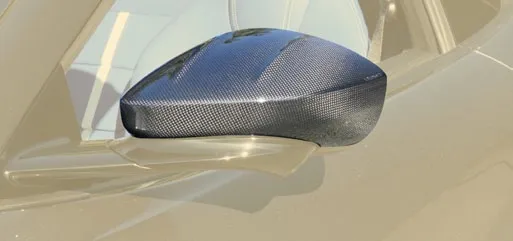
Mirror LHD housing for cars from 2020 Mansory for Ferrari 812 Superfast Stallone


Mirror LHD Housing 2020 Mansory Carbon for Ferrari 812 Superfast Stallone
The Mansory mirror LHD housing for 2020+ Ferrari 812 Superfast Stallone is a full structural housing replacement — not a cover overlay, but the complete carbon body that mounts to the door stalk and carries the OEM mirror glass assembly and electrical mechanism. Where the mirror LHD cover (2020+) is a cosmetic shell clipped over OEM plastic, this housing replaces the entire visible and structural exterior of the driver-side mirror on LHD 2020-onwards 812 Superfast builds. It is listed within the Mansory Body Kit for Ferrari 812 Superfast Stallone as the comprehensive mirror upgrade for owners wanting a full carbon mirror assembly. The 812 Superfast's door-mounted mirror positions the glass approximately 400 mm forward of the A-pillar — at this location, a full carbon housing reduces both the rotational mass of the mirror fold mechanism and the acoustic resonance at speed. At the 812 Superfast's naturally aspirated performance envelope — 789 hp, 8,500 rpm redline — approach speeds before braking zones are substantial, and a stable, flutter-free mirror reflection is a functional requirement for safe rear situational awareness. The stiffer carbon housing provides this stability at speeds where OEM ABS construction exhibits measurable flex in the mirror face panel.
Construction & Materials
The housing is a three-component assembly: the main body shell, the inner stalk junction adapter, and the wiring loom channel routing the mirror heating and fold actuator cables through the housing cavity. All three are autoclave pre-preg carbon — the stalk junction adapter is the most heavily loaded piece, receiving the full bending moment of the housing-plus-glass assembly under motorway side-wind loading, built with six plies of UD carbon oriented along the stalk axis. The exterior face uses 3K twill in the 45° Stallone orientation, ensuring weave continuity with the adjacent door panels and outer door handle.
- Weave: 3K twill on exterior surfaces; UD at stalk junction adapter
- Cure: autoclave at 120 °C / 6 bar for all three components
- Wall thickness: 2.0–2.4 mm on housing body; 4.5 mm at stalk junction
- Weight: approx. 0.38 kg (vs. OEM ABS housing ~0.61 kg)
- Mounting: OEM stalk bolt pattern (4 × M6) on the door side; OEM glass carrier rail retained
- Finish: high-gloss clear lacquer; satin on request
- Orientation: LHD driver-side, 2020+ revised housing geometry
Design & Visual Function
As a complete housing, the LHD housing (2020+) presents a monolithic carbon surface from the stalk base to the upper rear of the mirror body — an uninterrupted 3K twill surface without the clip-seam line visible on cover-over-housing installations at raking light angles. This seamless appearance is particularly desirable for concours-oriented builds where close-range photographic scrutiny is common. The weave is aligned at 45° and maintained continuously from the rear face to the leading edge across the housing curve, requiring precise mould alignment during lay-up that is a hallmark of Mansory's autoclave programme.
The aerodynamic form matches the OEM 2020+ mirror geometry — verified against the original OEM profile to ensure no drag increase. The stiffer carbon construction reduces elastic deformation of the housing face under dynamic pressure, improving mirror-glass stability at 180–220 km/h versus the OEM ABS housing. Even 0.2 mm of face-panel deflection at these speeds produces visible image distortion in the mirror reflection — the carbon housing eliminates this deformation entirely. The weight saving of approximately 0.23 kg per housing reduces the door hinge loading from the mirror assembly mass over the vehicle's lifetime, marginally reducing the rate of hinge wear that causes door sag on high-mileage cars.
The mirror LHD housing (2020+) is the first of two Mansory LHD housing variants for 2020+ cars; the second is the new mirror LHD housing (2020+), representing a revised tooling iteration with minor geometry updates to the stalk junction upper flange and the rear-corner radius. Both replace the same OEM 2020+ unit; the new housing is the more current production version with refined fitment tolerances for late-production 812 Superfast cars.
Compatibility & Fitment
For LHD Ferrari 812 Superfast produced 2020–2022 (F140 V12, naturally aspirated, RWD). The stalk bolt pattern and wiring loom routing are specific to the 2020+ revised mirror design; pre-2020 cars have a different stalk geometry. Not compatible with the 812 GTS. Driver-side (left, LHD) housing only; passenger-side equivalents are not listed in the current Stallone programme — enquire directly. Cars with the optional 4WS system are not affected by the mirror housing change.
Installation & Reversibility
Replacing the full housing requires removing the mirror glass, disconnecting the mirror fold actuator and heating wiring, and unbolting four M6 stalk-to-door bolts accessible from behind the door card after partial inner card lifting at the upper forward corner. Allow 45–60 minutes for the full housing swap per side, including glass and wiring reconnection and door card refitting. Fully reversible — retain the OEM housing for future reinstatement. A Mansory-trained installer is strongly recommended given the electrical disconnection and loom routing involved in the swap.
Pairing within the Mansory 812 Superfast Stallone programme
The LHD housing pairs with the mirror LHD cover (2020+) for owners wanting both housing and outer cover in carbon — though the housing already presents a full seam-free exterior. For complete door-surface carbon at the approach angle, add the outer door handle. The new mirror LHD housing (2020+) is the updated tooling alternative for owners preferring the latest production revision.
Maintenance & Durability
As a full housing replacement, the LHD housing receives the same ceramic-coat protocol as other Stallone exterior carbon. The stalk junction zone should be inspected annually for lacquer micro-cracks from vibration transmitted through the door stalk under road use. Apply a flexible lacquer edge sealant to the housing-to-door gap after installation to prevent water ingress at the stalk junction base. Weekly wash with pH-neutral shampoo and soft microfibre; ceramic coat renewal every 3 months. Avoid ammonia glass cleaner migration from the adjacent door glass. Lacquer life 8–12 years with UV protection and consistent ceramic maintenance. The inner arch of the housing body — not visible during normal road use — should be wiped clean annually to remove dust accumulation that can trap moisture against the carbon edge at the stalk junction.
Lead Time & Warranty
Lead time 2–3 weeks for the multi-component assembly. Covered by Mansory's 12-month warranty against structural delamination, stalk junction failure, and wiring loom channel integrity under normal road use.
FAQ
Q: What is the difference between the LHD housing (2020+) and the new LHD housing (2020+)?
A: Both are complete structural housing replacements for 2020+ LHD 812 Superfast. The "new" housing is a revised tooling iteration with minor geometry updates to the stalk junction upper flange and the rear-corner radius, addressing fit feedback from initial production runs. The new housing is the current version; this original variant remains available for legacy orders referencing this part number specifically.
Q: Can the housing accept an aftermarket wide-angle mirror glass insert?
A: Yes — the OEM-spec glass carrier rail accepts any glass dimensioned to OEM 812 Superfast mirror glass (295 × 185 mm at the widest point). Aftermarket aspherical or wide-angle glasses can be fitted to the carrier before housing installation on the car.
Q: Is electrical reassembly of the fold actuator connector complex?
A: The fold actuator is a 6-pin plug-and-play OEM connector that reinstalls without specialist tools, and the heating element connector is a 2-pin spade. A competent installer familiar with Ferrari interiors completes both reconnections in under 10 minutes once the housing is bolted in position and the loom routed through the channel.
Q: Does the carbon housing affect the mirror auto-fold clearance on narrow streets?
A: No — the housing external dimensions match the OEM 2020+ mirror geometry, so fold clearance and the full travel arc are identical to the standard 812 Superfast mirror specification.
Q: Is the housing compatible with the camera-equipped mirror glass on cars with optional blind-spot monitoring?
A: Yes — the glass carrier rail is compatible with all OEM glass variants including the blind-spot camera glass insert. The housing body does not interfere with the camera field of view.
Complete your 2020+ LHD 812 Superfast mirror with the full carbon housing — enquire for availability. WhatsApp +44 7488 818 747 or [email protected].