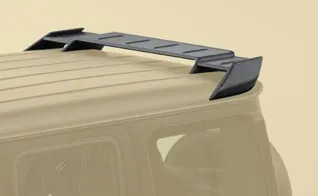
High roof wing performance Mansory Carbon for Mercedes G-class G500 / AMG G63 W463A


High roof wing performance Mansory Carbon for Mercedes G-class G500 / AMG G63 W463A
This is the top of the Mansory roof wing tree for the W463A G-class — sitting above the standard wing, the high wing, and the high wing with side flaps in the same family as the parent Mansory Carbon Body Kit for Mercedes G-class W463A G500/G63. Mounted to the rear of the factory roof rail, it combines a tall main body, integrated outboard end plates and an additional gurney lip running the full span of the trailing edge. Owners who specify it have already gone through the regular wings and want the most theatrical silhouette possible at the back of the car — a track-day-look claim on a tall, heavy SUV, executed in finish-grade carbon rather than painted plastic.
Construction & Materials
The "performance" version of the high wing is the most layered of the four. The main body is a hollow aerofoil shell with internal carbon ribs; the outboard end plates are co-bonded into the same shell rather than bolted on after; the gurney lip is moulded as a separate strip and bonded to the trailing edge with two-component epoxy and a 12-millimetre overlap. The skin uses 3K twill on every visible surface, with the gurney rolled in the same weave so the leading-to-trailing aesthetic stays continuous.
- Weave: 3K twill exterior, 0/90 plain underweave for stiffness
- Lay-up: full quasi-isotropic six-ply (0/45/90/-45/45/0) — the deepest stack of the four wings
- Cure: autoclave at 6 bar, 130 °C ramp, 90-minute hold
- Wall thickness: 2.4 mm at the body, 3.0 mm where the gurney bonds in
- Weight: ~6.4 kg complete with end plates and gurney
- Gurney lip height: 14 mm above the trailing-edge plane
- Hardware: four M8 stainless studs through the roof pan, EPDM gasket, butyl tape on the perimeter
- Finish: high-gloss UV-stable clear lacquer; matte / satin / paint-to-body all available on request
Design & Visual Function
Gurney Lip: From Motorsport to Statement
The gurney flap was popularised by Dan Gurney's All American Racers in the early 1970s — a small vertical strip on the trailing edge of a wing that punched well above its weight in downforce per millimetre of height. On formula cars and prototypes a 10–18 mm gurney can add measurable load with very little drag penalty. On a 2.6-tonne body-on-frame SUV the actual aero contribution is honestly modest: at autobahn speeds the wing-plus-gurney combination produces a few kilograms of downforce, not the dozens-of-kilograms a track car would extract. What it really does on the W463A is shift the visual centre of gravity of the rear silhouette upward and rearward, and it gives the eye a sharp horizontal line right where the bodywork ends.
Boundary-Layer Trip & Centre of Pressure
Aerodynamically, the gurney works by tripping the boundary layer at the trailing edge — it forces the flow over the upper surface to separate cleanly at a defined point instead of meandering down the back of the wing. The result is a small low-pressure pocket directly behind the gurney, which translates into a downward force on the wing and a slight rearward shift of the car's centre of pressure. On a G-class this matters most in two scenarios: a sustained motorway cruise where the rear feels marginally more planted, and a strong tailwind / crosswind condition where the extra rear-axle load helps stability. The integrated end plates reinforce the same effect by reducing tip vortices off the wing's outboard ends. None of this turns the W463A into a sports car — it nudges the high-speed feel from "tall box" toward "tall box that knows where its rear wheels are".
Six-Ply Quasi-Isotropic Lay-Up
Of the four Mansory roof wings on the menu, the performance version carries the most laminate. The lay-up is genuinely quasi-isotropic — six plies oriented to give roughly equal in-plane stiffness in all directions, rather than just along the chord. That extra material isn't there because the part needs to survive monstrous aero loads (it doesn't); it's there to keep the wing dimensionally rigid through years of UV, thermal cycling and the occasional tree branch in an off-road moment. A flexible roof wing telegraphs its ribs through the clear-coat after a few summers; this one shouldn't. The trade-off is weight — at ~6.4 kg it's the heaviest of the four — and a slightly higher centre of gravity for the part itself, which is invisible in driving terms but real on the spec sheet.
Compatibility & Roof-Pan Reinforcement
Mercedes-Benz G-class W463A generation (2018+ 4th-gen, Mercedes internal model code). Fits G500, G550, G400d, G350d and AMG G63 (M177 4.0 V8 BT). The pre-2018 W463 (old box-shape) is NOT compatible — different roof, different rain-channel layout, different mounting points; W464 / W465 Gronos use a separate wing programme. Sunroof variants are fine: the four mounting studs sit aft of the sunroof aperture in the structural roof pan. RHD / LHD make no difference to the wing itself; the AMG G63 styling package and the G500 base are equally supported because the roof skin is shared. We strongly recommend a small reinforcement plate (supplied) underneath the headliner at each stud — the gurney version sees a slightly higher torque arm in crosswinds and the plate spreads the load over a larger area of sheet metal.
Installation: Drilled Studs, Sealing, Indexing
Fitment is a workshop job, not a driveway one. Time on the bench is roughly 4–5 hours including paint, careful drilling and a leak test. Process: tape and template the roof, mark the four stud positions, drill 9 mm clearance holes, run butyl tape around each hole, drop the wing onto its EPDM gasket, torque the M8 stainless nuts to 18 Nm from inside the roof with the headliner partly dropped, and run a hose test before refitting the headliner. The gurney lip is delicate during fitment — an installer who indexes the wing by gripping the gurney edge will leave fingerprints in the lacquer that no compound removes. Use the body of the wing as a handle. Reversibility is technically possible (the holes can be plugged and re-sealed) but the four sealed penetrations are not invisible if removed; we always tell owners this is a one-way decision.
Pairing within the Mansory G-class W463A programme
Most owners specify this wing as part of a "loaded roof" build. The natural siblings are the high roof wing with side flaps as the comparison piece on the showroom floor (almost no one fits both — they're alternatives, not stack-mates), the roof panel with 3 position lights HELLA at the front of the roof to balance the gurney aft, and the interior roof handles carbon so the carbon story carries from the outside through to the cabin. The triangle of front-roof-panel, rear-performance-wing and interior handles is what most "fully-Mansoried" cars look like in the metal.
Repair, Refinish, Re-Polishing
The performance wing is the most expensive of the four to refinish because the gurney is bonded rather than bolted. A scuffed gurney lip can be sanded and re-clear-coated in situ; a snapped gurney is a return-to-shop job because the bond line has to be cut, the surface re-prepped and the new lip aligned to within 0.3 mm of the original index. The end plates, being co-bonded into the body, are even more involved if damaged — practically speaking we replace the whole wing in that case. The main wing body itself behaves like any autoclaved 3K twill panel: chips fill with clear epoxy, hairline crazing in the lacquer comes back with a two-stage machine polish, and full re-lacquering on a stripped wing takes about a day. UV-stable clear is critical — cheap lacquer ambers visibly within two summers and the gurney's sharp edge then looks dull against the rest of the wing.
Lead Time, Warranty
Lead time is 4–6 weeks from order confirmation. Each wing is laid-up, autoclaved and inspected individually; the gurney bond cure adds a separate fixture step which is what stretches the schedule beyond the simpler standard wing. The 12-month warranty covers manufacturing defects — delamination, voids, bond-line failure on the gurney, cracks originating from the laminate — but excludes impact damage, contact with chemical solvents and heat damage from uncovered storage in direct sun above 70 °C surface temperature. We always recommend taking delivery photos of the wing on the car immediately after fitment as a baseline reference for any future warranty conversation.
FAQ
Q: How much real downforce does the gurney actually add at, say, 200 km/h?
A: Honest answer — single-digit kilograms over the rear axle. Maybe 5–8 kg under ideal conditions. On a 2.6-tonne car that's noise. The gurney is on this wing for the look and for a small but real stability effect in crosswinds, not for measurable lap-time advantage.
Q: If I damage just the gurney, do I have to replace the whole wing?
A: No. A single damaged gurney lip can be cut off at the bond line and a new strip bonded in by a competent body shop, then re-clear-coated. End plates, because they're co-bonded into the main body, are a different story — significant end-plate damage is usually a full-wing replacement.
Q: Can the gurney be painted body colour or do I have to keep it visible carbon?
A: Both are available. Many owners spec the wing body in visible 3K twill but paint the gurney lip in body colour to break up the silhouette. Others go fully painted, others keep everything in clear-lacquered carbon. Cost difference between options is small; the choice is purely aesthetic.
Q: Is this wing legal for FIA-spec motorsport events?
A: No, and it's not designed to be. Mansory carbon roof wings are a styling product with mild aero-stability benefit. They do not carry FIA homologation, they don't have load-tested mounting documentation for race events, and the gurney height isn't certified for any specific class. For road use and concours / show events they're fine; for a regulated competition you'd need a homologated wing.
Closing pair-with: the performance wing earns its name by making the rear of the W463A look like the trailing edge of something altogether more serious — pair it with a front roof panel with 3 HELLA position lights and a set of carbon roof handles inside, and the whole roofline reads as a single design language. To check fitment for your car, request finish samples or ask about a paired-wing-and-roof-panel order: WhatsApp +44 7488 818 747 or [email protected].