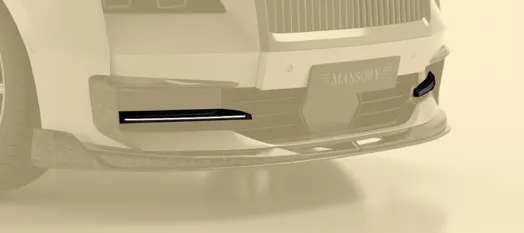
Front DRL light Mansory for Rolls-Royce Spectre


Front DRL Light Mansory for Rolls-Royce Spectre
The front DRL light unit is the most photographed millimetre on a Rolls-Royce Spectre. Two vertical segments of LED light flank the Pantheon Grille and stamp the car's identity into every approach photograph; Mansory's carbon-bezel reinterpretation reframes that signature without rewriting it. The part replaces the painted lower DRL housing and the slim surround that sits between the upper headlamp cluster and the Pantheon emblem, swapping body-coloured plastic for autoclave-cured 3K twill carbon and finishing the geometry to a tolerance that lets the OEM lens drop straight back into place. As part of the wider Mansory Carbon Fiber Body kit set for Rolls-Royce Spectre, this is one of the lowest-effort interventions on the car for the strongest visual return — and on a 2.97-tonne electric coupe whose drama lives in its silence and its proportions, the front face has to carry presence that a silent drivetrain leaves on the table.
Construction & Materials
Mansory laminates the bezel in pre-preg 3K twill carbon over a CNC-machined polyurethane buck taken from a digitised Spectre front-end scan. Cure happens in autoclave at 6 bar to clear voids and lock the weave alignment that owners actually see when sunlight rakes across the front of the car. The lens-pocket geometry is held to OEM tolerance so the factory DRL element seats with no shimming and the rubber gasket compresses uniformly; that detail is what stops water creeping behind the carbon over a winter of pressure-wash cycles.
- Weave: 3K twill carbon, 2x2 pattern, weft aligned with the bonnet shut-line so the diagonal reads continuous from headlamp to Pantheon Grille
- Cure: autoclave pre-preg, 120 °C dwell, post-cured for dimensional stability around the lens pocket
- Wall thickness: 1.8–2.2 mm at the visible bezel face, stepping to 3.0 mm at the lens-retention rib
- Weight: ~0.42 kg per side as a dry part, vs ~0.61 kg for the OEM painted housing
- Hardware: OEM lens-retention clips and original M5 bolts retained; threaded brass inserts moulded into the carbon at the stud locations
- Finish options: gloss UV-stable lacquer (default), satin matte, or raw twill with a clear protective film for owners who want the weave to read without lacquer reflection
- Gasket interface: original Rolls-Royce EPDM seal reused; bezel inner face is sanded and primed so the seal lip grips the carbon the same way it gripped the OEM plastic
Design & Visual Function
The Spectre's daytime running-light signature is engineered as a vertical column of 22 LED segments per side, illuminated through a smoked polycarbonate lens, set into a body-coloured frame. The light pattern itself is sacred — Rolls-Royce ran the photometric homologation on it, and Mansory does not touch the LEDs, the driver, or the lens. What Mansory rebuilds is the surround: the lower bezel where the vertical column terminates, and the inboard quarter that runs toward the Pantheon Grille. By swapping that surround to carbon, the eye reads a darker, denser frame around the same light pattern, and the DRL signature appears more architectural — more like a coachbuilt jewel and less like a production lamp.
Weave alignment matters here more than on almost any other carbon part on the car. The bezel sits at eye level when you walk up to the Spectre, and the diagonal of the twill needs to read as a continuation of the bonnet weave above it and the front-fender weave to the side. Mansory cuts the pre-preg with the warp axis aligned to the OEM bonnet shut-line so that, viewed three-quarters from the front, the weave runs cleanly across the entire nose. Owners who specify the Mansory front bonnet almost always specify this DRL bezel at the same time for exactly that reason.
Colour temperature is the second design hinge. The OEM Spectre DRL runs at roughly 6000–6500K — a cold, almost icy white that pairs with the chromed Pantheon Grille verticals and the silver Spirit of Ecstasy. Because Mansory does not touch the LED driver, that colour temperature is preserved exactly. Owners who have heard horror stories about aftermarket DRL "upgrades" coming in at 7500K or, worse, with a violet-blue cast can specify this part without that risk; the photometric profile is the factory profile.
Compatibility & Fitment
Rolls-Royce Spectre (MY2024+, all-electric, both LHD and RHD). The bezel is cut to the production geometry of the Architecture of Luxury front clip and is keyed to the OEM lens, the OEM gasket, and the OEM mounting studs. There are no variants for facelift cars because the Spectre has not been facelifted; future model-year revisions will be checked against the geometry buck before any batch is cured. The part is symmetric in concept but handed in production — left and right bezels are not interchangeable, and Mansory ships them as a matched pair with serialised lamination certificates.
Installation & Reversibility
Plan for 60–90 minutes per side at a body shop that has handled aluminium-spaceframe cars before. The procedure: remove the front bumper cover (Spectre service position), unbolt the OEM headlamp cluster, lift out the original lens unit, transfer the lens and gasket into the Mansory carbon bezel, refit the cluster with the OEM bolts torqued to the factory spec, and reseat the bumper cover. The wiring loom is never disconnected from the LED driver during the swap — the bezel slides over the existing harness and the OEM connector stays plugged. That matters because Spectre's body modules log connector cycles, and unnecessary unplugs can throw a soft fault on the front-end CAN segment.
Plug-and-play behaviour is genuine here. There is no PWM dimming surprise, no resistor pack, no inline driver, no CAN-bus emulator. The Mansory bezel does not change the electrical path — only the trim around the lens — so the Spectre's body-module health checks see exactly what they saw at the factory, and OTA updates to the lighting controller continue to apply normally. Reversibility is total: unbolt the bezel, refit the OEM painted housing, and the car is back to factory configuration with no trace, no drilled holes, no glue residue.
Pairing within the Mansory Spectre programme
This DRL bezel is rarely specified in isolation. Three companions earn their place on almost every order: the front bonnet for weave continuity from nose to windscreen, the silver-logo emblem for the front grille for a coherent treatment of the Pantheon Grille area, and the front fender panel for sideways weave continuation behind the wheel arch. Specifying these together lets the lamination team match weave batch and lacquer batch across the four parts, which is the only way to guarantee that the diagonal of the twill reads identical from any angle in any light. Mansory holds the four parts in the same cure window precisely for this reason.
Maintenance & Durability
The DRL bezel sits in the strike zone for stone chips, road grit, and bug acid. Treat it the way you would treat a freshly painted nose: a paint-protection film over the lacquer is the highest-yield single move owners make, and it is invisible at arm's length. For ceramic-coat owners, a 9H consumer-grade ceramic over the lacquer adds a second sacrificial layer; carnauba wax also works but needs reapplication every 8–10 weeks. What kills lacquered carbon on this part: ammonia-based glass cleaners drifting onto the bezel during a rushed wipe-down, alkaline wheel cleaners over-sprayed from the front wheel, dishwasher detergent in a panic-clean, and abrasive sponges. None of those belong near a Spectre nose.
Stone-chip repair is straightforward because the damage almost always lives in the lacquer rather than in the carbon weave itself. A trained detailer can wet-sand a chip out to 3000 grit, refill with a UV-cure clear, and polish back to gloss in under an hour per chip. Through-weave damage is rare — autoclave 3K twill at 1.8 mm is genuinely tough — but if it happens, Mansory operates a refurbishment service that re-laminates the affected face and re-cures the part, usually within a 3–4 week turnaround. Owners are encouraged to photograph any damage with a coin in the frame for scale before sending the part.
Lead Time & Warranty
Lead time is 4–6 weeks from order confirmation for the standard gloss-lacquer bezel pair. Satin-matte and raw-twill-with-PPF specifications add 1–2 weeks because they cure on a separate line. Mansory provides a 12-month manufacturing-defect warranty covering delamination, lacquer voids, fitment outside tolerance, and any electrical interaction with the OEM lighting loom (which, given the plug-and-play design, is effectively never invoked). The warranty does not cover stone-chip damage, road-debris impact, or chemical staining from non-pH-neutral cleaners.
FAQ
Q: Does this change the DRL light pattern or the photometric output?
A: No. Mansory does not touch the LEDs, the lens, or the driver. The bezel is purely a trim swap around the original light unit, so the photometric homologation that Rolls-Royce filed for the Spectre is preserved. Colour temperature stays at the factory 6000–6500K range.
Q: Will the car throw a CAN-bus fault when the bezel is fitted?
A: No. The OEM connector to the LED driver is not unplugged during installation, so the body modules never see a connector cycle. The Spectre's lighting controller continues to communicate over CAN exactly as it did from the factory.
Q: Can I specify a darker, smoked look while keeping the OEM lens?
A: The Mansory part swaps only the bezel, not the lens. Owners wanting a darker overall presentation usually combine the carbon bezel (which already darkens the surround substantially) with the matte-satin lacquer option; smoked-lens conversions are a separate conversation and not part of this SKU.
Q: What if a stone goes through the carbon?
A: Through-weave strikes are rare on autoclave 3K twill at this thickness, but Mansory runs a refurbishment programme: ship the bezel back, the affected face is re-laminated and re-cured, and the part returns within roughly 3–4 weeks. Lacquer-only chips are repaired locally by any competent detailer with UV-cure clear.
Q: Is the part the same on LHD and RHD Spectres?
A: Yes. The Spectre's headlamp geometry is symmetric across LHD and RHD markets — only ancillary lens elements differ in some regulatory regions, and those are handled inside the OEM lens, which Mansory does not touch.
The DRL bezel is the smallest carbon decision an owner can make on the Spectre and arguably the most consequential for kerb-side presence. Pair it with the front bonnet and the silver-logo grille emblem, and the front face of the car reads as an integrated coachbuilt object rather than a production Rolls with aftermarket trim. To specify, talk to the team on WhatsApp +44 7488 818 747 or write to [email protected].