Door welcome logo lights set for front door Mansory for Rolls-Royce Spectre


Door Welcome Logo Lights Set for Front Door Mansory for Rolls-Royce Spectre
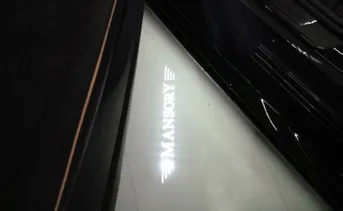
The Mansory door welcome logo lights set is the smallest piece of theatre in the Spectre programme and, arguably, the first one a passer-by registers. Specified as part of the wider Mansory Carbon Fiber Body kit set for Rolls-Royce Spectre build, the kit replaces the OEM puddle lamp inside each door card with a high-definition gobo projection module that throws a razor-sharp Mansory crest — or, optionally, the Rolls-Royce double-R cipher — onto the tarmac the moment the coach door begins its arc. Because the Spectre wears the longest passenger doors Goodwood has ever produced, the projection lands roughly 1.4–1.6 metres clear of the rocker, well beyond the radius of a conventional sedan, and the focal length of these modules is calibrated for that throw rather than the shorter geometry of a Wraith or Ghost.
Construction & Materials
Each module is a sealed aluminium-housing projector built around a 5 W high-CRI LED, an aspheric collimating lens, and a laser-etched glass gobo wafer. The optical stack is potted in two-part urethane so that the focal distance cannot drift over years of door slams, and the lens cover is a hardened mineral glass rather than polycarbonate — important on a coach-door car, because the puddle housings sit closer to the road than on a Cullinan and pick up more grit. The set ships as four lights total: a pair for the front coach doors and a pair for the rear, all dimensionally identical so a single spare covers any corner.
- Optical engine: 5 W LED, >90 CRI, 3000 K warm white standard; multi-colour RGBW option on request.
- Gobo wafer: laser-etched borosilicate glass, 25 mm diameter, Mansory crown logo or RR cipher (specify at order).
- Housing: anodised 6082-T6 aluminium, matte-black finish, 32 mm overall diameter to match OEM puddle-lamp cut-out.
- Sealing: IP67 around the lens cover and connector boot — survives splash, jet-wash, and standing puddles under the door sill.
- Connector: factory-style 2-pin plug-and-play harness mating directly to the Spectre puddle-lamp socket — no cutting, no splicing, no T-tap required.
- Focal distance: 800–1100 mm calibrated throw, sharpest at ~950 mm — chosen for the Spectre coach-door arc rather than a generic sedan footprint.
- Projection size: ~280 mm across the longest axis at the design throw, scaling slightly as the door opens.
- Operating range: −30 °C to +75 °C; rated 50,000-hour LED life at the standard drive current.
Design & Visual Function
A welcome-logo light is a piece of choreography rather than illumination. The Spectre door begins its travel slowly under the soft-close motor, and the projector switches on the instant the latch releases — by the time the door has reached its full arc the crest is already burned into the tarmac, sharp at the edges and clean in the centre. Mansory specifies a 950 mm sharpest-focus distance because the Spectre rocker sits a touch higher than the Wraith it replaces, and the door swings outward through a longer arc; a sedan-tuned projector would land its image too close to the sill, where the foot is about to fall and break it. The longer focal length keeps the logo visible until the passenger has fully stepped out.
Colour temperature is deliberately warm — 3000 K rather than the cooler whites used in many aftermarket courtesy lights — to harmonise with the Spectre cabin's amber accent lighting and the optional starlight headliner glow. When the optional RGBW board is specified the user can match the projection colour to the chosen ambient-light scene, so a blue cabin theme produces a blue logo on the ground and a red theme a red logo, with the white channel reserved for the default Mansory crest. The aspheric lens stack delivers a crisp edge falloff: the logo is visible from roughly three metres away, sharply legible at one metre, and does not bloom into a shapeless halo the way single-element lenses do.
Glass gobo wafers are used in place of the cheaper film inserts found in lesser welcome-light kits because film discolours under the LED's near-UV spike inside two seasons. A laser-etched glass wafer holds its black-on-light contrast for the life of the LED itself, and the etching is done at high enough resolution that the small serifs of the Mansory crown — the points of the coronet, the inner negative space of the M — survive intact at the projection distance.
Compatibility & Fitment
Rolls-Royce Spectre (MY2024+, fully electric, coach-door super-coupe). Both LHD and RHD markets — the modules are symmetrical and the harness pinout is identical on either side. The set is sized to the OEM front-door puddle-lamp aperture in the Spectre door card; the matching rear pair drops into the rear-door cut-outs further aft. Because the part is electrical rather than structural, none of the spaceframe-specific adhesive considerations relevant to bumpers or skirts apply here — the modules use the OEM clip retention plus a low-tack VHB ring as a vibration damper. The IP67 rating is meaningful on a coach-door car: the longer door means the puddle housing pivots through more vertical travel as the door swings, exposing it to splash and rain ingress that a conventionally hinged door would not see.
Installation & Reversibility
Installation is the simplest task in the entire Spectre Mansory programme. Door cards do not need to come off; the puddle lamp is accessed from beneath the door, the OEM clip is squeezed and the housing pulled clear, the OEM 2-pin connector is unplugged, and the Mansory module clips back in along the same path. Total time is 8–12 minutes per corner, 35–45 minutes for the full four-light set, and the only tools required are a plastic trim pry and a clean microfibre cloth. No drilling, no cutting, no harness modification, no recoding in the vehicle ECU — the OEM puddle-lamp circuit is a simple switched feed and the module reads exactly the same wake signal. Reversibility is total: the original puddle lamps go straight back into their cut-outs and the car returns to OEM specification with no visible trace, which matters for owners who lease or who plan to pass the car on without the cosmetic upgrade.
Spectre's spaceframe-specific bonding chemistry is not relevant to this part — there are no adhesive panels, no urethane vs modified-acrylic VHB decisions to make, no paint prep. DIY installation is fine for any owner comfortable with a trim tool; certified body-shop attention is overkill for a clip-in module and not required by the warranty.
Pairing within the Mansory Spectre programme
The natural pairing is with the coach-door sill plates: entrance panels with illuminated logo. Both surfaces light the moment the latch releases — the sill plate glows up under the foot and the puddle module throws the crest down onto the road, so the two effects bracket the passenger's first step and read as a single piece of choreography rather than two separate accessories. A second sensible companion is the individualized interior kit, which carries the colour-matched cabin treatments that the welcome-light hue can be tuned to in the RGBW configuration. For owners specifying the full ambient programme, the headliner with shooting stars closes the loop — the constellation overhead, the warm logo on the tarmac, and the illuminated sill all share the same colour temperature and dim through the same scene controller.
Maintenance & Durability
Welcome-light modules ask very little of the owner. The lens cover wants the same pH-neutral glass cleaner used on the rest of the car — never an ammoniated window spray, which will fog the lens coating over time. A microfibre and a slow circular pass clears road film without scratching the optic. The IP67 boot at the connector should be checked once a year for seating: a half-displaced grommet is the only common path to moisture inside the housing, and it shows itself as a slow-developing dim spot on one corner of the projection rather than a sudden failure. LEDs are rated 50,000 hours, which on a daily-driver Spectre with three or four door cycles per day translates to many decades — the modules will outlast most other parts on the car. If a gobo is ever damaged the wafer is a serviceable item: the housing comes apart on three small hex screws, the wafer slides out, a replacement slides in, and the unit is repotted at the lens face. Mansory holds replacement wafers as a stock line.
What kills welcome lights is the same list that kills any sealed optic: high-pressure jet-wash held at point-blank range against the connector boot, pressure-washing with caustic alkaline foam that attacks the gasket compound, and impact from kerb strikes during clumsy parallel parking. Routine touchless or hand washing is fine. The IP67 rating handles standing water under the door indefinitely; it does not cover continuous submersion, but no Spectre puddle housing should ever face that.
Lead Time & Warranty
Standard sets in white-light Mansory crest configuration are usually held to a 4–6 week lead time. RGBW multi-colour configurations and bespoke gobo artwork — owner monogram, family crest, custom typography — extend to 6–8 weeks because the gobo wafer is etched to order. A 12-month manufacturing-defect warranty covers LED failure, optical-stack delamination, gasket failure, and connector-pin issues. Mechanical impact, jet-wash penetration through a displaced boot, and ECU-side voltage faults caused by other aftermarket modifications are excluded. The wafer itself is a serviceable spare and remains available beyond the warranty window for the life of the model.
FAQ
Q: Does the kit work on a Spectre that has been built for a left-hand-drive market?
A: Yes. The modules are symmetrical and the harness pinout is the same on both sides — there is no LHD/RHD-specific part number.
Q: Will the projection still look sharp on a wet road?
A: Yes, on standing water the logo doubles as a faint reflection but the primary projection stays crisp because the gobo wafer is glass-etched rather than film. On heavily textured tarmac the edge softens slightly, as it would with any projector.
Q: Can I have my family crest or initials instead of the Mansory crown?
A: Yes — supply vector artwork at the order stage and a bespoke wafer is etched. This adds two to three weeks to the lead time.
Q: Does fitting the kit affect the Rolls-Royce factory warranty?
A: The modules are plug-and-play through the OEM connector and do not modify any vehicle wiring, so they are fully reversible. As always with aftermarket additions, the position of an individual dealer can vary; reverting to the OEM puddle lamps is a five-minute job per corner.
Q: Can the colour be changed on the fly with the optional RGBW board?
A: Yes. The RGBW configuration accepts a low-voltage scene-control input so the projected colour follows whatever cabin ambient theme is selected. A standalone fob is also offered.
Pair the welcome-light set with the illuminated coach-door sill plates and the constellation headliner for a single, coherent first-impression sequence. To configure colour, gobo artwork, or RGBW upgrades contact WhatsApp +44 7488 818 747 or [email protected].