Individualized Interior Kit Mansory for Rolls-Royce Spectre


Individualized Interior Kit Mansory for Rolls-Royce Spectre
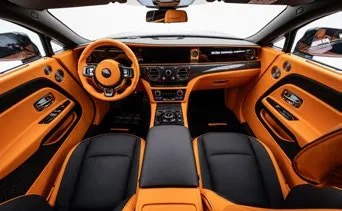
The Mansory Individualized Interior Kit for the Rolls-Royce Spectre is the most comprehensive bespoke cabin overhaul in the Spectre programme — a full retrim that takes every primary leather surface inside the coach-door coupe and rebuilds it to a single, owner-defined specification. It sits as the keystone above any individual interior accessory and complements the wider Mansory Carbon Fiber Body kit set for Rolls-Royce Spectre, taking the visual statement of the exterior carbon and continuing it into the cabin in hide, thread, embroidery and trim. Because the Spectre is fully electric and runs without combustion noise or transmission whine, the cabin is unusually quiet by design — every panel of leather, every stitch line, every foam carrier the kit touches is reassembled with that silence in mind so the retrim never trades the brand's hallmark hush for craftsmanship.
Construction & Materials
The kit is not a slip-on accessory. It is a strip-and-rebuild process where each panel that leaves the workshop is the OEM substrate carrying a new Mansory hide. Foam shapes, sound-deadening inlays, NVH felts and the wire frames of the seats are preserved and reused; only the leather, the thread and — where requested — the perforation pattern and the embroidered monograms are new. That is what allows the cabin to look entirely transformed yet retain factory crash performance, factory airbag deployment paths and factory fit between adjacent panels.
- Hide selection: full-grain semi-aniline bull hide as standard, with optional pure-aniline or nubuck on lower-wear surfaces, all sourced from northern-European tanneries to RR-comparable grading.
- Hide colour: any Pantone- or RAL-referenced shade matched in-house; two-tone splits across upper / lower cabin, around the waistline, or A-pillar to B-pillar are standard practice.
- Thread: bonded polyester or waxed linen in a customer-chosen colour; double-needle saddle stitch at 7–9 stitches per inch, with optional contrast piping along door-card edges and seat bolsters.
- Embroidery: monograms, family crests, hand-drawn signatures or commission numerals digitised in-house and stitched in up to four thread colours per motif, typically on headrests, door cards and console lids.
- Perforation: optional CNC-perforated patterns (linear, diamond, hex, gradient, bespoke graphic) backed by colour-matched perforation foam to keep the hue consistent through the holes.
- Fasteners and clips: every OEM clip, snap, J-channel and Velcro strip is replaced with new factory-spec hardware — re-using clips after a strip-down is a known source of long-term rattles, so the kit budgets new hardware for each panel.
- Adhesives: low-VOC, heat-stable trim adhesives compatible with the Spectre's cabin temperature envelope; no solvent-aggressive contact cements that could attack the underlying foam.
- Reassembly torques: every threaded fastener is brought back to OEM spec with a torque wrench, and door-card alignment is checked against the chrome waistline before final clip-down.
Design & Visual Function
The kit's design brief is to give the Spectre cabin a single, coherent identity. Most factory cars carry two leather grades and two colours — one on seats, one on uppers — the individualised kit pulls everything into one library of hide, thread and trim. That means the dashboard top, the lower dash, the door uppers, the door cards, the centre console flanks, the A-pillars, the B-pillars, the C-pillars, the rear quarter trims, the seat backs, the seat cushions, the seat bolsters, the headrests, the armrests, the loose pillows and (where the OEM headliner is leather-compatible) the headliner all read as one piece. Visually the cabin gains a depth and consistency that is impossible to achieve by adding accessories one at a time.
The Spectre's coach-door geometry is the single biggest design driver of this kit. The Spectre carries the longest passenger doors Rolls-Royce has ever produced, and the inner door card is correspondingly large — it is the dominant leather surface a passenger sees on entry, larger than a typical sedan door card by a meaningful margin. The kit budgets extra hide area, extra stitching pattern length and an additional design iteration for the door card precisely because it is where the cabin is judged. Patterns are drawn so that the major horizontal stitch line continues uninterrupted from the front door card, across the B-pillar trim, into the rear quarter, giving the long flank of the cabin a single visual axis when both coach doors are open at a kerbside reveal.
Light behaviour is engineered, not assumed. The design pack specifies how each panel is cut from the hide so grain direction is consistent across symmetrical panels — left door card mirrors right, left bolster mirrors right — so even under raking evening light no panel reads as patchy. Embroidered monograms are templated and dry-fitted to centrelines on headrests and door cards; a 3 mm offset is visible to the eye, so placement is set before the first needle drops.
Compatibility & Fitment
Rolls-Royce Spectre (MY2024+, fully electric coach-door coupe). Both LHD and RHD cabins are supported; the door-card pattern is re-handed for the driver side rather than mirrored, since switchgear cut-outs differ. The kit is fitted to the OEM Architecture of Luxury cabin furniture without modification to the underlying spaceframe — every reupholstered panel still bolts back through the original mounting points and torques. Because the Spectre is electric there is no transmission tunnel intruding into the rear footwell, which gives the rear-seat retrim a flatter, more generous floor area than any combustion-era Rolls-Royce coupe; the kit takes advantage of this by extending the carpet binding and leather kick-panel area further into the centre than would be possible on a Wraith. Where the OEM headliner is the standard cloth or fibre-optic starlight-style canopy, leather wrapping is offered as an option subject to inspection of the donor headliner; some star-canopy variants are not leather-compatible without losing star points, and that limit is flagged at quotation, not at delivery.
Installation & Reversibility
This is a workshop-only fitment. The car is driven into a controlled-environment trim bay, the entire cabin is stripped to the spaceframe in a sequenced disassembly that protects the dashboard wiring loom, the airbag squibs, the seat-occupancy sensor harness and the door-latch electronics. Panels are catalogued, photographed and shipped to the trim shop where the new hide is cut, sewn, fitted to the OEM substrate and quality-checked. Reassembly is the reverse sequence with new clips and freshly torqued fasteners. End-to-end shop time for the full kit, including a strip-down day, the trim work, the reassembly and a 48-hour quality settlement and squeak-and-rattle road test, runs to roughly 10–14 weeks depending on hide availability and embroidery complexity. The whole kit is reversible in the sense that the underlying OEM substrates are preserved — a future owner could in principle return the car to factory by sourcing factory leather and repeating the strip-and-retrim, although in practice owners specify the kit as a permanent identity for the car.
Pairing within the Mansory Spectre programme
The kit is the umbrella package; many owners specify it together with a few focused accents that reinforce the same colour and stitching language. Sensible companions include the Headliner with shooting stars when the donor headliner is constellation-compatible, the Headrest pillows set in matching hide and thread, the Exclusive leather floor mats bound in the kit's secondary colour, and a Carbon trims set as a structural counterpoint along the dash and door waistline. The kit touches nearly every soft surface, so add-ons should be chosen for contrast — carbon, stars, rugs — rather than more leather.
Maintenance & Durability
The cabin behaves like any high-grade leather interior, with one caveat: the panels are owner-bespoke, so care must protect colour and stitch. Use a pH-neutral leather cleaner and a soft microfibre cloth — never household soaps, baby wipes, or alcohol-based dashboard sprays, which strip aniline pigment over time. Condition high-touch areas (steering area, seat bolsters, armrest) every six months and lower-traffic uppers annually, with a non-silicone conditioner that does not gloss the hide. Embroidered monograms should be brushed dry with a soft horsehair brush, never scrubbed. Perforated panels should be vacuumed at low suction with a brush attachment to clear dust from the holes; trapped dust over years is what greys a perforated pattern, not the leather. UV load on the dashboard top is controlled with a ceramic film on the windscreen and a soft cabin cover when parked outside. Any single panel can be re-trimmed against the original spec — the design pack and hide reservation are kept on file.
Lead Time & Warranty
Lead time for a full kit is approximately 10–14 weeks from confirmed specification, including hide reservation, design pack sign-off, embroidery digitisation, the strip-and-trim cycle and the post-fit settlement period. Partial kits (cabin uppers only, or seats only) run shorter, typically 6–9 weeks. The work is covered by a 12-month Mansory bespoke-trim warranty against manufacturing defects — stitch pulls, panel fitment, clip seating, glue lift and embroidery thread anchoring. Wear items (leather scuffs from rings, watches, belt buckles or pet claws) are excluded by the nature of leather, but individual panels can be re-trimmed against the original spec if needed.
FAQ
Q: Does the kit cover absolutely every leather surface in the Spectre?
A: It covers seats, dash, door cards, A/B/C-pillars, rear quarter trims, headrests, armrests, console flanks, loose pillows and — when the donor headliner is compatible — the headliner. Some star canopies are excluded from leather wrapping; flagged at quotation.
Q: Can I bring my own hide colour, my own thread shade and my own monogram?
A: Yes. Customer-supplied Pantone or RAL references are matched in-house, thread colour is selected from a dedicated thread library or matched to a sample, and monograms are digitised from artwork you provide before the embroidery runs.
Q: Is the cabin still as quiet as factory after the retrim?
A: Yes. OEM foam, NVH felts, wire frames and the clip plan are preserved; new clips and OEM-spec adhesives reseat panels without micro-movement. The Spectre's electric drivetrain leaves nothing to mask, so a careful retrim is essential.
Q: How does the coach-door geometry change the work?
A: The Spectre's passenger doors are the longest Rolls-Royce has ever made, so the inner door cards carry significantly more hide than a standard sedan. The kit budgets additional hide area, extra stitching pattern length and an extra fitting iteration for the door card so the dominant entry-view surface is right.
Q: Can the work be done in stages — seats first, uppers later?
A: Technically yes, but it is rarely advised. Hide batches drift in tone over months even within the same tannery, so trimming everything from a single reserved hide is what guarantees a unified cabin. If a staged approach is unavoidable, we reserve and store the full hide volume against the project number.
Pair this kit with a starlight headliner, matching headrest pillows, leather mats and a carbon trims set for a single coherent cabin identity. CTA: WhatsApp +44 7488 818 747 or [email protected].