
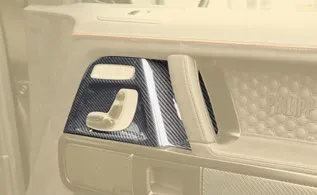
Door switch panel for Mercedes G-class W463A Gronos


Door Switch Panel for Mercedes G-Class W463A Gronos
The door switch panel — the integrated control surface at the door's upper inner face carrying the window lifter, mirror adjustment, door lock, and seat memory controls — is one of the most frequently used interior surfaces in the W463A G-Wagon. Every window operation, every door locking event, every mirror adjustment involves a direct finger contact with this panel's switch face. In OEM specification the door switch panel is a moulded plastic unit in the interior trim colour, functional and well-integrated but with no material identity beyond its colour match to the door card. The Door Switch Panel from the Mansory Body Kit for Mercedes G-Class W463A Gronos replaces the OEM plastic panel carrier with a carbon-fibre equivalent that presents the same switch layout in a Gronos-programme carbon face, upgrading the most-touched interior switch surface from a colour-matched plastic to a material-defined programme element.
Construction & Materials
The Door Switch Panel is produced as a direct replacement for the OEM door switch panel carrier at all four door positions. The carbon carrier replicates the OEM panel's switch aperture pattern, wiring harness connector positions, and door card mounting interface precisely — the OEM switch modules, membrane contacts, and illumination elements transfer from the OEM carrier to the carbon carrier without modification. The carrier's visible face is 3K twill prepreg carbon, autoclave-cured, with a flat face geometry that matches the OEM panel's switch-mounting surface — the switch buttons' operating travel and tactile feedback are governed by the switch modules themselves, not the carrier, so the carbon carrier does not alter the switch feel. The carrier's back face replicates the OEM clip and connector positions for direct installation at the door card's OEM switch-panel mounting interface.
- Material: 3K twill prepreg carbon carrier — OEM switch modules transfer without modification
- Switch apertures: exactly replicated from OEM panel — window lifter, mirror, lock, seat memory positions preserved
- Wiring harness connector positions: OEM positions replicated on carbon carrier back face
- Clearcoat: dual-layer cabin-grade lacquer on visible face
- Mounting: OEM door card mounting interface replicated
- Supplied: set for all four door positions (front driver, front passenger, rear LH, rear RH)
Design & Visual Function
The door switch panel occupies a specific position in the driver's and passengers' visual field — at the door's upper inner face, adjacent to the door pull and below the window glass. It is visible on every door approach and during every window or lock operation from inside the cabin. The carbon carrier face provides the Gronos programme's material identity at this high-use surface, so that the occupant's most frequent switch operation occurs against a 3K twill carbon surface rather than an OEM plastic one. The visual effect of the carbon switch panel in the door card context is one of precise specification: the carbon face, with its defined weave visible between and beside the switch button apertures, reads as a precision-machined component rather than a production moulded plastic.
The switch apertures' spacing and layout on the carbon face also creates a tactile orientation reference for the driver's right hand when operating window controls without looking at the panel. The OEM piano-black panel provides no tactile reference — all surfaces feel identical. The 3K twill carbon carrier's weave creates a micro-texture between the apertures that the driver's fingertip registers as a surface change as it moves from the inter-aperture carbon to the button cap surface. This tactile contrast between the weave-textured carbon field and the smooth switch button surface provides a non-visual position reference that the OEM panel's uniform texture cannot offer.
The switch apertures in the carbon face create a visual rhythm of functional openings in the 3K twill weave — the weave's continuity is interrupted at each aperture position by the switch button, and this interruption-and-continuation pattern creates a dynamic surface reading that differs from the uniform surface of an OEM piano-black panel. Each switch position is emphasised by its aperture in the carbon field, which gives the panel's functional layout a visual clarity that the OEM panel's colour-match approach deliberately suppresses.
Compatibility & Fitment
Door Switch Panel fits Mercedes-Benz G-Class W463A 2018 to present, G63 AMG and G500/G550. The W463A's switch layout is the same across LHD and RHD configurations at the front driver door — rear door panels are symmetric and fit corresponding positions. Confirm full four-door switch configuration at order. Post-2024 facelift W463A: confirm switch layout at order as the facelift revised some door panel switch positions.
Installation & Reversibility
Installation requires OEM door trim panel removal for access to the switch panel's rear face wiring harness connectors. Transfer each switch module from the OEM carrier to the carbon carrier in sequence, confirm each connector engages correctly, and fit the carbon carrier at the OEM mounting position. The OEM carrier is retained for reversibility. Installation time: 30–45 minutes per door. Fully reversible.
Pairing within the Mansory Gronos programme
The door switch panel integrates into the door card programme alongside the other door-face Gronos elements. The Carbon Door Handle with Logo provides the exterior carbon programme at the door's opening grip, completing the door's interior-to-exterior Gronos specification. The Interior Trim Set covers the door card carbon inserts that frame the switch panel's position on the full door inner face. The Roof Handles Carbon continues the Gronos carbon specification from the door switch zone upward to the ceiling handle position.
Maintenance & Durability
The door switch panel's carbon face is the highest-contact-rate interior surface in terms of per-unit-area contact frequency — the switch aperture zones receive finger tip pressure multiple times per journey for window operations alone. At the switch-adjacent carbon areas between the apertures, the finger edge contacts the carbon face at an oblique angle with each switch operation. This oblique finger-edge contact is the primary mechanism for clearcoat micro-abrasion on the switch panel face — clean the inter-aperture carbon surface with a damp microfibre cloth following the weave direction at each weekly interior clean, and apply ceramic cabin sealant to the switch panel face every 4 weeks to maintain the clearcoat's abrasion resistance against the switch-operation contact events.
The rear door switch panels are exposed to the highest UV dose of the four positions because the rear window glass area is typically not UV-blocked as thoroughly as the front windscreen in markets where only windscreen UV-blocking is standard. Apply UV-blocking window tint to the rear side glass to protect the rear door switch panel carbon faces — the dose reduction is significant enough to double the clearcoat service life at the rear panel positions compared with unprotected rear glass. If UV-blocking tint is already fitted, the rear door switch panels receive the same reduced UV dose as the front positions and no additional action is required.
The wiring harness connectors at the carbon carrier's back face should be inspected at each 2-year service interval for any connector housing fatigue cracks from the thermal cycling of the door panel microclimate (door panel ambient temperature swings 30–40 °C between winter overnight cold and summer direct-sun parked conditions). Connector housing cracks in the OEM connectors can cause intermittent switch function; the same failure mode applies to the connectors on the carbon carrier. Replace any cracked connector housings before the crack propagates to the locking tab zone, which would require connector replacement rather than housing refurbishment.
Lead Time & Warranty
Lead time for Door Switch Panel is 2–3 weeks from order. 12-month warranty against carbon carrier delamination, clearcoat adhesion failures, and switch aperture dimensional errors. Switch module function is covered by the OEM switch warranty.
FAQ
Q: Are the switch module button caps visible against the carbon face?
A: Yes — the switch module buttons project through the apertures in the carbon carrier face. The button cap surfaces are the OEM components and retain their original material and illumination finish. The carbon carrier provides the face between the button caps.
Q: Does the carbon carrier affect the switch modules' illumination through the panel?
A: The switch modules illuminate through the apertures in the carbon face, not through the carbon carrier material itself. Illumination function is unaffected by the carrier material change.
Confirm W463A door configuration and facelift status with the Hodoor Mansory team: Contact us via WhatsApp +44 7488 818 747 or [email protected].