
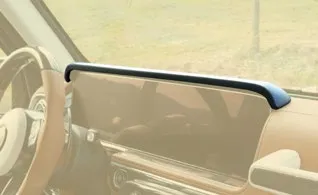
Speedometer top panel for Mercedes G-class W463A Gronos


Speedometer Top Panel for Mercedes G-Class W463A Gronos
The instrument cluster cowl — the curved shroud that extends forward from the dashboard top surface over the cluster housing — is the first interior surface the driver sees when they sit in the W463A and the last they see when they exit. It frames the instrument cluster's upper boundary in a continuous surface that runs from the windscreen base to the cluster face, and its upper face is in the driver's direct eyeline at the narrow window between the steering wheel top and the windscreen lower edge. The Speedometer Top Panel from the Mansory Body Kit for Mercedes G-Class W463A Gronos replaces or overlays the OEM instrument cluster cowl top with a carbon-fibre panel that frames the cluster's upper boundary in the Gronos programme's 3K twill specification, completing the cluster's top-and-bottom carbon framing when combined with the Steering Wheel Panel below.
Construction & Materials
The Speedometer Top Panel is a precision-formed carbon-fibre overlay for the instrument cluster cowl's upper face. The visible surface is 3K twill prepreg, autoclave-cured, with a horizontal fore-aft weave that creates a visual connection to the cluster's horizontal layout and the Steering Wheel Panel's horizontal weave specification below the cluster. The panel profile follows the cowl's curved geometry within ±0.3 mm, maintaining a flush presentation at the cluster housing boundary and the windscreen-base junction. Mounting is via VHB adhesive at the primary contact face and push-fit engagement at the cowl's retaining clip positions. The panel does not cover any cluster display apertures — the instrument cluster's digital or analogue display faces are fully visible through the cowl aperture beneath the panel.
- Material: 3K twill prepreg carbon, autoclave 120 °C / 4 bar, horizontal fore-aft weave
- Profile: matched to cluster cowl geometry within ±0.3 mm
- Clearcoat: dual-layer cabin-grade UV-stable lacquer
- Mounting: VHB at contact face; push-fit at cowl clip positions
- Instrument display apertures: unobstructed — cowl aperture geometry fully retained
- Panel footprint: cowl upper face from windscreen-base junction to cluster housing top edge
Design & Visual Function
The speedometer top panel's position at the driver's most-viewed interior surface — the zone directly above the instrument cluster and below the windscreen — gives it a visual prominence that belies its relatively modest size. In the driver's seated eyeline, the cowl top panel is the surface that frames the upper boundary of the information zone: it is visible every time the driver reads the cluster, which in normal driving is several times per minute. The carbon panel at this position frames the cluster with the same material language as the wheel face and the console surfaces in a complete driver's operational-zone carbon specification.
The horizontal weave's visual alignment with the instrument cluster's lower horizontal register creates a perceptual framing effect that experienced interior designers refer to as a material gateway: the cluster's digital display or analogue gauges appear to be set within a precision-formed carbon aperture defined above by the speedometer top panel and below by the steering wheel panel. This gateway framing concentrates the viewer's attention on the cluster's functional display zone, making the cluster face read as a deliberately framed element in the dashboard rather than a screen embedded in a plastic surface. The effect is particularly strong on W463A specifications with the full-digital MBUX instrument cluster, where the wide display format's horizontal extent is emphasised by the parallel horizontal carbon weave on both bounding faces.
The horizontal weave orientation at the cowl face creates a matching weave direction to the Steering Wheel Panel below the cluster — when both panels are fitted, the cluster is framed above and below by horizontal-weave 3K twill carbon, creating a coherent carbon frame around the instrument cluster's operational display zone. This top-and-bottom framing effect is strongest at the driver's eye-level viewing angle from the seated position: the cluster appears set within a carbon aperture rather than embedded in a plastic dashboard, which is a visual quality that significantly elevates the perceived precision of the instrument cluster presentation.
Compatibility & Fitment
Speedometer Top Panel fits Mercedes-Benz G-Class W463A 2018 to present. The cluster cowl geometry is the same across G63 AMG and G500/G550. LHD configuration standard — RHD: confirm mirror geometry at order. Post-2024 facelift W463A compatible — cluster cowl geometry unchanged.
Installation & Reversibility
Installation time is 15–25 minutes. IPA-clean the cowl top face, apply VHB, align the panel from the windscreen-base junction forward to the cluster housing top edge, engage push-fit clips, and press VHB zones home. Allow 1 hour for full VHB development. The panel does not require cluster or dashboard removal for fitment. Fully reversible.
Pairing within the Mansory Gronos programme
The speedometer top panel pairs with the Steering Wheel Panel and extended column programme for a complete cluster-framing specification. The Steering Wheel Panel below the cluster completes the bottom boundary carbon frame. For the dashboard zone adjacent to the cowl, the Middle Console + Dashboard Trims continue the Gronos carbon programme at the surfaces flanking the cluster zone. The Door Switch Panel extends the Gronos carbon programme to the adjacent door aperture switch panel zone beside the cluster.
Maintenance & Durability
The cluster cowl top panel is at the highest solar UV accumulation position of any dashboard carbon element — it receives direct UV from the windscreen glass directly above it at the sun-low-in-the-sky angle and diffuse UV from the full windscreen area at all other sun angles. UV exposure at the cowl top face is 2–3 times higher than at the adjacent console surfaces below the dash. Apply UV-blocking ceramic sealant to the panel face every 4 weeks during high-UV seasons and every 8 weeks in winter. The horizontal fore-aft weave makes the sealant application straightforward — apply in a fore-aft stroke following the weave bundles' long axis for even coverage across the panel width.
At long highway sections in summer heat, the cowl top panel's horizontal orientation allows it to accumulate the warm-air boundary layer rising from the dashboard surface, which creates a localised high-temperature micro-environment at the panel face during extended drives. The clearcoat at this face is specified for cabin temperatures up to 80 °C, which provides adequate margin under normal dashboard temperature conditions. However, if the W463A is used without climate control in a hot-climate market with the cabin temperature exceeding 60 °C, the clearcoat at the cowl face approaches its operating limit — always use the climate control system to maintain cabin temperature below 60 °C at the cowl panel level when the vehicle is occupied.
The windscreen-junction edge of the speedometer top panel requires the most active maintenance of any interior carbon component. This edge is at the precise boundary between the cabin interior and the windscreen's lower glass zone, which is a transition area where cabin-interior moisture, dashboard outgassing, and windscreen condensation converge. In cold climates where windscreen defrosting creates a sustained temperature differential between the glass and the dashboard surface, condensation can form at the panel edge and penetrate under the VHB adhesive if the edge sealant bead has not been maintained. Re-apply neutral-cure silicone sealant at the panel's windscreen-junction edge at each autumn service before the cold weather season begins to prevent this moisture-driven VHB degradation from developing during winter use.
The panel's windscreen-junction edge should be resealed with a neutral-cure silicone bead annually — this edge is the most exposed to UV, rain ingress at the windscreen base, and dashboard thermal cycling. A continuous sealant bead at the windscreen junction edge prevents moisture from wicking under the panel at the junction gap during heavy rain, which is the primary moisture ingress vector for VHB bond degradation at this panel position.
Lead Time & Warranty
Lead time for the Speedometer Top Panel is 2–3 weeks from order. 12-month warranty against delamination, clearcoat adhesion failures, and VHB retention failures at the cowl face.
FAQ
Q: Does the panel affect the W463A's head-up display (HUD) if fitted?
A: The speedometer top panel covers the cowl top face above the cluster, not the HUD projector aperture. On W463A configurations with a factory HUD, the projector is at the cowl's forward end — confirm the panel geometry relative to your W463A's HUD projector position with Mansory before ordering.
Q: Is the panel removable for cluster or dashboard service access?
A: Yes — the panel releases at the VHB and clip positions with a trim pry tool for any cluster or dashboard service work that requires cowl removal.
Confirm LHD/RHD and HUD specification with the Hodoor Mansory team: Contact us via WhatsApp +44 7488 818 747 or [email protected].