
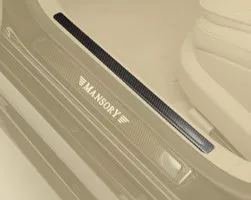
Inner entrance panels Mansory for Mercedes-AMG S63E


Mansory Inner Entrance Panels for Mercedes-AMG S63E
Inner entrance panels cover the part of the door no one expects to be carbon — the door-jamb interior face that is visible only when the door is open, below the latch and door-hinge. On the OEM AMG W223 saloon this surface carries a body-coloured stamped-metal trim with a small AMG-spec script. It is the surface a passenger sees while their feet are on the ground and they are looking down before stepping in, and it is exactly the surface where a coherent carbon programme either completes itself or breaks. The Mansory inner entrance panels close that loop. They are the cabin counterpart to the visible-entrance panels — where the visible panel sets the upper sill register, the inner panel sets the door-jamb register. Together they give the doorway a fully integrated carbon presentation. Four-piece set, one panel per door, mirror-symmetric LHD/RHD. It is part of the parent Mansory Carbon Fiber Body kit set for Mercedes-AMG S63E.
Construction & Materials
Inner-jamb panels see less abrasion than upper-sill plates but they are exposed to door-shut compression cycles and to weather-seal contact, both of which require dimensional accuracy at the edges and a layup that does not compress under repeat door cycling.
- 3K 2×2 twill A-side cosmetic skin, biased so weave runs along the jamb's vertical axis
- Pre-preg autoclave cure at 130 °C, multi-axial fibre orientation
- Wall thickness 1.4–1.8 mm in the show face, 2.6 mm at the OEM jamb-stamping bond pad
- Net dry weight: 0.10–0.16 kg per panel (4 panels per set)
- 3M VHB 5952 along the bond face, OEM door-jamb metal as substrate
- Edge-detail: chamfered to clear the OEM door weather-seal at door-shut compression
- UV-stable 2K clear lacquer (gloss / satin / matte) over hydrophobic primer
- Substrate prep: solvent wipe, 3M Cleaner-Primer 94, low-tack masking on bond pads
Design & Visual Function
The inner panel's geometry tracks the OEM body-coloured stamped trim it replaces; what changes is the surface — from body-paint to lacquered carbon — and a small Mansory engraving at the panel centre. The 3K twill is biased so the diagonals run along the door's vertical axis, which is consistent with the rest of the Mansory cabin programme and gives the carbon palette across the doorway a coherent kinetic logic.
An owner who specifies the inner panels alongside the upper-sill panels gets the closest the Mansory cabin programme comes to a continuous carbon corridor: from the moment the door opens, the eye reads carbon at the upper sill, on the inner door-jamb, and (with the door-welcome-lights option) catching the projected pavement light at the moment of exit. The carbon palette wraps the doorway in a way that body-coloured paint cannot. This kind of detailing is the difference between a kit-of-parts upgrade and a coordinated design programme — owners who notice these things will notice this part working long after they have stopped seeing the more obvious upgrades.
The chamfered edge along the door weather-seal interface is critical — it keeps the OEM weather-seal compressing against carbon at the same rate it compresses against the OEM stamped metal, which means door-shut feel is unchanged from OEM. Owners who notice if the door-shut sound subtly changes after a modification will hear no difference; the door reads as OEM-tight on close.
For owners specifying body-colour wraps over the OEM AMG paint, the inner panel can be painted to match. The lacquered carbon underneath is fully primer-compatible; a local body shop can paint to a PPG/Standox match in a single coat.
Compatibility & Fitment
Engineered for Mercedes-AMG S 63 E PERFORMANCE (W223), 2023+, saloon. Four-piece set with mirror-symmetric LHD/RHD geometry. The OEM door-jamb stamping is the bond datum; OEM door weather-seal compression behaviour is preserved. AMG Night Package and AMG Carbon Package cars are supported. The OEM door-handle internal mechanism, OEM safety-latch, and OEM child-lock (rear doors) are unaffected because the inner panel sits below the latch hardware. The OEM long-wheelbase rear-door has a longer jamb than the front-door; the corresponding rear panels in the four-piece set are sized accordingly.
Installation & Reversibility
Plan 60–80 minutes for the four-piece set. Required tools: plastic emblem-removal tool, low-temperature heat pad, isopropyl alcohol, 3M Cleaner-Primer 94, low-tack masking. Workflow per door: open the door fully, warm the OEM body-coloured stamped trim with the heat pad to release the OEM adhesive, lift away with a plastic pry tool, clean the OEM jamb-stamping with IPA, apply primer, peel the VHB liner on the carbon panel, set down with a slight rocking motion, press home with hand pressure for 30 seconds. Allow 24 hours cure before the door is exposed to high-pressure water. Reversibility is full — the OEM stamped trim can be reinstalled at any time with fresh trim-grade adhesive.
Pairing within the Mansory Mercedes-AMG S63E programme
Most often combined with the upper-sill Entrance panels with logo or the illuminated variants for a fully coordinated cabin-entry programme, with the Door welcome lights front door for an integrated illuminated door-shut sequence, and with the Sport steering wheel for cabin-carbon coherence at the hand-and-foot interaction surfaces.
Maintenance & Durability
Inner-jamb panels see less abrasion than upper-sill plates — passengers do not step on them, and only the door-weather-seal compresses against them at door-shut. Wipe with a damp microfibre and a small amount of automotive interior cleaner during routine cabin cleaning. Avoid solvents and alcohol-based cleaners. The OEM door weather-seal occasionally leaves a soft compression mark on the lacquer at the seal-contact line; this is normal and polishes off with a soft microfibre and a gentle interior-grade polish. Bird-strike risk is zero given the position. Cosmetic-finish lifespan: 10–13 years given the panel's sheltered position.
Lead Time & Warranty
Production turnaround: 3–4 weeks for the four-piece set. The shorter cycle relative to the upper-sill panels is because there is no anti-slip texture to etch and no LED carrier to pot. Custom topcoat finishes (matte, satin, forged-look) extend by roughly one week. Warranty: 12 months against manufacturing defects — delamination, voids, fitment, edge-chamfer dimensional accuracy, clear blistering — running from delivery date. Outside warranty: dropped-item impact, child-seat-strap abrasion, and chemical staining. Each set ships in a foam-lined carton with the panels separated by interleaved soft tissue and a QC photograph documenting weave alignment and edge-chamfer dimensional accuracy under raking light.
FAQ
Q: Why are inner entrance panels needed if I already have the upper-sill entrance panels?
A: Different surface, different position. Upper-sill panels cover the surface a passenger steps over; inner panels cover the surface a passenger sees while their feet are on the ground and they are looking down before stepping in. Together they complete the cabin-entry carbon programme.
Q: Will door-shut feel change after installation?
A: No. The chamfered edge preserves OEM weather-seal compression behaviour; door-shut sound and feel are unchanged from OEM.
Q: Are LHD and RHD panels different?
A: No — same SKU set fits both. Panels are mirror-symmetric and clearly marked left/right and front/rear.
Q: Do the rear panels match the front in size?
A: No — the W223 long-wheelbase rear-door jamb is longer than the front-door jamb, so the rear panels in the set are correspondingly longer.
Q: Is the engraved Mansory logo paint-filled?
A: Standard supply has a flush engraved Mansory mark. Paint-filled variants are available on order.
Q: Will the panel affect the OEM child-lock on the rear doors?
A: No. The child-lock toggle is on the door's edge above the inner panel and is unaffected.
Q: Are the inner panels visible from outside the open door?
A: Yes — they are the surface a passenger sees while looking down before stepping in. From a distance they read as part of the doorway's carbon programme; up close the engraved Mansory mark resolves.
Q: Will the panels survive frequent valet-grade pressure-wash exposure?
A: Yes after the 24-hour cure. The lacquered carbon is rated for sustained automotive cleaning regimes; mechanical-brush wash on the doorway is not a concern.
Pair the inner entrance panels with the upper-sill entrance panels, the door welcome lights, and the sport steering wheel for a fully integrated cabin-entry carbon programme. To configure your build, message WhatsApp +44 7488 818 747 or write to [email protected].