
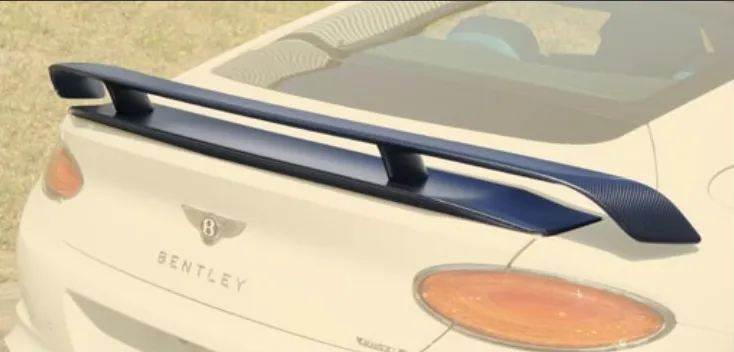
Biplane performance wing with decklid spoiler Mansory Carbon for Bentey Continental GT


Mansory Biplane Wing with Decklid Spoiler — Bentley Continental GT (3W Coupé, 2003–2011)
When a biplane wing is fitted to a car, a pressure gap opens between the boot lid surface and the underside of the lower wing element. High-pressure air from above the car bleeds through this gap into the low-pressure zone beneath the wing, reducing its downforce efficiency. The decklid spoiler element in this combined system seals that gap: it sits at the boot lid trailing edge, directs attached flow up into the wing underside, and maintains the pressure differential that drives the wing's lift-reduction function. The result is approximately 15–20% more rear-axle downforce than the biplane performance wing alone, with no significant drag penalty — the reason Mansory offers these two elements as a single integrated SKU rather than allowing owners to combine the standalone decklid with an existing wing after the fact. This combined assembly is part of the Mansory Carbon Fiber Body Kit Set for Bentley Continental GT and represents the maximum rear aero specification for the 3W coupé.
Construction & Materials
The combined kit comprises three distinct carbon components: the upper biplane element, the lower biplane element on carbon endplates, and the decklid spoiler element positioned between the wing legs at boot lid level and connected to the endplate structure. All three are autoclave-cured 3K twill weave prepreg carbon fibre. The upper and lower wing elements use a unidirectional spar and closed-cell foam core to maintain aerofoil section geometry under aerodynamic loading. The decklid spoiler element uses the same autoclave layup as the standalone decklid spoiler but is geometrically specific to this integrated system — its trailing edge profile is calibrated to the lower wing element underside at the designed 35 mm gap and is not interchangeable with the standalone SKU without modification. The endplates share their form with the standalone biplane wing but include additional bracket provisions for the decklid element mounting tabs. The complete assembly weighs approximately 4.6 kg versus 3.8 kg for the standalone wing.
- Upper wing element: 3K twill prepreg, UD spar, foam core, autoclave-cured; 1,100 mm span
- Lower wing element: same construction; 1,100 mm span, 120 mm chord
- Decklid spoiler element: 3K twill prepreg; VHB tape base + endplate bracket mount
- Gap — decklid trailing edge to lower wing underside: 35 mm (calibrated aerodynamic dimension)
- Slot between upper and lower wing elements: 55 mm
- Endplates: common form with standalone wing; include decklid bracket provisions
- Total assembly weight: approximately 4.6 kg
- Boot lid drill positions: same 4 × 12 mm as standalone biplane wing
Design & Visual Function
The three-element configuration — decklid spoiler at the base, lower wing above, upper wing at the top — functions as an integrated multi-element rear aerofoil. The decklid spoiler element increases the mass flow of attached air entering the lower wing element underside, which amplifies the accelerated flow through the 55 mm slot toward the upper wing element. Each element's suction peak is enhanced by attached flow from the element below — this cascade is why the combined system generates more downforce than any element alone. At 160 km/h the combined system generates approximately 65–90 kg of rear-axle downforce. The 3W coupé carries approximately 960 kg of static rear axle load; 90 kg of aerodynamic downforce represents approximately 9.4% of that figure — a meaningful shift in rear grip threshold in high-speed corners. The standalone biplane wing generates approximately 55–75 kg at the same speed; the decklid element adds approximately 15–20% by sealing the pressure gap at the wing underside root.
Visually, the combined system is more resolved than the standalone wing. Without the decklid element, the biplane wing floats above the boot lid with an open gap at the base. The decklid element fills this gap, grounding the wing to the body and creating a layered stack from boot lid level to the upper wing tip. From the rear, the three-element architecture reads as an intentional system — each element separated by a calibrated gap, mounted on carbon endplates running the full vertical height from boot lid level to the upper wing tip. The 3K twill weave across all three elements is aligned by Mansory for visual consistency across the assembly.
Compatibility & Fitment
Continental GT coupé, 3W platform, 2003–2011 only. Not compatible with the Continental GTC convertible — see the performance wing for GTC. Not compatible with the second-generation Continental GT (D2A chassis). All 3W coupé engine variants: W12 6.0L twin-turbo and V8 4.0L twin-turbo. The four 12 mm boot lid drill positions are identical to the standalone biplane wing — existing boot lid holes are reused. The decklid spoiler element attaches additionally via 3M VHB tape to the boot lid surface; no extra drilling is required. This system cannot be installed simultaneously with the standalone decklid spoiler. Components are not directly interchangeable with the standalone biplane wing or standalone decklid spoiler SKUs without modification to the endplate structure.
Installation & Reversibility
Installation time approximately 4–5 hours for an experienced body shop — slightly longer than the standalone wing due to the decklid spoiler alignment step. The 35 mm gap between the decklid element trailing edge and the lower wing underside must be verified during installation. Sequence: boot lid drilling at the four 12 mm positions, leg insert installation and torque verification, wing element assembly on endplates, decklid element bracket connection to endplate provisions, VHB tape bonding to boot lid, full system alignment check, final fastener torque verification. The VHB bond provides base retention; the endplate bracket mount provides structural retention against aerodynamic lift forces — both are required. Post-installation: verify boot lid operation, confirm all M10 leg fasteners are at specified torque, verify wing attack angle. Boot lid drill holes are irreversible without panel repair. Professional body shop installation required.
Pairing within the Mansory Continental GT 3W Programme
The biplane wing with decklid spoiler is the highest rear downforce configuration in the Mansory 3W programme. It pairs naturally with the rear bumper with Diffuser II, contributing approximately 25–40 kg of additional rear-axle downforce at 160 km/h. At the front, balance the rear downforce with the Mansory front bumper with integrated front lip — without front aero, high rear downforce shifts the aerodynamic balance toward understeer at speed. The carbon side skirts and front fenders with stripe complete the visual programme. The standalone biplane performance wing remains available for owners not requiring the maximum rear downforce figure.
Maintenance & Durability
Ceramic coating of all element faces is strongly recommended: upper and lower wing elements (both sides), decklid spoiler upper face, and endplate outer faces. Annual inspection: tap test all aerofoil faces for delamination. The decklid element upper face and lower wing lower face are the primary hailstone impact surfaces — inspect annually. The VHB bond at the decklid element base should be inspected annually for edge lifting; apply fresh VHB strip at any lifted corner immediately. Re-torque M10 endplate fasteners and attack angle hardware annually. Check leg insert interfaces for seasonal corrosion. Carbon laminate and lacquer service life with UV protection: 10–14 years.
Lead Time & Warranty
Complete clear-lacquered kit — wing elements, decklid spoiler element, endplates, leg inserts, all hardware — lead time 5–7 weeks. 12-month warranty against manufacturing defects from delivery: delamination, structural laminate voids, leg-endplate fitment failure, lacquer manufacturing faults. Installation damage from incorrect boot lid drilling or improper torque is not covered. Professional installation is a condition of warranty claims for structural fitment issues.
FAQ
Q: Can I retrofit the decklid element to a standalone biplane wing already installed?
A: Not directly. The decklid element in this kit mounts via endplate bracket provisions absent in the standalone wing endplates. Retrofitting requires replacing the endplates with the integrated-version endplates from this kit. Contact us to discuss the endplate replacement process for an existing standalone wing installation.
Q: Is the 35 mm gap between the decklid spoiler trailing edge and the lower wing underside aerodynamically important?
A: Yes — it is a calibrated aerodynamic dimension controlling the mass flow of attached air into the lower wing element underside. This dimension was set during integrated system development and should not be modified.
Q: Does the three-element assembly vibrate or resonate at speed?
A: No — autoclave prepreg with foam-core sections is substantially stiffer than vacuum-bagged hollow constructions. Carbon endplates prevent inter-element deflection. Any rattling after installation indicates a loose leg fastener — check all M10 fasteners to specified torque.
Q: What total rear downforce does the Diffuser II plus this combined system produce at 160 km/h?
A: The Diffuser II contributes approximately 25–40 kg; the biplane + decklid combo contributes approximately 65–90 kg — total approximately 90–130 kg rear-axle downforce at 160 km/h.
Q: Is this the configuration Mansory fits to their fully built Continental GT 3W programme cars?
A: Yes — the biplane wing with decklid spoiler is the rear aero configuration on Mansory's completed 3W programme builds, representing the maximum rear aero specification for this platform.
Specify the Mansory biplane wing with decklid spoiler for the ultimate rear aero package on your Continental GT coupé — contact us via WhatsApp +44 7488 818 747 or [email protected].