
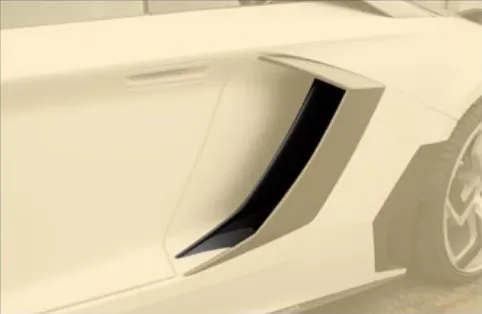
Air intake - middle part Mansory Carbon for Lamborghini Aventador Competition


Mansory Carbon Air Intake Middle Part for Lamborghini Aventador Competition
The Mansory carbon air intake middle part is the divider element that sits between the paired side intakes on the Lamborghini Aventador Competition flank, a mid-line bridge that converts two separate openings into one composed twin-portal architecture. Within the broader Mansory Carbon Body Kit for Lamborghini Aventador Competition programme, this central segment is what gives the SVJ-derived bodyside its rhythm: a slim carbon bisector that anchors the geometry, carries the weave continuity, and lets the V12 naturally aspirated airbox feed read as one cohesive sculpt rather than two unrelated holes punched into the quarter panel. Owners running the LP, S, SV, SVJ or Ultimae chassis specify the middle part when the larger replacement intakes are already on the car and the centre divider needs to match in weave, sheen and depth so the scissor-door cut, the rear-wheel-steered haunch and the aluminium-CFRP monocoque silhouette stay visually unified.
Construction & Materials
The middle part is a single autoclave-cured carbon moulding produced in Mansory's bespoke composite line. It is a thin, sculpted bridge piece: tall in the vertical axis, narrow across, with sharp inner radii where it meets each of the paired intake openings. Because it bisects two airflow channels, the geometry is asymmetrical front-to-back to follow the body crease that runs from the door cut towards the rear haunch. The exterior face carries a continuous weave that aligns with the surrounding intake replacements, so when both sides of the divider are read together the twill diagonals cross the bisector without breaking.
- 3K twill outer ply, 2×2 diagonal weave aligned to the body crease so the divider does not interrupt the surrounding pattern.
- Prepreg lay-up, autoclave cure at 120°C, 6 bar — yields a dense, void-free laminate with consistent depth on the cured surface.
- Aerospace-grade UV-stable lacquer; deep gloss is standard, satin Soft-Touch and matte are optional finishes.
- Wall thickness 1.6–1.9 mm across the bridge, locally 2.4 mm where the part meets each intake lip for chip resistance.
- Mass approximately 0.18 kg per piece — an almost incidental contribution to overall mass, but the part removes a section of original painted bodywork.
- Hidden fixings: M5 stainless studs bonded into the back face plus 3M VHB perimeter tape for a flush, fastener-free outer face.
- Edge sealing with flexible polymer bead so weave terminations do not delaminate at washes.
- Compatibility-engineered with the surrounding Mansory intake replacements — the divider's flange profile mates to the stepped lip on the larger intake parts.
Design & Visual Function
Visually the middle part is what turns two intakes into a paired pair. A pair of plain replacement intakes, no matter how cleanly executed, will read as two isolated mouths on a long flank. Drop the carbon divider in between and the eye reads a single twin-portal architecture — like the bisector on a horizontal grille, except here the two openings remain functionally independent and continue to feed the V12's rear-mounted airbox and oil-cooler radiators. The bridge gives the bodyside a midline anchor and pulls the surrounding sculpt into a composed whole.
The weave continuity matters more on this part than on almost any other. Because the divider sits between two larger carbon panels, any rotation in the twill direction is instantly visible as a pattern jump at the boundary. Mansory cuts this part from a master ply orientation aligned to the surrounding intake replacements, so the diagonals from the front intake march across the bridge and continue, uninterrupted, into the rear intake's outer face. Under sun the deep lacquer holds a wet, three-dimensional depth and the bridge becomes a thin vertical glint that emphasises the Aventador's already dramatic side geometry — the scissor-door shut line above, the rear-haunch shoulder behind.
Aerodynamically the middle part is conservative by design. It does not block any duct, does not redirect flow, does not alter the V12's intake roar at WOT. On SVJ chassis the ALA 2.0 channel runs centrally over the rear deck and is not affected by side-flank trim — the divider lives well clear of the active aero geometry. The reason this part exists is not aero — it is the geometry of the bodyside, which without a centre piece looks unfinished.
Compatibility & Fitment
The middle part is compatible with Lamborghini Aventador LP700-4, LP750-4 SV, S, SVJ and Ultimae, in coupé as well as Roadster body. Pre-SVJ and SVJ flank geometry differ in the depth of the intake opening and the rake of the body crease that runs through the section, so two production tools are used and Mansory ships the variant matched to chassis VIN. The part respects OEM Lamborghini parking sensors, scissor-hinge pivot geometry and the oil-cooler intake plumbing that lives behind the side ducts. It is intended to be installed alongside the matching Mansory replacement intakes — it does not work as a standalone piece on a stock bodyside, because the OEM intake openings on a factory Aventador do not present the bridge geometry the part is shaped to.
Installation & Reversibility
Allow approximately 60–90 minutes per side. The body shop removes the surrounding Mansory intake replacements, dry-fits the middle part to verify weave alignment with both panels, primes the bonding surface, and sets the part using methacrylate adhesive on the central rib plus 3M VHB on the perimeter. The studs accept M5 nuts on the back side for redundant retention. Because the Aventador's CFRP monocoque uses methacrylate adhesive bonds for several body panels, the substrate chemistry must be respected — only methacrylate or polyurethane adhesives qualified for carbon-on-carbon bonding belong here. The job is reversible: heat-line release and clean-off of adhesive residue restores the surrounding panels, although it is rarely undone in practice because removing the bridge leaves the bodyside looking incomplete.
Pairing within the Mansory Aventador Competition programme
The middle part is by definition a companion piece — it never travels alone on a build. The most common bookend is Replacement Air intake — rear, which sits aft of the divider and carries the matching weave outward to the rear haunch. Many Competition specs also stack the larger Designed big air intake (replacement aesthetic) on the same flank; in that case the middle part is what reconciles the bigger opening's outline with the forward intake's softer geometry. Where owners want the cleanest possible execution, the divider is paired with Air intake cover, which lives on the upper edge of the rear-quarter intake and continues the carbon weave up onto the haunch.
Maintenance & Durability
Lacquered weave responds well to pH-neutral two-bucket washes, microfibre mitt only, and a light coat of carnauba or, for more permanent protection, a single-layer ceramic on top of factory lacquer. Avoid alkaline degreasers, ammonia-based glass cleaners migrating onto the part, and abrasive sponges — these are the three things that shorten lacquered carbon life on a bodyside trim piece. The middle part sits well clear of the V12's hot zone (which is concentrated above the engine bonnet and around the central twin-exhaust on SVJ), so thermal degradation of the lacquer is not a practical concern at this location. UV is the relevant ageing vector. A ceramic coating refreshed every 24–30 months, plus regular paint decontamination, keeps the weave depth visually stable for the life of the car. Stone chips on the leading edge are repairable with a clear-coat dab and gentle level; deeper damage is sent back to a carbon specialist for re-lacquer.
Lead Time & Warranty
Production runs in Mansory's bespoke composite atelier, lead time 4–8 weeks from order, longer for a colour-shift or forged-look option. 12-month manufacturer warranty against laminate defects and lacquer adhesion failure under normal use. Each part is shipped with VIN-traceable production documentation.
FAQ
Q: Does this part work on a stock Aventador bodyside, or only with Mansory intakes around it?
A: The bridge geometry is shaped to match the Mansory replacement intakes. On a factory-stock bodyside the OEM openings do not present the matching flange profile the part lands on, so it is intended exclusively as a companion to the Mansory side-intake set.
Q: Will the divider affect V12 intake or oil-cooler airflow?
A: No. The middle part is a body-surface bridge that sits between the openings — it does not enter either airflow channel and does not change the volumetric feed to the airbox or the oil-cooler radiators.
Q: Pre-SVJ and SVJ flanks are different — which version do I get?
A: Both variants exist and Mansory matches by chassis VIN. The SVJ version accommodates the slightly different intake opening depth introduced on that platform; the LP/S variant fits Aventador LP700-4, LP750-4 SV and S. Ultimae uses the SVJ-pattern flank.
Q: Is the divider visible enough to justify on its own, or only as part of a full carbon spec?
A: It is most often specified as part of a flank carbon spec, because the part exists to unify two larger panels. On a pair of body-colour intakes the part would still read but the visual logic — weave-on-weave bisector — only resolves when the surrounding pieces are also carbon.
Q: Coupé and Roadster — same part?
A: Yes. The flank geometry behind the door is identical between coupé and Roadster, so the same middle-part tool serves both bodies. Roof and engine-cover differ by body, but the side-intake bridge does not.
The middle part is the geometry hinge of a paired-intake bodyside — pair it with the rear replacement, the designed big intake or the air intake cover, and the carbon flank reads as one composed line. WhatsApp +44 7488 818 747 or email [email protected] for spec, lead time and weave options.