
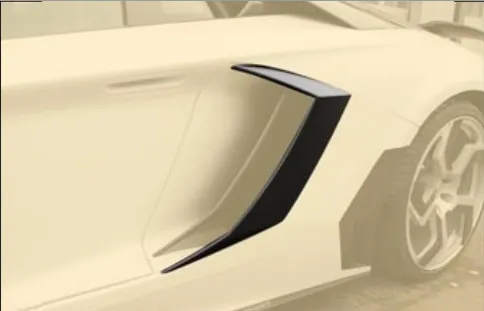
Designed big air intake for replacement Mansory Carbon for Lamborghini Aventador Competition


Mansory Designed Big Air Intake (Replacement) Carbon for Lamborghini Aventador Competition
This piece is the sculpted, signature-aesthetic edition of the oversized side-induction panel within the Mansory Carbon Body Kit for Lamborghini Aventador Competition wardrobe. It occupies the flank pocket behind the scissor-door cut, ahead of the rear haunch, where the Aventador's body necks toward the engine bay that houses the 6.5-litre naturally aspirated V12. Where the plain big-throat sibling treats that pocket as a clean, motorsport-flavoured aperture, the designed variant carves the same opening into a graphical, fin-led composition — internal fences split the throat, decorative ribs trace the lip, and the signature Mansory Carbonado language appears on a panel that competes with the diffuser and the wing for visual authorship of the rear three-quarter view.
Construction & Materials
Because the designed silhouette demands tight radii at the fence roots and crisp shadow lines along the rib crests, the laminator builds this part with extra care. The outer skin is laid up in twill prepreg; the fence webs and ornamental ribs are local sub-laminates indexed off the master pattern, then co-bonded so the visible weave reads continuous from the panel face up onto each sculpted feature. The whole assembly is autoclaved as one piece — the designed geometry would be impossible to keep dimensionally honest with bonded inserts. The result is a single carbon sculpture that wears its detailing like jewellery rather than carrying it like a sticker.
Because the part is a body-mounted panel and not a runner, the owner is paying for sculpted topology and signature graphics, not for a re-engineered intake tract. OEM ducting behind the panel remains untouched.
- Outer ply: 3K twill prepreg, plies oriented so the weave grain follows the longitudinal fence direction for visual coherence.
- Sculpted features: integrated fence webs and decorative ribs co-bonded under autoclave, not glued on as cosmetic afterparts.
- Cure schedule: full autoclave under heat and pressure, post-cured for dimensional stability across the deeper sculpted draws.
- Wall thickness: approximately 1.7–2.2 mm on the panel face, locally thicker around the fence roots and ornamental rib bases.
- Mass: tracks the OEM cosmetic module within tens of grams once trimmed — this part is about styling vocabulary, not headline weight reduction.
- Mount points: factory locating pins, threaded bosses and clip channels carry over from the OEM side-vent module unchanged.
- Finishes: glossy UV-stable lacquer over visible weave, satin matte over visible weave, or naked weave with a sealing flow-coat for the rawest read.
- Optional accent inlay: contrast-coloured or anodised mesh behind the fence apertures for an extra graphical layer at the back of the opening.
Design & Visual Function
The designed big intake is what owners specify when they want the Aventador's flank to look authored rather than merely opened. Internal fences cut the wide throat into rhythmic vertical slices — a cadence the eye reads even from twenty metres away — while the ornamental ribs along the lip pick up sunlight and throw a fine secondary shadow under the main aperture shadow. The vocabulary borrows from Mansory's Carbonado / J.S.1 design idiom: sculpted negative space, graphical fin work, and unapologetic carbon ornamentation, all married to the existing Aventador hexagonal cues that already live around the side-skirt termination and the rear bumper outtake covers.
Functionally the throat still presents a generous inlet area to the body face, and the fence webs are sized so they decorate the opening without strangling it; flow into the OEM ducting behind the panel remains generous. Owners considering whether to choose this sculpted edition or the plain oversized sibling usually decide on visual grammar — the plain sibling reads disciplined and motorsport-honest, while the designed edition reads couture and authored, with more story per square centimetre.
On SVJ specification the panel respects ALA 2.0 entirely. The active-aero system routes through the rear deck and the central wing channel, not the side flank, so a sculpted side intake does not touch any working aero surface. Scissor-hinge geometry is similarly untouched — the panel sits well below the door cut and the hinge swing path. From a packaging point of view it is a pure body cosmetic with deep styling intent, indistinguishable from the OEM module in terms of where it bolts up and how it interfaces with the rest of the shell.
Compatibility & Fitment
Engineered for the Lamborghini Aventador across LP700-4, LP750-4 SV, S, SVJ and Ultimae, in coupé and Roadster bodies. The flank pocket geometry is consistent across pre-SVJ and SVJ shells in this region, so the designed panel locates on the same hard-points either way. Where OEM proximity sensors live within the surrounding bodywork, the sculpted aperture is dimensioned to leave their windows undisturbed — fences and ribs are kept clear of sensor cones so parking-aid behaviour is unchanged.
Note that the designed edition and the plain oversized panel are alternative answers to the same question, not parts that combine. Owners who want the maximum visual authorship choose the designed; owners who want a cleaner motorsport throat choose the plain. Some clients order one of each as a future-proof spare, but only one is fitted on the car at a time.
Installation & Reversibility
Allow roughly 50–80 minutes per side at a Lamborghini-certified or Mansory-trained shop. The OEM cosmetic intake module is released from its hard-points, fasteners and clips are inspected, and the new sculpted carbon panel is offered up dry to verify gap-and-flush against the door shut-line and the side-skirt termination. Because the sculpted features cast pronounced shadow lines, any panel rotation or edge mismatch reads more visibly than on the plain sibling — the alignment phase is therefore a touch more pedantic. Once the geometry is correct, the panel is bonded to OEM hard-points and any threaded fasteners are torqued into factory bosses.
Reversibility is full. The OEM module can be re-installed at any later point with no scarring of the surrounding paintwork, provided the methacrylate adhesive family appropriate to the Aventador's CFRP monocoque is used wherever the panel touches structural carbon, and provided the original hard-points are kept clean. DIY-keen owners with body-shop habits can manage this part themselves, but most clients hand it to the same shop that fits their bumpers, side skirts and engine bonnet — both for paint-match handover and for warranty paperwork.
Pairing within the Mansory Aventador Competition programme
The designed big intake is best understood as the graphical anchor of the rear-quarter induction family. It pairs naturally with the following siblings:
- Replacement Big Air intake — rear (plain) — the disciplined, motorsport-honest counterpart at the same scale; pick this card for sculpted authorship, pick the plain panel for restraint, never both.
- Replacement Air intake — rear — the smaller-aperture standard-shape sibling, useful as a reference for owners deciding how loud they want the flank to read.
- Air intake cover — the trim cap that sits across the upper edge of the same induction zone; specifying it in matching weave keeps the layered story of the flank coherent.
For owners going full kit, the sculpted panel reads strongest alongside the matching side skirts, the designed diffuser and a chosen wing — biplane, performance or high-performance — in a coordinated weave specification.
Maintenance & Durability
Lacquered weave asks for a gentle protocol: pH-neutral shampoo, a soft microfibre mitt, and a rinse-first technique to flush grit before any pad meets the surface. Harsh traffic-film removers, ammonia-based glass cleaners drifting off the side glass, and abrasive sponges are the predictable killers of clear-over-weave — given enough wash cycles, any of them will dull the gloss and eventually etch the resin beneath the sculpted features. A modern ceramic coating works particularly well around the fence apertures, where mitt access is awkward.
Heat exposure is moderate. The rear quarter sits beside the V12 hot zone, but the composite layup is well within its ambient envelope and the sculpted topology stays dimensionally stable across the working range. If a stone chip lands on a fence leading edge, seal the lacquer promptly so moisture does not lift the clear; a localised flat-and-clear repair restores the gloss without disturbing structural plies.
Lead Time & Warranty
The designed edition is bespoke-built at Mansory production, so allow roughly 4–8 weeks from spec confirmation to ship. Mixed-finish requests, dyed-weave accents and contrast mesh inlays can extend that window slightly. The panel carries a 12-month manufacturer warranty against laminate and finish defects, with the standard exclusions for stone-chip damage, kerb contact, alkaline-cleaner abuse and incorrect installation.
FAQ
Q: What exactly distinguishes the designed edition from the plain big intake?
A: Visual authorship. The plain panel is a clean, oversized motorsport throat. The designed panel takes the same throat scale and adds integrated fences, decorative ribs and signature Carbonado styling — a sculpted carbon composition rather than a clean aperture. Same mounting footprint, very different read.
Q: Do the fences hurt airflow into the engine bay?
A: They are sized as styling features, not flow restrictors. The aggregate open area behind the fences keeps the OEM ducting fed comfortably; this is a cosmetic panel, not an induction conversion, so any throughput delta is well inside the noise of the OEM tract behind it.
Q: Will it fit a pre-SVJ Aventador, or is it for SVJ shells only?
A: It fits LP, S, SV, SVJ and Ultimae shells in coupé and Roadster — the flank pocket is consistent in this region across the family.
Q: Naked weave, satin matte or full gloss?
A: Naked weave with a sealing flow-coat is rawest and shows the laminate truthfully; satin matte softens reflections and lets the sculpted shadows read first; gloss lacquer is the most photogenic and the most forgiving across the lifetime of the part. All three are offered.
Q: Does the sculpted geometry cause any ALA interaction on SVJ cars?
A: No. ALA 2.0 works through the rear deck and the central wing channel, not the side flank. A sculpted side intake panel does not touch any active-aero surface.
Q: Can the panel be repaired if a fence gets clipped?
A: Minor lacquer chips on a fence edge are a flat-and-clear repair. Larger fence damage is a panel-level swap rather than a structural repair, because the fence webs are co-bonded into the master laminate and cannot be patched cleanly without disturbing the surrounding weave alignment.
Run this sculpted panel together with the designed diffuser and a chosen Mansory wing for a flank-and-tail composition that reads authored end to end. Spec via WhatsApp +44 7488 818 747 or [email protected].