
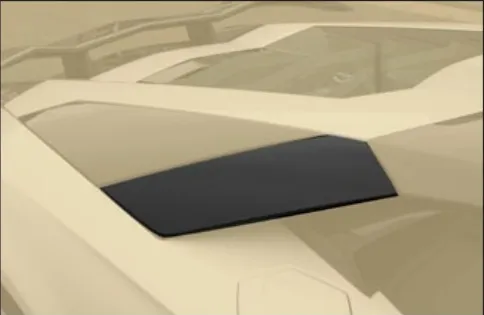
Replacement Air intake - front Mansory Carbon for Lamborghini Aventador Competition


Mansory Carbon Replacement Air Intake — Front for Lamborghini Aventador Competition
The replacement front air intake is the quietest piece in the Mansory Carbon Body Kit for Lamborghini Aventador Competition catalogue, and arguably the smartest one to start with. Where bumper kits and lips ask the owner to commit to a full aesthetic, this panel is a one-for-one swap: out comes the OEM black plastic intake louvre that lives in the lower corner of the factory front bumper, in goes a CFRP twin that bolts to the same captive nuts and clips, feeding the same brake-cooling duct and the same radiator core behind it. The Aventador's 6.5-litre naturally aspirated V12 leans hard on front-end thermal management — the front coolers sit ahead of the wheels, and the carbon-ceramic brakes need a clean column of cold air through corner one. This part keeps that plumbing intact while turning a previously matt-plastic surface into lacquered 3K twill that catches light against the scissor-door cuts and ALA-era nose geometry.
Construction & Materials
The panel is laid up as a structural skin with a perimeter mounting flange that mirrors the OEM stamping. Mansory uses prepreg 3K twill on the visible face, a unidirectional inner ply for stiffness across the duct opening, and a closed-cell core only where the geometry calls for crash energy absorption — most of the panel is a thin, rigid monolithic shell. The mesh aperture is shaped to keep the original mass-airflow geometry; nothing about the duct mouth is narrowed.
- Prepreg 3K twill outer ply, autoclave cured at 120 °C and 6 bar for void-free clarity
- Unidirectional 200 gsm reinforcement around the duct opening to resist torsional flex at speed
- Wall thickness 1.6–2.4 mm depending on zone (thinner at the visible flat, thicker at the perimeter flange)
- Net weight 0.55–0.7 kg per side — a meaningful drop versus the moulded thermoplastic original
- Stainless captive studs and clip-in tangs matched to the factory bumper hardware — no drilling, no helicoils
- Optional sintered stainless mesh or honeycomb grille insert behind the aperture, bonded with structural acrylic
- Choice of high-gloss UV-stable lacquer, satin matte, or untreated raw weave (raw requires recoating every 18–24 months)
- Edge sealing with self-amalgamating tape on the flange to prevent water ingress into the radiator return path
Design & Visual Function
Visually the part trades a uniform plastic louvre for a layered composition: a glossy carbon ring frames a mesh field, and behind the mesh a second twill weave is just visible under direct light. That interplay — mesh in the foreground, twill behind — is what gives the front corner its depth on a kitted Aventador. On a black or dark-grey car the effect is subtle and reads as factory premium; on a Bianco Isi or Verde Mantis car the carbon punctuates the painted surface and accentuates the forward rake of the SVJ-derived nose.
Functionally the duct routes ambient air to the carbon-ceramic brake rotor and, on cars with the upgraded radiator pack, contributes to the side-radiator feed. The brake-cooling channel inside the bumper is preserved exactly — the panel does not narrow the throat, does not introduce internal ribs that would shed turbulent flow onto the rotor face, and does not bias airflow to the centre. On SVJ cars the central ALA 2.0 channel sits well inboard of this aperture, so there is no interaction with the active aero map; ALA's flap-stall behaviour at the rear wing is unaffected.
Designers also use this panel as a transition piece between painted and raw-finish elements. Pair it with a painted bumper and the carbon reads as an accent; pair it with the carbon front add-on lip and it reads as a continuous lower-bodywork weave that flows from chin to wheel arch. The replacement nature of the part — drop-in geometry rather than an add-on stack — is what makes that visual cleanliness possible: there is no shadow gap, no exposed silicone bead, no second-surface seam.
Compatibility & Fitment
Lamborghini Aventador LP700-4, LP750-4 SV, S, SVJ, and Ultimae — coupé and Roadster, both sides of the front bumper. Pre-SVJ and SVJ bumper geometries differ at the lower corners, so the panel ships in two variants matched to the bumper the car wears. If the car already runs the Mansory front bumper, fitment is to the kit-specific aperture; if the car retains the factory bumper, fitment is to the OEM cutout. OEM parking sensors are not affected by this panel — the sensor pucks live further outboard. The brake duct hose stub behind the aperture is preserved with no modification. Cars with the optional carbon-ceramic brake package and the larger oil-cooler core both run the same intake panel — the change in cooling demand is handled by the duct downstream, not by this aperture.
Installation & Reversibility
This is one of the friendliest parts in the entire Aventador Competition programme to install. The OEM panel releases with two T20 Torx fasteners and four plastic clip tangs that pull rearward; the carbon replacement re-engages the same clips, accepts the same fasteners, and seats with a tactile click on the flange seal. Bench time is 25–40 minutes per side for a careful first-time installer, 15 minutes per side for a body-shop technician who has done it before. No paint or primer prep is required because the part arrives lacquered or in raw weave at the customer's choice. Reversibility is total: the OEM panel can be re-fitted at any point with no marks on the bumper and no residue on the captive studs. Because the Aventador's CFRP monocoque uses methacrylate adhesive elsewhere on the chassis, owners sometimes assume every panel is bonded — this one is not, it is a clip-and-screw part. Recommended workflow: clean the bumper aperture with isopropyl alcohol, dry-fit the carbon panel to confirm flange seating, bed the seal, then torque the Torx to the OEM specification and verify clip engagement by lifting the inner edge gently.
Pairing within the Mansory Aventador Competition programme
The replacement front intake is a foundational piece — quiet on its own, transformative as part of a triad. The most common pairing is with the Front bumper I Mansory Carbon, where the kit-specific bumper aperture and the carbon intake panel share the same weave run and read as a single moulding from a metre back. Owners who keep the factory bumper instead reach for the Front add-on lip Mansory Carbon, which clips below the chin and mirrors the intake's twill direction across the lower bodywork, giving the nose a continuous carbon hem without committing to a full bumper swap. For thermal symmetry — and for the cleanest visual signature on the rear corners — pair this part with the Replacement Air intake — rear Mansory Carbon, so the front and rear apertures share lacquer, weave alignment, and grille style. The rear sibling is the natural counterpart to the front intake and the two are quoted together more often than not.
Maintenance & Durability
Lacquered carbon at the front of the car takes the worst of the road's chemistry: salt spray, brake dust, insect impact at speed, and the occasional kerb-rash from a low-line nose. Care routine is the same that any 911 GT or McLaren owner already practises — neutral-pH shampoo, soft microfibre, a synthetic sealant or ceramic coat refreshed once a year, and absolutely no alkaline wheel cleaner allowed near the lacquer. Ammonia-based glass cleaner is also off the menu; it crazes the topcoat in months. Brake dust is best dealt with at the wheel itself, not by chasing fall-out across the carbon panel. Stone chips on the leading edge of the carbon ring are repairable with a clear UV-cure resin if caught early; deeper chips that breach the lacquer should go to a carbon refinisher who can feather the topcoat without lifting the weave. Engine-bay heat does not reach this part — it lives ahead of the wheel, far from the V12 thermal envelope — so the lacquer is not heat-cycled, which is why the panel typically outlasts the lacquer on rear-end carbon by a clear margin. Realistic lifespan is the lifespan of the car when properly maintained.
Lead Time & Warranty
Lead time runs 4–8 weeks from confirmed order, depending on Mansory production scheduling and the chosen finish; raw weave usually ships fastest, custom-tinted lacquer sits at the slower end. The panel carries a 12-month warranty against manufacturing defects covering layup voids, delamination, and fastener-thread integrity. Crash damage and stone-chip wear are not covered by the warranty but are repairable through Mansory's carbon refinishing channel.
FAQ
Q: Does this part fit a pre-SVJ Aventador or only the SVJ?
A: Both, with the correct variant. The pre-SVJ bumper aperture and the SVJ aperture differ at the lower corner; specify chassis VIN at order and the matching variant ships.
Q: Will it interfere with ALA 2.0 on the SVJ?
A: No. ALA 2.0 routes air through the central rear-wing channel and the underbody; the front intake aperture sits well outside the ALA path and does not change the active-aero map.
Q: Can the OEM panel be re-fitted later?
A: Yes, completely. The carbon replacement uses the same captive studs and clip tangs as the OEM panel, so reverting takes minutes and leaves no marks.
Q: Does the mesh restrict airflow to the brake duct?
A: The aperture is sized to match or exceed the OEM louvre opening, and the mesh option is sintered stainless with a high open-area ratio. Brake-cooling and radiator-feed flow are preserved.
Q: Raw weave or lacquered finish — which lasts longer at the front of the car?
A: Lacquered. Raw weave looks closer to factory carbon-fibre marketing photography but needs a topcoat refresh every 18–24 months, especially at the front where insect impact and stone chips are routine. Lacquered carbon will hold for years with normal care.
Pair the front replacement intake with the matching rear intake and the front add-on lip for a clean carbon hem across the entire lower body. Order, finish selection, and chassis-specific fitment via WhatsApp +44 7488 818 747 or [email protected].