
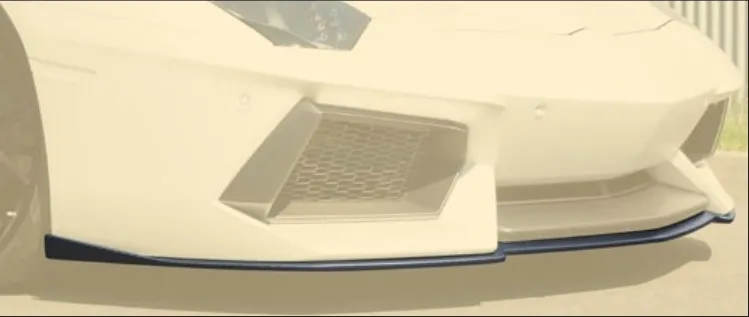
Front add-on lip Mansory Carbon for Lamborghini Aventador Competition


Mansory Carbon Front Add-On Lip for Lamborghini Aventador Competition
The front add-on lip is the lowest, most exposed carbon element on the Aventador's nose — a bonded blade that hangs ahead of the bumper's lower lip, tugging the stagnation point downward and feeding more pressurised air beneath the chassis floor. Inside the wider Mansory Carbon Body Kit for Lamborghini Aventador Competition, this piece is the surgical addendum: it does not replace bumper sheet metal, it grafts onto it. Owners specify it because the SVJ-derived front fascia is already aggressive, but the Competition lip pushes the visual centre of gravity another finger-width forward, and on a naturally aspirated V12 with rear-wheel steering and aluminium-CFRP monocoque architecture, even a small front-axle bite shift makes the chassis feel sharper at corner entry without disturbing the ALA 2.0 channel that lives further back.
Construction & Materials
The blade is laminated as a single shell with an internal foam core that gives it stiffness against road-debris flutter at autobahn cruise. Mansory presses the visible face in 3K twill so the weave reads cleanly across the slim aspect ratio of the lip, then sheaths it in a UV-stable two-component lacquer that resists the stone-rash this part will inevitably absorb. The leading lip edge is doubled in cloth — an under-layer sacrificial weave plus the show-face — so a kerb scuff abrades the inner ply first and gives the show face a chance to survive.
- Show face: 3K twill prepreg, weave aligned along chord
- Sub-laminate: 2x200 gsm carbon biaxial under the leading edge
- Cure: autoclave, 6 bar / 130 °C cycle
- Wall thickness: 1.6–2.2 mm at trailing flange, 3.0 mm at leading lip
- Weight: ~1.4 kg painted, ~1.2 kg raw
- Finish: high-gloss lacquer (default), matte clear, or raw weave with anti-UV impregnation
- Hardware: methacrylate adhesive bead + four M6 stainless captives
- Substrate prep: included alcohol wipe pack, primer pen, mixing nozzle for adhesive cartridge
Design & Visual Function
Two things separate this lip from a generic carbon splitter. First, the chord: it follows the bumper's lower mouth contour with a 6–9 mm offset, never crashing into the brake-cooling ducts that feed the front rotors. Second, the dihedral: the blade is not flat but mildly cambered, dropping toward the centreline by roughly 8 mm so that yaw-induced side flow spills outward rather than tumbling under the floor. The visible result is a forward jaw that reads sharper from a low three-quarter angle, which is exactly the photographic position the Aventador's wedge profile rewards.
From a paint-break standpoint, the lip is where bodywork meets road. Specifying raw weave here, even when the bumper above it is colour-matched, is the cleanest aesthetic choice — the lacquered carbon then serves as a horizontal datum line that the eye reads as a shadow, lengthening the car visually. If the donor car is a launch shade like Verde Mantis or Rosso Bia, that horizontal carbon datum reinforces the wedge silhouette. If the bumper is body-colour and the lip is gloss-painted in matching shade, you lose that effect but gain visual mass at the prow — both are valid, the choice depends on whether the owner wants the car to look longer or heavier.
Front-axle aero behaviour is the functional payoff. By extending the front floor tunnel inlet length, the lip raises ground-effect contribution at the nose. On a pre-SVJ Aventador without ALA, the trade is straightforward — more front download, a touch more induced drag, slightly higher front tyre temperature on long laps. On an SVJ, the lip's contribution stacks under ALA's static balance map, so when ALA opens its rear stalk for low-drag mode, the front retains more of the static download than it would without the lip — useful on circuits with long fast straights bookended by hard braking zones.
Compatibility & Fitment
Two geometries are supplied. The pre-SVJ blade fits LP700-4 and S coupé/Roadster with the OEM front fascia or the Mansory Front Bumper I/II — the bumper lower edge profile differs subtly, and the lip's mounting flange is cut to match. The SVJ/Ultimae blade respects the SVJ's reshaped lower bumper and the central front intake that feeds the radiator pack — it does not block the ALA-related front flap channel, which on SVJ is a small static surface ahead of the wheel-arch liner. Parking-sensor positions are unaffected because the lip mounts below the sensor band. Front-lift hydraulics, where fitted, retain their stroke envelope: a lifted nose still clears a 14 % ramp at standard creep speed.
Installation & Reversibility
This is one of the simpler Mansory carbon parts to fit, but the prep is unforgiving. Time budget is 2.5–4 hours including cure. The bumper's lower flange is degreased with isopropanol, scuff-sanded with a maroon abrasive, then wiped again. A primer pen activates the painted bumper substrate so the methacrylate two-component adhesive can bond to clearcoat — you cannot skip this step, the structural acrylate chemistry needs an open hydroxyl on the lacquer or it just sits on top. The adhesive bead is laid in a 6 mm continuous line along the upper flange, and the four M6 captives are torqued to 8 Nm into pre-existing OEM bumper threads (no drilling). Open time is roughly 7 minutes at 20 °C, full handling strength at 90 minutes, full cure at 24 hours.
Reversibility is good but conditional. Because the methacrylate bonds chemically to the lacquer rather than the underlying primer, removal is done with a mono-filament cutting wire fed behind the bead — the wire severs the acrylate cleanly and leaves the bumper paint intact 90 % of the time, with light buff-out needed on the remainder. The four M6 captives back out without trace. Kerb-impact reversibility is the more relevant scenario: the lip is a sacrificial element by design. A heavy kerb strike at low speed will craze the show face but will not transfer load into the bumper sheet because the methacrylate flexes before it transfers shear. Replacement of the lip alone is a 90-minute job with the same prep cycle.
Pairing within the Mansory Aventador Competition programme
The lip is rarely specified alone. The most coherent visual stack pairs it with one of the front bumpers: Front bumper I for owners who want a more chiselled mouth without going to the Competition's most aggressive face, or Front bumper II when the brief is the full Carbonado-language nose treatment. With Front bumper II, the add-on lip extends the bumper's lower jaw forward by another 25 mm and the two pieces read as one continuous carbon mass.
For owners running the kit's replacement front air intake, the lip directs incoming air around and beneath the intake plane, leaving the intake's own pressure recovery untouched. The combined assembly — front bumper, intake, and lip — gives the Aventador's prow three vertically stacked carbon layers, each performing a distinct aero job, and reads as a coherent design rather than a parts-bin pile-on.
Maintenance & Durability
The lip lives where stones, salt and bug-strike concentrate. Wash with pH-neutral shampoo and a soft mitt; rinse before contact to flush grit. A ceramic coat refreshed every 12–18 months is the simplest defence — it sheds tar more easily than carnauba and resists the alkaline tunnel-wash chemistries that haze lacquered carbon. Avoid ammonia-based glass cleaners drifting onto the lip, and never use scouring sponges. UV degradation shows as a yellow shift in the lacquer rather than weave damage; gloss-painted lips age by clearcoat micro-marring on the upper face from wash cycles. Chip repair on the show face is a body-shop operation: feather-edge the chip, fill with clear UV-cure resin, level with 3000–5000 grit, machine polish. Done right, a stone chip on a lacquered lip is invisible from arm's length.
Lead Time & Warranty
Lead time is 4–8 weeks from order confirmation. Mansory builds carbon parts in measured batches rather than from stock, and the lip's two geometries (pre-SVJ, SVJ/Ultimae) are layed up to order with the requested finish. A 12-month manufacturer's warranty covers laminate defects, lacquer adhesion, and adhesive system performance under normal road use. Kerb damage, stone-chip surface marring, and accident impact are not covered — the lip is, by intent, a part you will replace once or twice in the car's life.
FAQ
Q: How much front download does the lip actually add?
A: Independent CFD on similar splitter geometries shows roughly 10–18 kg of front-axle download at 200 km/h on a non-ALA Aventador. On SVJ with ALA static, the swing is smaller in absolute terms but the front balance under low-drag ALA mode improves measurably.
Q: Will the lip affect ground clearance?
A: Yes — it lowers the front edge by approximately 18–22 mm depending on bumper. On cars with front-lift hydraulics this is a non-issue at parking speed. Without front-lift, expect the lip to scrape on steep driveways and speed humps; the sacrificial leading edge is designed for this.
Q: Can I bolt it on without the methacrylate adhesive?
A: Mechanically the four M6 captives hold the lip in place, but without the adhesive bead the upper flange will flutter at speed and the front face will not seal against the bumper, killing the aero benefit. The bonded joint is integral to the design.
Q: What happens if I kerb it badly?
A: The lip is sacrificial. A heavy kerb strike will craze or split the leading edge but the methacrylate joint will flex before it transfers load to the bumper. Replacement of the lip alone is straightforward — the bumper paint is preserved.
Q: Does the same lip fit pre-SVJ and SVJ?
A: No. Two distinct geometries are supplied because the SVJ's lower bumper line and central intake reshape changed the mounting flange. Specify by chassis: LP700-4 / S = pre-SVJ; SVJ / SVJ Roadster / Ultimae = SVJ geometry.
Q: Raw weave or painted?
A: Raw lacquered weave is the most common spec — it creates a horizontal carbon datum line that lengthens the car visually. Body-colour paint matches a body-colour bumper and adds visual mass at the prow. Both are correct; the choice is aesthetic, not functional.
Pairs naturally with the front bumpers and the replacement front air intake to complete the Aventador Competition's three-layer carbon prow. To configure the lip's geometry, finish, and adhesive kit for your chassis, message WhatsApp +44 7488 818 747 or [email protected].