Performance wing EVO Mansory for Lamborghini Urus Venatus


Mansory Performance Wing EVO for Lamborghini Urus Venatus
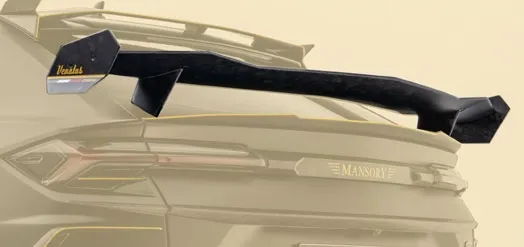
The Performance Wing EVO is the apex aero piece of Mansory's Mansory Body Kit for Lamborghini Urus Venatus S programme — a large pedestal-mounted carbon rear wing engineered to add genuine downforce to the rear axle of the twin-turbocharged V8 super-SUV. It sits proud above the rear deck on a pair of swan-neck-style carbon pedestals, the airfoil clear of the boundary layer that crawls along the OEM tailgate. Owners specify the EVO wing when the car is built around the rest of the EVO race-flap front aero, when the Performante's already-aggressive personality wants visual escalation, or simply when nothing less than the Venatus EVO statement will do. Urus runs no movable rear-aero system, so the wing is a pure passive aero device — no constraint, no compromise.
Construction & Materials
The wing is a fully autoclave-cured pre-preg construction. The airfoil is a hollow monocoque with internal ribs supporting a closed upper and lower skin; the pedestals are solid laminate where they bolt to the rear deck, transitioning to a hollow blade section higher up.
- Large airfoil + pair of pedestals — pedestal stance is what gives the wing its swan-neck silhouette and clears the airfoil from rear-deck boundary-layer turbulence.
- 3K twill carbon-fibre pre-preg, autoclave-cured at controlled temperature and pressure for optimal fibre-volume fraction.
- Approximate finished mass 6–9 kg depending on pedestal height and finish — well below an aluminium-cored OEM-style wing of equivalent chord.
- Mounts to the OEM rear-deck panel with a stainless-steel reinforced backing plate that spreads load into the body's transverse bulkhead.
- Pre-tensioned through-bolts torqued to spec; thread-locker applied; gasket seals between pedestal foot and painted body panel.
- Finishes available — Mansory deep-gloss UV-clear lacquer over visible 3K twill, matte UV-clear, or supplied primed for body-colour or contrast paint.
- Wall thickness 1.6–2.4 mm in the airfoil skin; pedestal solid laminate up to 6 mm at the foot for bolt-bearing strength.
- Hardware kit — torque values specified in the installation document, gaskets and backing plate included.
Design & Visual Function
The Performance Wing EVO is the rear-axle counterweight to the front-axle aero of the Venatus programme. Pair it with race flaps at the front canard line or the EVO race flaps for the front lip and the Urus develops a balanced front-to-rear downforce signature — at autobahn speed the rear axle is loaded, the V8 BiTurbo punches through the air without tail-end lift, and the steering stays weighted. Pair the wing alone, without front canards, and the balance shifts rearward — fine for a stable car but not the intended spec; the EVO programme is designed as a matched aero kit.
Pedestal height is tunable at order time — taller pedestals lift the airfoil into cleaner air for more downforce coefficient; shorter pedestals tuck the wing closer to the deck for a less-extreme silhouette. Mansory typically ships a default height that suits both Urus / Urus S body lines and the Performante; if you have a specific track-day or autobahn brief, declare it and the build can be tuned accordingly. The wing's chord, span and angle of attack are fixed at the EVO geometry — a known-good profile that's tuned for the Urus's frontal area, ride height and aero map.
Visually it is the most aggressive piece in the Mansory Urus aero menu. The airfoil sits above the roof line at the leading edge of the rear glass; the pedestals frame the centre of the rear deck like a podium. Combined with the high-performance roof spoiler and a quad-tip exhaust the rear three-quarter view becomes pure motorsport-derived theatre. With no movable rear element to consider on Urus, the wing is fixed-geometry — every kilometre at every speed it is doing the same job, deterministically, at the angle of attack the engineer specified. That predictability is part of why the EVO wing is favoured over softer rear spoilers among owners who actually drive their Urus hard.
Compatibility & Fitment
Designed for the full Lamborghini Urus / Urus S / Urus Performante line, 2018 to present. The Venatus parts retrofit across the line — the slug uses the generic Venatus naming and the wing's pedestal footprint is shared across the body-shell variants. A reinforced backing plate is mandatory underneath the OEM rear-deck panel — this is not a job for a generic detailer, it is a body-shop fit. There is no movable rear-aero element on Urus to clear, no controller to recalibrate, no software intervention required. Adaptive air-suspension self-levelling is unaffected; rear-wheel-steering geometry is unaffected; OEM parking sensors remain operational since none are on the rear-deck panel; the six driving modes — Strada / Sport / Corsa / Sabbia / Terra / Neve — behave exactly as before, with the wing simply contributing passive rear-axle downforce at every mode and speed.
Installation & Reversibility
Plan on 4–6 hours in a body shop with a paint-shop bay if the wing is supplied primed and needs colour-matching to the car's body or to a contrast palette. Workflow — drop the rear deck weatherstrip, fit the reinforced stainless-steel backing plate from inside the trim cavity, mark and drill the four pedestal holes through the OEM panel using the Mansory drill template, apply gasket and primer to drilled edges, set the wing on the gasket, torque the through-bolts to spec, refit trim. The visible-carbon and pre-lacquered finishes ship ready-to-fit; the primed finish ships ready-for-paint and adds a half-day in the booth.
Reversibility — the wing comes off whenever you want, but the four through-holes in the rear-deck panel and the backing-plate footprint remain as witness marks. A body shop can re-skin the OEM panel or supply a replacement deck panel if you ever resell to a stock-spec buyer. For most owners the wing stays on for the life of the car. DIY install is not recommended — the drilling, the backing-plate fit, the gasket and the torque sequence reward professional hands.
Pairing within the Mansory Urus Venatus programme
Front-rear aero balance is the priority pairing. Specify the EVO wing alongside Race flaps carbon as front canards, or step up to EVO race flaps for front lip for the matched-EVO front geometry — that is the canonical Venatus EVO aero spec, a balanced front-rear downforce signature that suits both autobahn miles and trackday-style use. For an even denser roof-to-deck stance add the High-performance roof spoiler — it cleans the airflow leaving the roof so the EVO wing's airfoil sees a less turbulent freestream. Owners who want the EVO statement without a separate decklid lip can also consider Rear decklid spoiler as a complementary lower-deck element.
Maintenance & Durability
The wing lives in the highest-airflow, highest-UV zone on the car — it sees more sunlight per kilometre than the bonnet because it is unshaded at every angle. Apply a quality ceramic coat to the lacquered carbon and refresh annually; the ceramic shrugs off bug strikes, brake-dust haze and the soft acid in rain. Avoid alkaline degreasers, ammonia-based glass cleaners drifting onto the wing, and any abrasive sponge — these are what kill UV-clear coats faster than UV itself. Rinse before any contact wash, two-bucket method, plush microfibre.
Bonding integrity — inspect the pedestal-foot gasket annually and after any high-pressure-wash session aimed at the rear deck. If you see lacquer hazing at the pedestal foot (a sign of micro-flex), get the torque rechecked. The autoclave laminate itself is service-free — carbon's fatigue life at this stress level is essentially indefinite. If the airfoil chips on a stone strike or trolley contact, a Mansory-trained body shop can lay-in a localised patch or, for a clean repair, re-skin the affected face. Lacquer-only damage is even simpler to fix.
Lead Time & Warranty
Lead time 4–8 weeks from order to dispatch — Mansory builds the wing to spec, including pedestal height and finish choice, and the autoclave cycle plus QA cannot be rushed. Twelve-month warranty against manufacturing defects covers laminate integrity, finish defects out of the box, and hardware. Stone chips, trolley impacts, paint-shop colour-match issues from third-party body-shops, and torque drift from missed-service bolts are owner-side responsibility.
FAQ
Q: Is the downforce a real number or a styling number?
A: Real. The EVO wing is profiled and ramped to add measurable load on the rear axle at autobahn speeds — it is not a decorative wing. Mansory does not publish a Cl figure publicly because aero numbers are body-state-dependent (ride-height, paint, attitude), but the airfoil section and pedestal height are chosen for a known-good downforce contribution at 200+ km/h.
Q: Will it cost me top speed?
A: A pure-passive wing trades drag for downforce — yes, you will see slightly higher drag at full chat than the OEM lip. The trade-off is intentional. The Urus's V-Max is rarely the brief; stability at autobahn cruise and track-style use is. If your priority is the absolute V-max number, choose the rear-decklid spoiler or the high-performance roof spoiler instead, which are far less aggressive aero pieces.
Q: Will it fit my Urus / Urus S / Performante?
A: Yes — the wing's pedestal footprint and rear-deck attachment are shared across all three. Mansory ships a fitment kit appropriate to your VIN-coded body shell, and a reinforced backing plate is included regardless of variant. The body-shop install workflow is the same in each case.
Q: Can the wing be repaired if it chips?
A: Yes. Lacquer-only chips polish or fill in. Through-clear-coat chips into the weave are repaired by a Mansory-trained body shop with localised lay-in and refinish. Severe airfoil damage from impact is treated as a panel re-skin or replacement — slower and costlier, but possible.
Q: How long is the lead time and can I get matching paint?
A: 4–8 weeks lead time. Yes — order the wing primed, ship it to your local Lamborghini-certified or Mansory-trained paint shop along with the body code, and they will match exactly. Or order the lacquered visible-weave finish for the canonical Venatus EVO look.
Pair the EVO wing with EVO race-flaps front and the high-performance roof spoiler for the canonical balanced Venatus EVO aero spec. To configure pedestal height, finish, and matching front aero, get in touch — WhatsApp +44 7488 818 747 or [email protected].