Mansory Carbon Fiber Body kit set for Porsche 911 991


MANSORY for the Porsche 911 (991) — wide programme spanning 991.1 and 991.2
The 991 is the seventh-generation 911, in production at Porsche Zuffenhausen between 2011 and 2019, before the 992 generation replaced it. The 991 ran across two production phases: 991.1 (2011-2015) carrying the naturally aspirated 3.4 / 3.8 flat-six on Carrera variants and the 3.8 twin-turbo on Turbo trims; 991.2 (2015-2019) replacing the Carrera engine line with a twin-turbo 3.0 flat-six and retaining the 3.8 twin-turbo on Turbo / Turbo S. Mansory's programme is dimensioned to fit both phases on a single part-number set — bumper architecture stayed largely consistent across the facelift, and the bonded fender flares are common to both phases.
Adjacent Porsche 911 programmes: 991 Turbo full carbon set, 992 Turbo S aero, 997 Turbo, 997 Carrera Facelift. Other Porsche siblings: Cayenne 958, Panamera 971, Taycan, Macan.
One kit covers both 991.1 and 991.2 — why
Porsche's 2015 facelift on the 991 changed the Carrera engine architecture (NA 3.4 / 3.8 flat-six replaced by the twin-turbo 3.0 flat-six) but bumper architecture stayed nearly identical between the phases; headlamp signature carried only minor revisions; fender geometry was unchanged. Mansory's kit dimensions to the shared fender geometry, with bumper-level fitment that respects both phase hardpoint patterns. The rear-bumper exhaust pass-through is the only variation — twin-tip on Carrera, quad-tip on Turbo / Turbo S.
| Spec | 911 Carrera S 991.2 | 911 Turbo S 991.2 | Turbo S + Mansory Powerbox |
|---|---|---|---|
| Engine | 3.0 flat-six twin-turbo | 3.8 flat-six twin-turbo | 3.8 + Mansory Powerbox |
| Power | 420 PS / 500 Nm | 580 PS / 750 Nm | ~660 PS / ~830 Nm |
| 0-100 km/h | 3.9 s | 2.9 s | ~2.7 s (estimated) |
| Top speed | 308 km/h | 330 km/h | 330 km/h (limit retained) |
| Curb weight | ~1 460 kg | ~1 600 kg | ~1 560 kg (carbon parts net) |
| Wheel (OEM) | 20" cast / forged | 20" forged | M-series 21" forged |
Component schedule — every Mansory piece on the 991 body
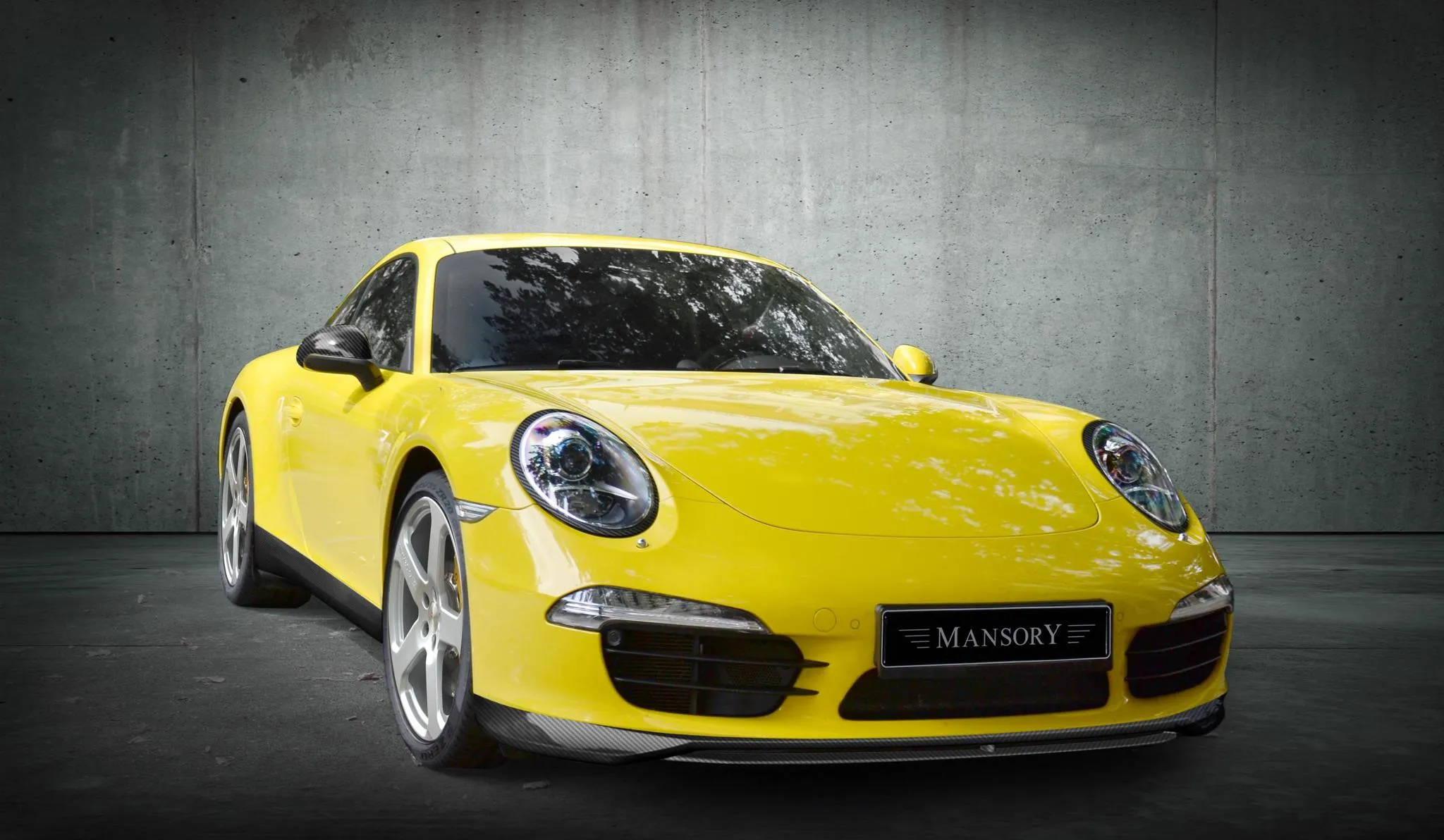
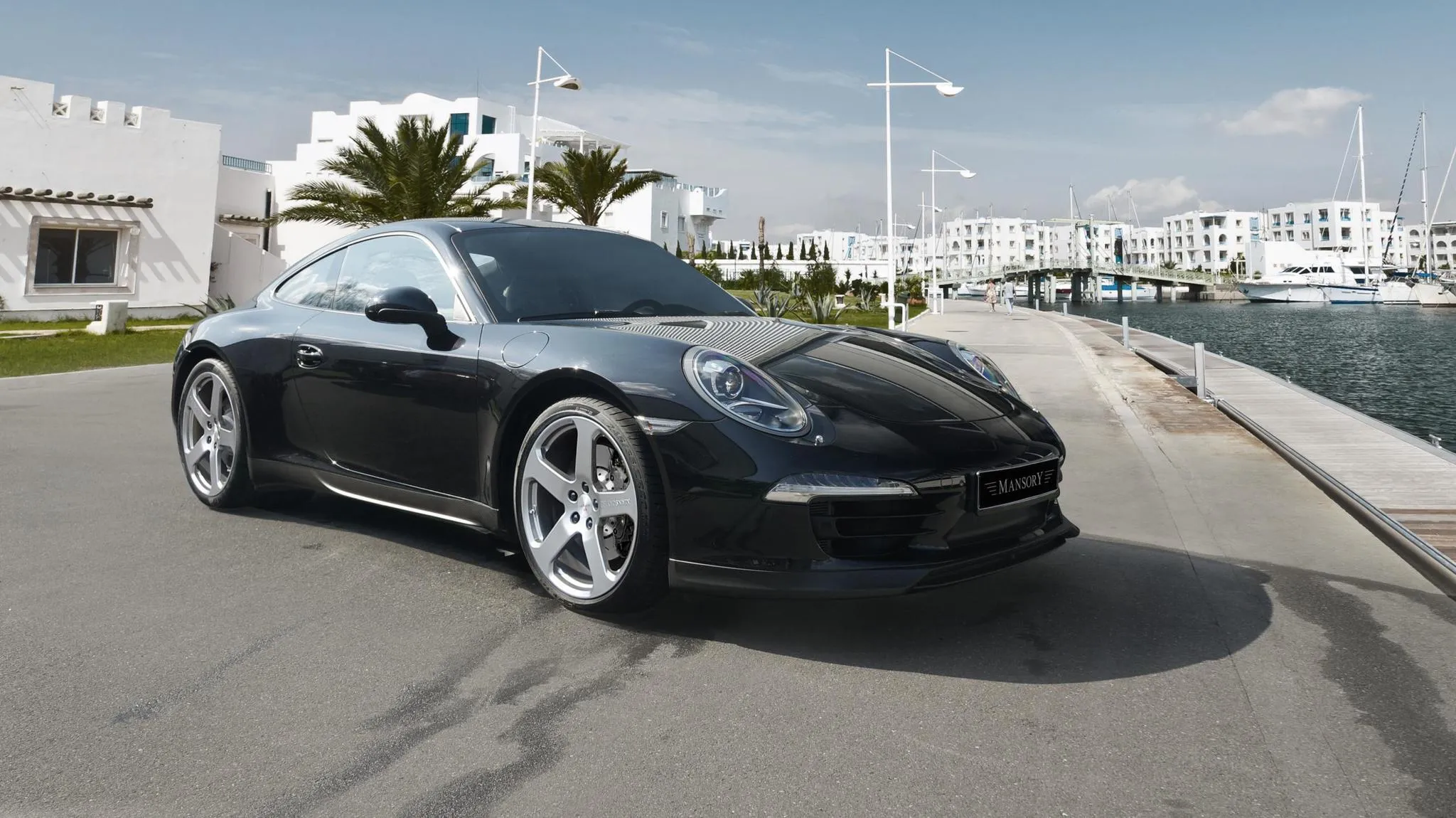
Comprehensive carbon body conversion. OEM bumpers replace; OEM bonnet (front trunk lid on the rear-engined 911) replaces; fenders are cut back and bonded with composite flares — permanent at the fender level. Hand-laid 2x2 twill on visible pieces, PU-RIM composite on bumpers and flares; dry-carbon upgrade quoted on bumper assemblies.
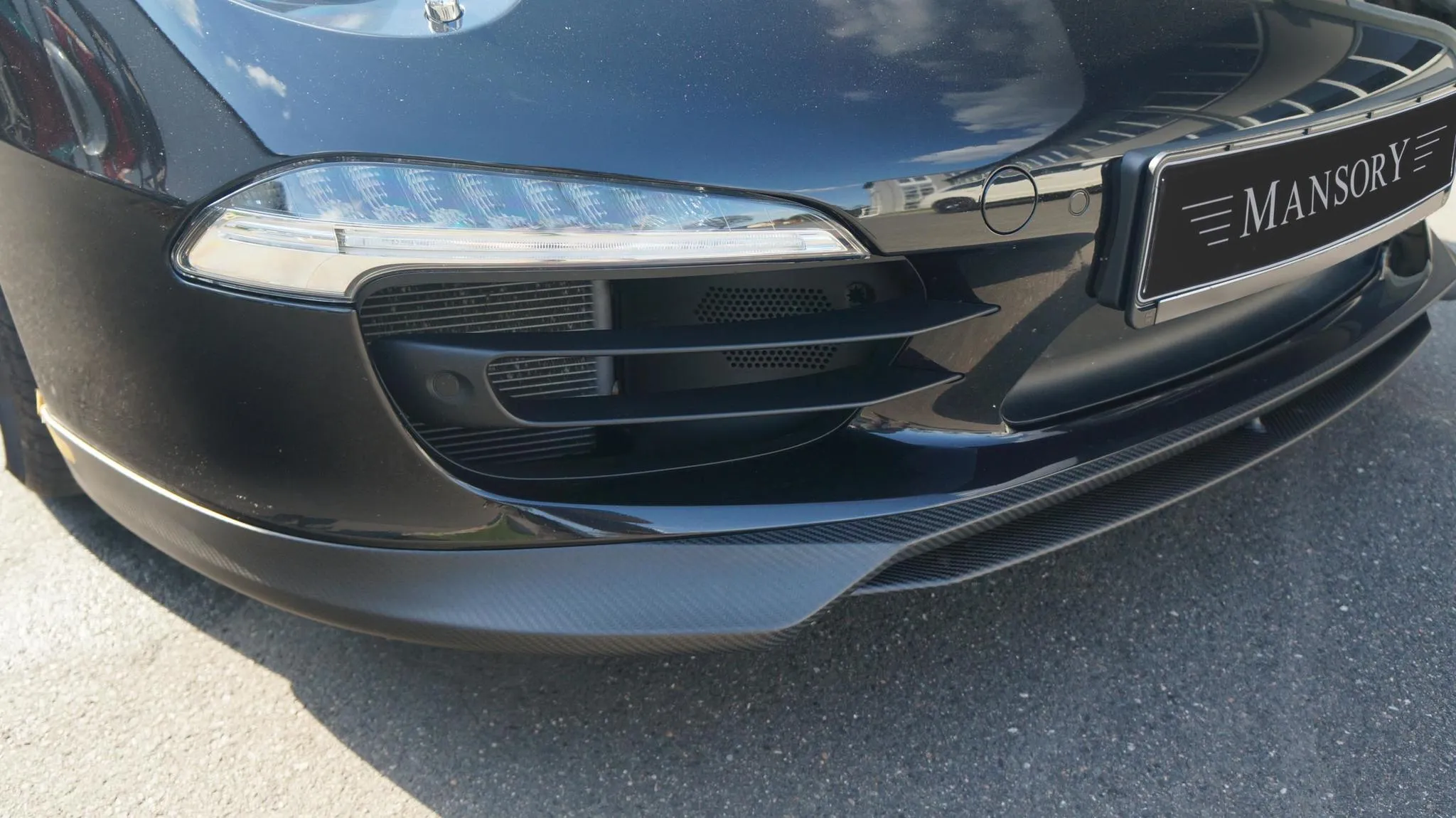
- Replacement front bumper — full carbon, revised intake geometry, integrated splitter, brake-cooling cuts. OEM headlamp pass-through retained for both 991.1 and 991.2 phase headlamps.
- Vented carbon bonnet (front trunk lid) — full carbon replacement with two functional NACA cuts.
- Bonded fender flares — front and rear, +25 mm per side at the front axle, +30 mm per side at the rear; dimensioned to clear the matched 21" forged stagger. The flare extension preserves the 991's signature shoulder line into the door reveal.
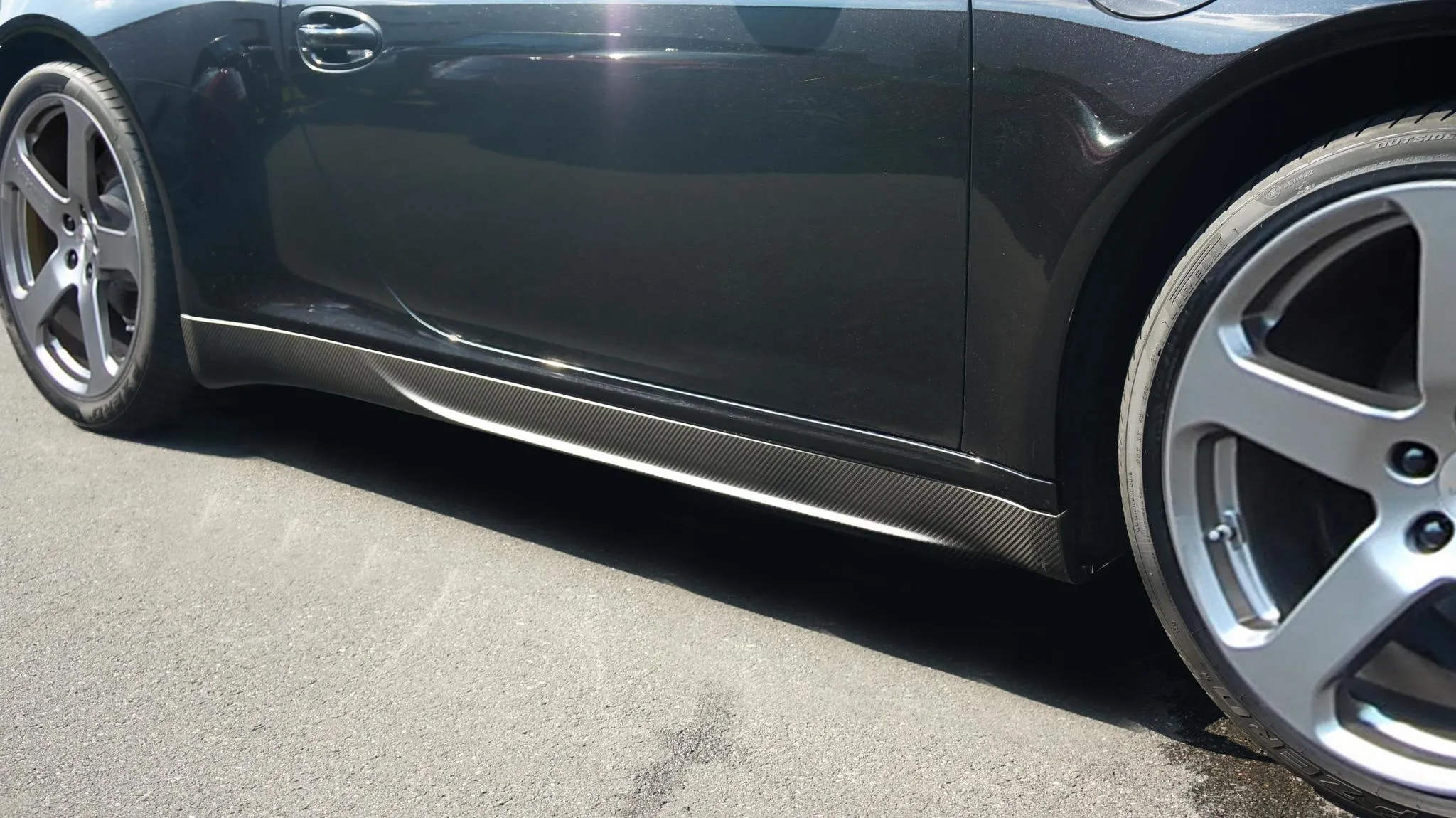
- Carbon side strakes and side skirts — shoulder pieces bridging the front and rear flares; OEM rocker preserved.
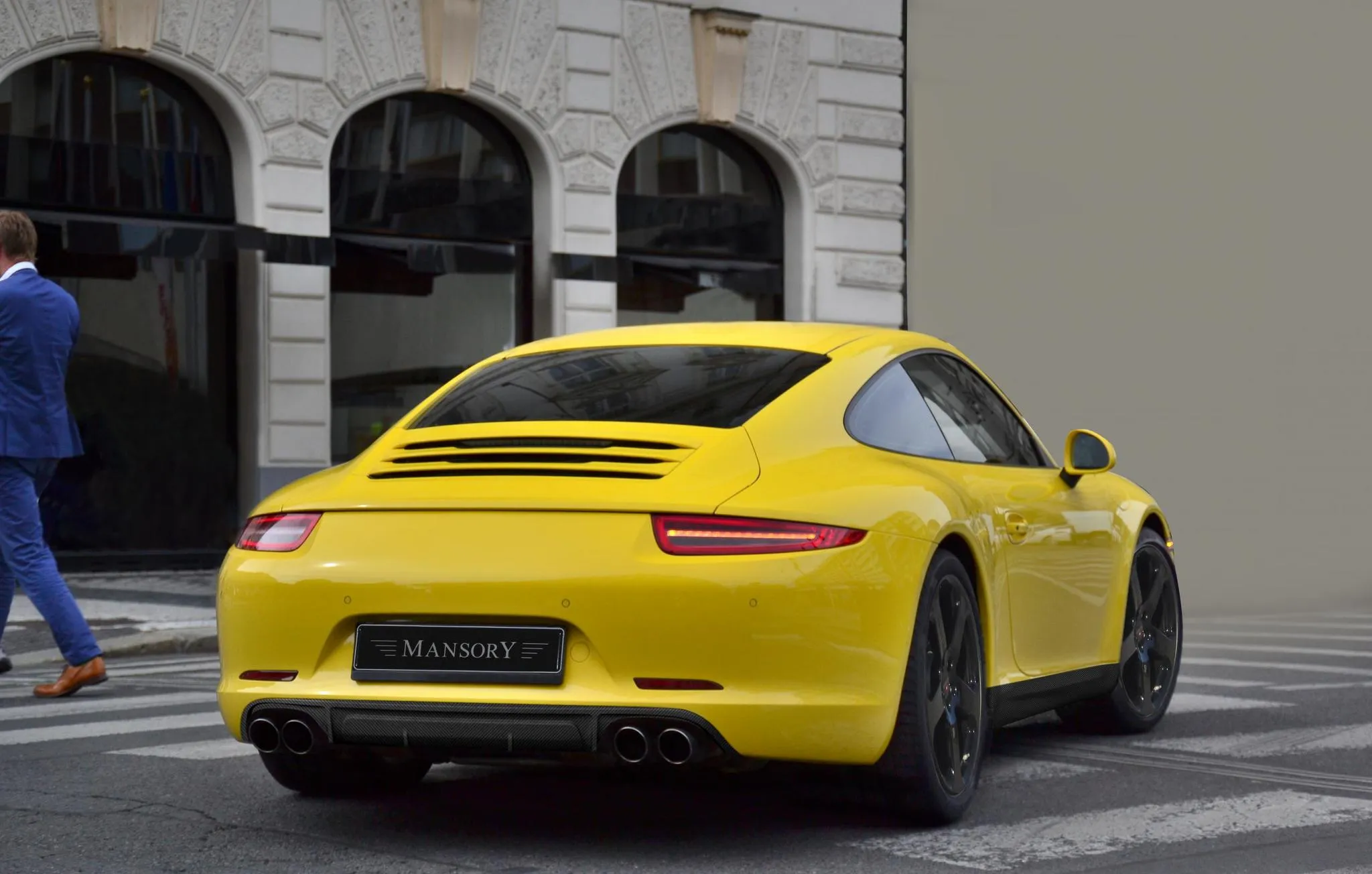
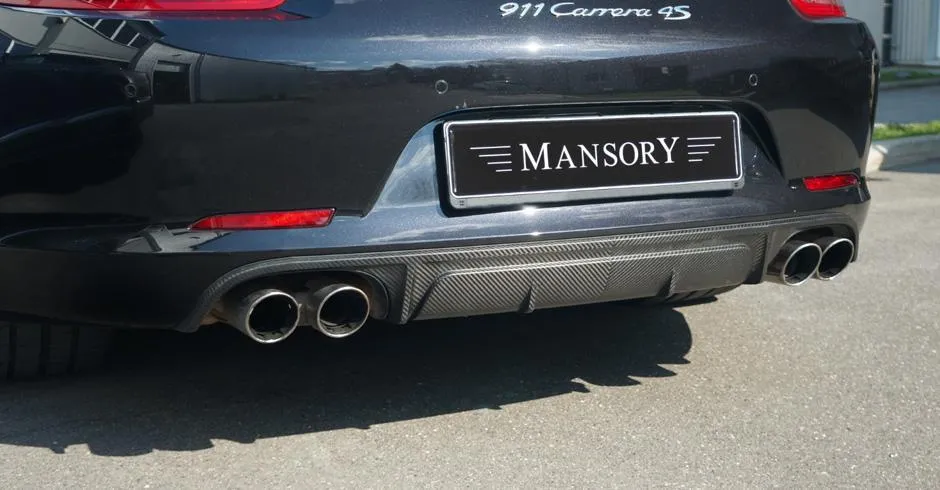
- Replacement rear bumper — full carbon with integrated diffuser; exhaust cutout dimensioned to donor variant (twin-tip on Carrera, quad-tip on Turbo / Turbo S).
- Two rear-aero options — fixed carbon rear wing on swan-neck mounts (Turbo / Turbo S spec) or extended carbon decklid that overlays the OEM 991 active wing electronics (Carrera spec). Owners specify the option at order.
- Mirror caps in visible weave overlay.
Powerbox + sport exhaust — Turbo donors only
The Mansory Powerbox is offered on the 991.2 Turbo and Turbo S only. Stock Turbo S makes 580 PS / 750 Nm; with the Powerbox plus Mansory sport exhaust the channel rises to roughly 660 PS / 830 Nm. The 991 Carrera donors (NA 991.1 and twin-turbo 991.2 alike) are not catalogued for a Powerbox — Carrera owners who want power gains run that conversation through TechArt or Manthey-Racing rather than Mansory.
Wheels — M-series forged 21" stagger
Matched fitment is the Mansory M-series fully forged 21" wheel in stagger optimised for the 991's rear-engine weight distribution. OEM 991 wheel runs 20" cast on entry Carrera to 20" forged on Turbo S; the 21" forging adds an inch and trims approximately 4 kg of unsprung mass per corner. Tyre fitment: 245/35 R21 / 305/30 R21. Patterns: FV.5, YN.5, M.7. Diamond black, polished silver, gun metal, Mansory bronze, paint-to-sample. Clears OEM Porsche carbon-ceramic brakes on Turbo S without spacers. Forged catalogue: hodoor.world/collection/forgedwheels.
Donor scope — 991 only
The kit fits the 2011-2019 Porsche 911 (991) in 991.1 and 991.2: Carrera / S / 4 / 4S (Coupe and Cabriolet); Targa / Targa 4 / Targa 4S (rear-deck spoiler kick is omitted on Targa builds); Turbo / Turbo S. Cabriolets share fitment with Coupes up to the windowline; rear-deck spoiler is Coupe-only and Cabriolet builds run the extended decklid option instead. The kit does not fit the 991 GT3 / GT3 RS / GT2 RS (different fender geometry), the 992 generation (separate part-number set), or the earlier 997 generation (different chassis).
Where the 991 kit ships in 2026
The 991 sits in a price bracket that suits aftermarket carbon language well, with strong used-market activity across European, Asian and Gulf buyers.
- UAE dominates the 991 order book — Dubai and Abu Dhabi 991.2 Turbo S commissions often run with the Powerbox bundled.
- Hong Kong and Macau serve the Asia-financial corridor — Turbo S leads, usually with the extended decklid rather than the fixed wing.
- United Kingdom takes a steady mid-volume share via Mayfair-and-Surrey commissions; UK 991 owners more often specify the Carrera variant with the extended decklid.
- Monaco ships small-volume Cabriolet commissions; 991 Targa is more common in the Swiss Alpine corridor.
- Tsar programme closes the CIS lane on Turbo donors typically bundled with the Powerbox; Japan closes the Asian tail with body-only specifications to remain within inspection-regime tolerance.
Build sequence & lead time
Carbon panel manufacture: four to five weeks from confirmed deposit. Body-shop install: 10 to 14 working days. Powerbox: four weeks where applicable. Forged 21" wheel set: four weeks. Email [email protected] with the 991 VIN, donor variant, phase (991.1 / 991.2), body style and OEM Porsche paint code; WhatsApp +44 7488 818747 for fastest landed-quote calculations. Care notes for the lacquered carbon parts: carbon fibre care guide.
FAQ
Will the kit fit a 992-generation 911?
No. The 992 launched in 2019 with redrawn bumpers, a wider Carrera body and different fender geometry. A separate 992 part-number set covers the new generation; the 992 Turbo S has both an aero-kit programme and a full widebody programme listed in the catalogue.
Is the Mansory wing legal for road use?
Yes. The fixed rear wing is a road-legal aero element — swan-neck mounts route through reinforced carbon load points on the OEM 991 rear deck and the wing sits within standard EU pedestrian-impact envelope. Mansory supplies ABE / certificate-of-conformity documents on request.
Can the kit be run on a 991 GT3 or GT3 RS?
Not as a catalogue order. GT3 / GT3 RS use different fender geometry (wider rear arches, vented front fenders on the RS) that the Mansory 991 kit does not align on. GT-car builds are bespoke commission only.
Fixed wing vs extended decklid?
Fixed wing is a downforce element on swan-neck mounts — appropriate for Turbo / Turbo S aggressive builds. Extended decklid is a body-coloured or carbon overlay extending the OEM rear deck without a separate wing — appropriate for Carrera. Cabriolets require the extended decklid; fixed wing is Coupe-only.
Is the Powerbox safe on the 991.2 Turbo S?
The 991.2 Turbo S sits at the upper end of factory tune but the 3.8 twin-turbo flat-six has demonstrated tuning headroom — TechArt and Manthey-Racing run higher-output variants in customer programmes. The Powerbox at +80 PS maintains engine longevity on regular service intervals; the module is reversible and does not modify the OEM ECU mapping.