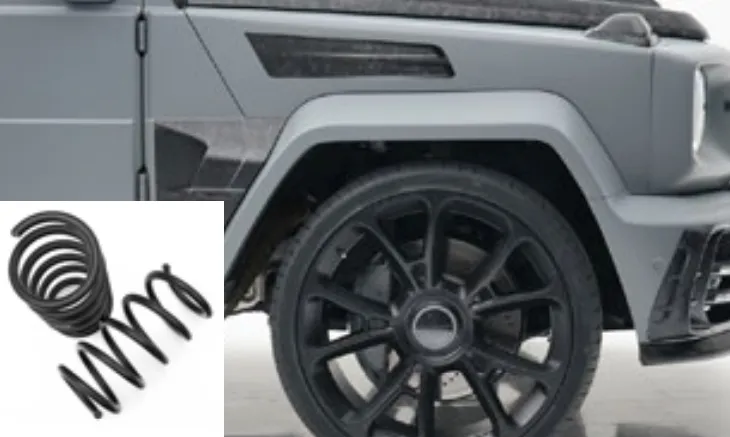
Lowering for G-Class


Mansory Lowering for Mercedes-Benz G-Class W465 Gronos — AIRMATIC Re-Coding and Link-Arm Engineering for the Air-Suspended Chassis
The G-Class is a vehicle defined by its ride height. The factory geometry is set for off-road approach, departure and breakover angles, with an air-suspension envelope that lifts the body further on demand and lowers it for highway running. On the new W465 generation the chassis architecture has changed in ways that matter for any lowering project: the front end runs a fully independent multi-link with single-chamber air struts, the rear retains a solid axle but on a more sophisticated air-spring layout with revised linkage geometry, and ride height is governed by an electronic control module that reads four ride-height sensors and commands the compressor, valve block and damper-rate solenoids to maintain the requested level. The Mansory Lowering kit for the W465 Gronos is engineered to drop that chassis correctly — to express the wider track and the broader fender flares of the Gronos build, to balance the visual mass of the body kit, and to do so without confusing the air-suspension control module, without compromising the OEM ESP and ABS calibration, and without forcing the owner into a one-way modification. Two engineering routes are offered, each with its own envelope and its own trade-offs, and the right choice depends entirely on how the vehicle will be used.
Route A — AIRMATIC Height Re-Coding (Software-Only)
The first route is purely electronic. The W465 air-suspension control module stores a target ride-height value for each operating mode — Comfort, Sport, Off-Road, Wading. Those targets are not physically defined by spring length or strut geometry; they are software values that the module compares against the four ride-height sensor readings, then commands the valve block to vent or fill each corner until the sensor reading matches the target. Re-coding the target value lower — by 25 to 40 mm — produces a permanent body-down stance with no mechanical change to the suspension whatsoever.
- How it is performed: a calibrated diagnostic interface communicates with the AIRMATIC ECU through the OBD-II gateway, the existing target-height parameters are read out, the new lower target is written, and the module is instructed to re-self-level to the new target on the next ignition cycle.
- What changes mechanically: nothing. The struts, the air springs, the linkage, the dampers, the sensors and the wheel-arch hardware are unchanged. The chassis simply settles to a lower target on each corner.
- What changes electronically: the new target value is stored in the ECU non-volatile memory. ESP and ABS receive ride-height information from the same sensor set; because the sensors continue to report a true height value, the stability and brake-distribution logic continue to operate on accurate data.
- Reversibility: the original target value is archived at the start of the procedure. Reverting to OEM ride height is a five-minute software write that returns the vehicle to its as-delivered specification — a buyer at resale, or an owner returning to factory service, simply has the original target restored.
- Service-friendliness: because no mechanical part has been changed and the ECU change is logged in the standard parameter table, an authorised service centre can read, document and (if required) restore the OEM target without proprietary tooling.
The software-only route is the right choice for most Gronos buyers. It is the path that respects warranty conditions in the broadest range of jurisdictions, it is reversible, and it produces a stance reduction sufficient to balance the wider body-kit fender flares against the OEM track of the chassis.
Route B — Lowering Link-Arms (Mechanical, Deeper Drop)
The second route is mechanical. For buyers who want a more aggressive stance — the kind of body-down attitude that pushes the carbon side steps closer to the ground line, or that drops the rear quarter under the wider Gronos fender flares for a hard motorsport read — the AIRMATIC software route alone runs out of envelope. Beyond approximately 40 mm of drop the air-spring stroke begins to encroach on its lower bump-stop margin, the dampers operate outside their primary control band, and the ride-height sensors report values close to the lower end of their calibration. The correct engineering response is not to push the software target further; it is to mechanically reset the linkage so the chassis sits lower at any given air-spring extension.
- What the link-arms do: they replace the OEM ride-height sensor link-arms (front lower control arm to sensor lever, rear axle to sensor lever) with adjustable units that re-zero the sensor reading at a lower physical chassis position. The AIRMATIC module continues to read its target; the chassis is now physically lower at that target.
- Drop envelope: 40 to 60 mm relative to OEM, depending on chassis configuration and tyre selection. Deeper drops are mechanically possible but begin to compromise damper travel.
- Sensor recalibration: mandatory. After link-arm fitment the AIRMATIC ECU is re-zeroed against the new physical reference using a calibrated diagnostic interface — the same procedure the factory runs after a suspension component replacement. ESP, ABS and self-levelling continue to operate on accurate sensor data.
- Damper-rate matching: the OEM dampers are valved for the OEM ride-height envelope. At deeper drops some buyers elect to specify Mansory matched dampers tuned for the lower geometry; this is optional and outlined as a separate part on a deeper build.
- Reversibility: the OEM link-arms can be refitted; the AIRMATIC re-zero is rolled back to OEM. The vehicle returns to factory specification with no permanent change to chassis, body or wiring.
The mechanical route is the right choice for a build oriented around stance — typically a Gronos with the wider fender flares, the carbon side steps, larger-diameter forged wheels, and an on-road usage profile that does not require off-road approach angles.
The Trade-Off — Ground Clearance and Off-Road Geometry
This is the single most important conversation in any G-Class lowering project, and it must be had honestly with the owner before any work begins. The G-Class is engineered as an off-road vehicle. Its approach angle, departure angle, breakover angle, and minimum ground clearance are defined by the OEM ride height. Lowering the chassis reduces all four of those parameters in proportion to the drop — a 40 mm drop reduces the approach angle by approximately 3 to 4 degrees, the departure angle by a similar amount, and the breakover angle by 2 to 3 degrees, with minimum ground clearance reduced by the full drop value. Concretely:
- An OEM Gronos at standard height clears most kerb-cut ramps, speed bumps at municipal heights, and shallow off-road obstacles without contact.
- A 30 mm software-lowered Gronos clears the same ramps with marginal contact at the front lip — particularly with the front lip carbon spoiler fitted — and may rub on aggressive speed bumps at low approach angles.
- A 50 mm link-arm-lowered Gronos requires care on standard kerb cuts, will contact most speed bumps approached straight-on, and is no longer suitable for any meaningful off-road use.
The AIRMATIC system mitigates this in part — most owners use the suspension Lift mode for kerb-clearance situations, which adds approximately 30 mm above the lowered target. That recovery does not return to the original off-road envelope, however. The honest framing is: a Gronos that is being built for stance and on-road expression is a road vehicle, full stop. A Gronos that needs to retain off-road capability should run the OEM ride height, period. Mansory's lowering offering is for the former case.
Suspension Travel and Damper Behaviour
Lowering the chassis does not change total suspension stroke directly, but it does shift where in the stroke the chassis operates. At OEM ride height the dampers run with approximately equal compression and rebound headroom around the static position — that is where they are valved to perform best. After a 40 mm software drop, the damper sits 40 mm closer to the bump stop on compression, with 40 mm extra rebound headroom. This shifts the damper's operating curve into a stiffer-feeling region under heavy compression (large kerb impact, deep-stroke event over a broken road) while leaving the small-stroke ride at low frequency largely unchanged. After a 60 mm mechanical drop, the shift is more pronounced and matched dampers should be considered.
Owners who drive the Gronos on smooth roads in major cities — the typical use case — will not notice a subjective ride degradation from the software route. Owners who drive on broken surfaces, with passengers and luggage loading the rear, will notice a firmer impression on heavy compressions; this is the geometry talking, not a fault.
ESP, ABS and OEM Calibration Preservation
The W465 stability and brake-distribution systems are tightly coupled to the air-suspension data. ESP uses ride-height as one input into roll-rate estimation; ABS uses sensor wheel-speed primarily but cross-checks against weight transfer estimated from ride-height delta during braking. Any lowering project that disturbs sensor data — for example, a mechanical drop without sensor re-zero — confuses these systems and can produce false-positive ABS or ESP intervention.
The Mansory engineering response on both routes is to preserve sensor truthfulness:
- Software route: sensors continue to read the chassis at its true (now lower) physical position. The AIRMATIC target is the only changed parameter. ESP and ABS see correct data.
- Mechanical route: sensors are re-zeroed against the new physical reference at fitment. ESP and ABS see correct data, calibrated to the new geometry.
No part of the work involves wiring changes, sensor signal manipulation, or ECU emulation. The factory stability and brake systems continue to operate on accurate inputs across their full intervention envelope.
Homologation and Documentation
Some jurisdictions require homologation paperwork for any change that alters vehicle ride height — particularly where the vehicle's registered specification includes a stated ride-height range. Compliance is the owner's responsibility, but the kit is supplied with the documentation needed to support a homologation submission where required:
- For the software route: a parameter-change record listing the original AIRMATIC target value, the new target value, and the date and odometer reading at which the change was performed. The record is in a format accepted by most engineering inspection bodies.
- For the mechanical route: a fitting certificate identifying the link-arm part numbers, the material and load specification, and the post-fit AIRMATIC re-zero record. Where required, a load-tested torque-and-stress certificate is supplied for the link-arm components.
Owners considering the lowering project in jurisdictions with strict homologation requirements should consult their local authority before order. The kit's documentation is sufficient to support a positive inspection in most regimes; it cannot guarantee acceptance, which depends on local interpretation.
Why the Ride-Height Conversation Matters
Most aftermarket lowering offerings for the G-Class lead with the visual outcome — "drops the car X mm, looks aggressive, fits over forged wheels." That framing is incomplete. The W465 chassis is a software-managed, sensor-coupled system; lowering it correctly is an engineering exercise that begins with the AIRMATIC parameter table and ends with the post-fit calibration record. Mansory's offering is structured to give the owner the full set of choices — software-only for most cases, mechanical for deeper builds — and to protect the chassis-management systems through both routes. The visual outcome is the product of correct engineering, not the goal in isolation.
How the Lowering Kit Pairs With the Rest of the Gronos Build
A lowered Gronos visually demands the rest of the body kit to read at its full intent. The wider fender flares need the lowered chassis to balance the additional track. The carbon side steps benefit from the closer ground line. The roof-line carbon work — A-pillars, side rails, rear wing — reads as a continuous carbon frame around a body-down stance. Common pairings on a Gronos build include the Mansory Short Auto Side Steps for buyers prioritising clean rocker proportion, the Long Steps for buyers prioritising ingress comfort, and the Roof Wing Performance at the rear roofline for the full motorsport read. The Engine Cover closes the under-hood carbon expression for owners who want the build to read in carbon at every cabin and bay surface.
The full Gronos catalogue and the wider Mansory range are available at the parent Mansory Gronos kit page and the Mansory collection.
Procedure on Day of Fitment
Software route — fitment time approximately 60-90 minutes:
- Vehicle on level ground, full fluid loads, no occupants, fuel tank at delivery state.
- Diagnostic interface connected to the OBD-II gateway, AIRMATIC parameter table read.
- Original target values archived to a written record and the digital service file.
- New target values written for each chassis mode (Comfort, Sport, Off-Road as applicable).
- Ignition cycle, allow the chassis to self-level to the new targets.
- Verify ride height at each corner against the design reference; verify ESP and ABS warning lamps clear.
- Test drive, confirm no fault codes after a 20-minute run cycle.
Mechanical route — fitment time approximately 4-6 hours:
- Vehicle on a four-post lift, wheels off, OEM link-arms removed.
- Mansory lowering link-arms fitted and torqued to the supplied specification.
- Wheels refitted, vehicle off the lift onto level ground.
- AIRMATIC ECU re-zeroed against the new physical reference using the diagnostic interface.
- Verify ride height at each corner; verify ESP, ABS and self-levelling lamps clear.
- Test drive, confirm no fault codes after a 20-minute run cycle including a Lift-mode cycle to verify the upper envelope.
Both routes can be performed at any competent independent workshop with a calibrated AIRMATIC diagnostic interface. Mansory supplies the parameter file and the fitting documentation at order; the workshop provides the labour and the diagnostic tooling.
Compatibility — W465 Specific
The lowering kit is engineered for the 2024+ W465 generation only. The previous-generation W463A used a different ECU architecture and different ride-height sensor link geometry — the parameter file does not transfer, and the link-arms do not fit. Verify VIN at order time. The kit is compatible with all factory drivetrain configurations of the W465 — petrol, diesel, mild-hybrid — and with both the narrow-body and the Wide Kit fender flare variants of the Gronos build.
Ordering and Lead Time
The lowering offering is supplied to order. Standard delivery window is 10-14 weeks from confirmed order to dispatch:
- Software route: the parameter file is generated against the specific VIN and chassis specification at order; lead time is dictated by VIN data confirmation and parameter validation.
- Mechanical route: the link-arms are machined to order against the chassis specification and surface-finished; lead time covers machining, finishing and quality inspection.
Order specification at quote time:
- Vehicle VIN (W465 verification, drivetrain, chassis variant).
- Route — software-only, link-arms only, or both (for a deeper build with full envelope).
- Target drop (within the relevant envelope for the chosen route).
- Pairing — body kit components, wheel diameter and tyre profile (informs the final stance check).
- Documentation requirement — homologation file required yes / no.
Worldwide freight is arranged at ex-works or DAP terms. Mechanical components ship in foam-fitted hard cases; software files are supplied via secured digital delivery to the owner or the appointed workshop.
Contact us to start a build:
WhatsApp +44 7488 818 747 — route selection, drop envelope, fitment by VIN
[email protected] — quote, lead-time, documentation
FAQ — Lowering for the W465 G-Class Gronos
Q: Is the software-only route reversible, and will it affect factory warranty?
A: Yes, the software route is fully reversible — the original AIRMATIC target values are archived at the start of the procedure and can be written back at any time. Warranty interpretation depends on the regional importer; in most regimes a parameter change to the AIRMATIC target table is treated as a tunable setting (similar to chassis-mode preferences) rather than a hardware modification, and remains within warranty interpretation. Owners with a factory-warranty case after the change should request the OEM target restoration before the warranty inspection.
Q: What is the difference between the software route and the mechanical route in driving terms?
A: At a software-only 25-40 mm drop the chassis dynamics are essentially unchanged from OEM — the dampers operate within their primary control band and ride quality on smooth and broken surfaces is indistinguishable from factory. At a mechanical 40-60 mm drop with link-arms, ride is firmer on heavy compressions because the damper is closer to its bump stop on the compression stroke, and the chassis is less tolerant of broken surfaces with full passenger load. The choice is entirely about the build's intent — stance versus ride composure on rough roads.
Q: Will ESP, ABS or the AIRMATIC self-levelling system throw warning lamps after the change?
A: No, on either route, provided the procedure is followed correctly. The software route changes the target value but the sensors continue to report accurate physical position; ESP and ABS see correct data. The mechanical route requires post-fit AIRMATIC re-zero, after which the sensors report accurate data referenced to the new geometry. Warning lamps after the change indicate either an incomplete re-zero (mechanical route) or a sensor faulted by a separate cause; both are diagnosable in standard workshop conditions.
Q: Can I keep using off-road and Lift modes after lowering, and how much height do they add back?
A: Yes. Off-Road and Wading modes continue to function on both routes — the AIRMATIC module simply commands a higher target in those modes. The absolute height in Off-Road mode is reduced by approximately the static drop (the off-road envelope sits lower in absolute terms after lowering), and Lift mode adds approximately 30 mm above the lowered static target. This is sufficient for kerb cuts and shallow ramps but does not return to the OEM off-road envelope; a build oriented around lowering should not be expected to perform off-road regardless of the suspension mode selected.
Q: My jurisdiction requires engineering inspection for ride-height changes — what do you supply?
A: For the software route, a parameter-change record listing original and new AIRMATIC target values with date and odometer. For the mechanical route, a fitting certificate identifying the link-arm part numbers, material and load specification, and the post-fit AIRMATIC re-zero record. Where required, a load-tested torque-and-stress certificate is supplied for the link-arm components. The documentation is sufficient to support a positive engineering inspection in most regimes; final acceptance depends on local interpretation, which the owner should confirm with the relevant authority before order.