Electrical auto side steps - short


Mansory Electrical Auto Side Steps — Short Variant for Mercedes-Benz G-Class W465 Gronos
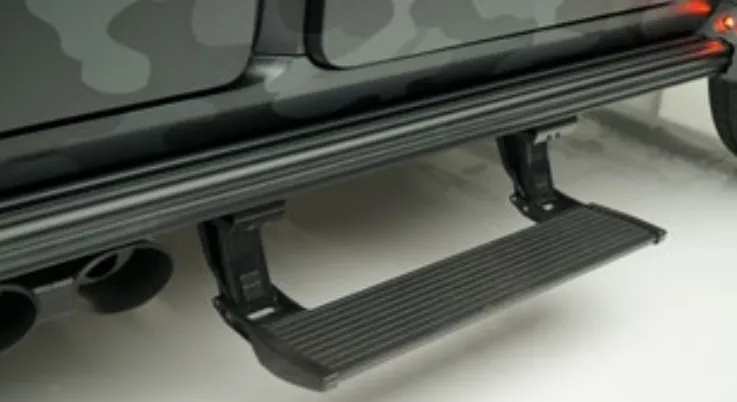
The G-Class is tall. That fact is the whole point of the silhouette — the upright cabin, the high belt line, the dramatic ride height — and it is also the practical problem the side steps solve. With the W465 sitting on portal-style suspension geometry and 22-inch wheels, the door sill height to ground at curb is in the 600-650 mm range; that is a serious step up for a passenger in evening dress, for a child in a car seat, for an older buyer. The market answer used to be a fixed running board: a single bar bolted to the rocker, always there, always in view, always reducing the underside clearance the platform was engineered to provide. The Mansory Electrical Auto Side Steps — Short variant for the W465 Gronos is the modern answer. The board is there when the door opens. It folds flush under the rocker the second the door closes. The G-Class keeps its ground clearance, keeps its silhouette, keeps its presence — and the passenger gets a finished, lit, motor-deployed step exactly where the foot needs to land.
Short Variant Versus the Long — Door Zone Only
This is the short board, not the long. The short variant covers the door area only — front and rear door together, with the step plate length sized to land directly under both doors and stop short of the wheel arches. The board does not extend along the full rocker panel: there is clean rocker visible forward of the front step and aft of the rear step, which lets the visible-carbon rocker trim or the painted rocker line read as designed. Buyers who want a continuous board running the full length of the rocker — wheel arch to wheel arch — should look at the long auto side steps instead; the long set covers the full rocker length and reads as one continuous deployed plank when extended. The short variant is the choice for buyers who want the function — easy ingress for any passenger, every time, no climb — without losing the clean rocker silhouette of the W465 and without the visual mass of a full-length running board.
Deploy and Retract Logic — CAN-Bus, Speed Lock, Drive-Mode Awareness
The board is power-deployed from a stowed position tucked flush against the underside of the rocker. The deploy/retract sequence is wired into the OEM door-handle and door-latch logic over the W465 CAN-bus rather than running off a separate aftermarket switch on the door:
- Door handle pulled (any door, driver or passenger): CAN-bus message triggers the corresponding step motor; the board rotates outward and downward to its deployed position in approximately 1.4 seconds.
- Door open and stationary: the board holds in deployed position with the motor unenergized and a self-locking worm-gear preventing back-drive under load. Walking onto the board does not cause it to retract or sag.
- Door closed and latched: CAN-bus latch-confirmed signal triggers retract; the board rotates back to the stowed position in approximately 1.2 seconds and tucks flush against the rocker.
- Vehicle in motion: a vehicle-speed signal above 5 km/h locks the board in the stowed position regardless of door-handle input — accidental handle pulls in motion (children in the rear, loose clothing) cannot deploy the step at speed.
- OEM off-road or low-range mode active: the controller suppresses deploy on the door open signal, holding the board stowed for maximum underside clearance during off-road use; the board can be force-deployed by a long-press of the dome-light button if needed.
The CAN-bus integration is the core engineering choice that separates this product from a generic aftermarket retractable step. A generic step deploys from a magnetic door-jamb switch — a piece of hardware that fails in winter ice, in deep mud, after a body wash. The Mansory step listens to the same digital handle signal the cabin lighting and the comfort-entry features listen to. When the OEM signal is healthy, the step is healthy. When the OEM signal fails, the OEM door-handle has already failed.
Motor, Drive Mechanism, and IP67-Sealed Pivot Bushings
- Drive type: sealed worm-gear motor with brushed DC armature, 12 V from the door wiring harness, peak current draw 4.5 A during deploy stroke.
- Self-locking gearset: the worm-and-wheel pair is non-back-drivable — load applied to the deployed board (a passenger stepping on it) cannot rotate the gear train backward through the motor. The board stays planted under load even with the motor unenergized.
- Stroke time: 1.4 s deploy, 1.2 s retract; the asymmetry is intentional — slightly slower deploy gives the door-open animation a more deliberate feel, faster retract minimises the window in which the closed-door silhouette is briefly broken by a still-extended board.
- Duty cycle: rated continuous for 200,000 stroke cycles minimum; lab-cycled past 350,000 cycles before bearing wear becomes measurable.
- Acoustic: motor and gearset operate below 38 dB at 1 m — quieter than the OEM door-handle latch click that triggers them.
The motor housing is mounted to the rocker structure under the carpet line of the cabin floor — sealed to IP67 against road-spray, salt water, and pressure-washing during car washes. Service access is via the same lower-rocker panel removed during installation; no cabin-floor disturbance is required for motor swap.
The two highest-stress components on a deployable side step are not the motor — they are the two pivot bushings the step plate rotates around. Bushings live at the underside of the rocker, in direct line of road spray, salt slush in winter, and the high-pressure jets of a typical commercial car wash. A bushing that is not properly sealed will start binding inside one winter season; a bound bushing draws excess motor current, eventually triggering a thermal cutout and a stowed-deploy fault. The Mansory pivot design is built specifically against that failure mode:
- Bushing material: oil-impregnated sintered bronze running on a hardened stainless pin — a metal-on-metal pair sized for thermal stability across the -30 °C to +85 °C environmental range.
- Sealing: double-lip nitrile rubber seals at both ends of the bushing housing, plus a secondary labyrinth deflector outboard of the primary seal to break up direct jet impingement during pressure-washing.
- IP67 rating: the assembled bushing housing is rated for 30 minutes of submersion at 1 m depth without water entry. Real-world: a deep-puddle wade at urban-flood level, or a mud-line car wash with under-body lance, will not reach the bushing internals.
- Service interval: the bushings are sealed-for-life under typical road use; a re-grease point at the outer pivot allows manual re-lubrication if the vehicle sees frequent off-road or salt-belt winter use.
The pivot pin itself is a 12 mm hardened stainless dowel, retained at both ends by circlips behind the bushing housing — replaceable as a service part without removing the step plate from the cradle.
Anti-Pinch Torque Sensing and Ice-Bond Recovery
An automatic step that can deploy and retract under power has to handle the case where something is in the way of the stroke — a child's foot positioned where the retracting board will land, a parking-lot kerb stone the deployed board strikes during retract, snow or ice frozen between the board and the rocker after a winter overnight. The Mansory controller monitors motor torque on every stroke and detects an anomaly:
- Motor current is sampled at 200 Hz across the full stroke; the controller compares the live torque profile against a learned baseline for that specific board (each motor learns its own torque signature during the first 10 cycles after install).
- On excess resistance during retract: the controller stops the motor immediately, reverses to the deployed position, illuminates a small LED on the door-jamb to indicate fault, and logs the event for diagnostic readout. The board does not pinch.
- On excess resistance during deploy: the controller stops at the resistance point and holds; this protects the board against forcing through an obstacle (kerb stone under a low-clearance parking situation).
- On ice-bonded retract: the first attempted stroke uses a higher-torque profile (the controller knows the previous deploy was clean); if resistance is logged consistent with ice rather than obstruction, the controller cycles the motor through three short deploy-retract pulses to break the ice bond before completing the retract.
The result: the step is safe around feet, safe around kerb stones, and operationally robust through winter without manual intervention from the driver.
Ground-Clearance Preservation and Drive-Mode Suppression
The W465 G-Class with portal-style geometry and 22-inch tyres has a curb-position underside clearance under the rocker line in the 245 mm range. Bolting a fixed running board to that rocker — a single bar permanently 80-100 mm below the rocker — knocks 80-100 mm off that clearance number, every kilometre of every drive, including kerb-clearance during city parking, speed-bump clearance in private estates, and underside-strike risk on rural roads. The retracted Mansory board sits flush within the rocker structure: the underside profile of the vehicle in stowed mode is identical to the OEM rocker contour, with zero added drop. Ground clearance is preserved at the as-engineered W465 figure. Off-road approach, departure, and break-over angles are unchanged.
The controller also listens to the W465 drive-mode CAN message and adapts deploy logic to vehicle state:
- In Comfort and Sport, the deploy sequence runs as standard on door-handle pull at zero speed.
- In Off-Road or Low-Range, the controller suppresses auto-deploy: doors open without deploying the step, preserving underside clearance for a planned off-road egress (driver exits onto rough ground, not onto the step).
- In winter or low-friction modes with electronic ride-height raised, the same suppression rule applies — the deployed step would protrude lower than intended for the off-road envelope.
- A force-deploy override is available via a long-press of the dome-light button (factory-style hidden switch), for the case where the driver does want the step deployed in off-road mode.
This is the engineering detail that separates an OEM-grade integration from a bolt-on aftermarket step that fires every time a door opens regardless of context. The Mansory controller knows the vehicle state.
Step plate construction:
- Plate body: aerospace-grade aluminium extrusion, internally ribbed for stiffness, anodised black for substrate corrosion resistance.
- Tread surface: rubber-bonded grip insert with deep-section drainage channels — wet-foot grip retained, slush and sand shed off the tread under foot load.
- Edge profile: rolled outer edge, no exposed sharp lip — clothing snag-free for buyers exiting in long coats or evening wear.
- Underside lighting: integrated LED strip projects a soft white light pool on the ground at the foot-landing zone, illuminating the step face and a 600 mm radius of ground beneath. Triggered by the same CAN deploy signal, dimmable via the OEM cabin ambient lighting controller.
- Plate finish: matte black powder-coat; optional accent line in body colour at the leading edge if specified at order.
The board is not a styling piece — it is a functional deployment that is invisible most of the time. The visible-when-deployed surface treatment is therefore minimal and engineered for grip and longevity rather than show.
W465-Specific Mounting, Wiring, and Installation
- Mounting brackets: machined steel brackets keyed to the W465 rocker structural section — no shared parts with the W463A; the rocker geometry, threaded boss positions, and inner-rocker reinforcement layout are different.
- Power tap: 12 V draw from the door wiring harness via a Mansory wiring splice block (no harness cutting), fused at 7.5 A per side at the body fuse box, with a dedicated chassis ground stud at the rocker structural rib.
- CAN integration: the controller taps the body CAN bus at the door-control module; tap is a non-cut splice using OEM-spec connectors, fully reversible. No modification to OEM module firmware.
- OEM module compatibility: verified against the W465 body-control module software up to the latest factory release. CAN messages used are stable across W465 model-year revisions; controller firmware is field-updatable via OBD-II in the unlikely event of a future OEM message change.
- Reversibility: full system removal returns the vehicle to factory state; warranty work on the door wiring is not affected.
Installation sequence:
- Remove OEM lower rocker trim: the lower rocker plastic on the W465 is a service part — the trim unclips and exposes the rocker structural rib used as the mounting surface.
- Bolt mounting brackets to rocker rib: M8 machined steel brackets into factory-threaded inserts (no drilling); torque-spec to 28 Nm with anti-corrosion thread treatment.
- Mount motor and step cradle: motor housing pre-assembled to the cradle, drops onto the bracket pair, four M6 fasteners.
- Run wiring: power tap and CAN tap at the door-jamb; controller sits inside the rocker cavity protected from spray.
- Refit OEM lower rocker trim: the trim now hides the bracket and motor, with cutouts for the step pivot points only.
- Calibration: first 10 deploy cycles are learning cycles where the motor logs its own torque baseline; the install is complete after this self-learn sequence.
- Total install time: 4-5 hours both sides at a competent workshop.
Visual pairings on a Gronos build:
- With the lowering kit: a lowered Gronos rides closer to the ground, making the deployed step taller in proportion to the door opening — the auto step becomes the practical answer that lets the vehicle keep its lowered stance without compromising entry comfort.
- With the aluminium exhaust tips: the rear of the rocker stays clean to read against the polished tip cluster, with the short step retracted and out of view.
- Versus the long auto side steps: the long variant runs the full rocker length for a continuous deployed plank; the short variant chosen here keeps the rocker silhouette clean forward and aft of the doors.
- With the rest of the kit: the full Gronos catalogue is at the parent Mansory Gronos kit page and the broader Mansory collection.
Maintenance and W465 Compatibility
- Hand wash with the rest of the rocker — pressure-wash the step in deployed position once monthly to clear road-grime out of the pivot region.
- Quarterly deploy-cycle test through the full ten-cycle sequence is built into the controller diagnostic — a long-press of the dome-light button initiates self-test.
- Annual inspection of the bushing seals at a workshop visit; the system is sealed-for-life under typical road use.
- Salt-belt or off-road owners: re-grease the outer pivot at the start of each winter via the dedicated grease nipple (NLGI 2 lithium complex grease).
- Tread rubber refresh at the 5-7 year horizon depending on entry frequency; the insert is a service part and replaces in 20 minutes per side without removing the cradle.
The kit is engineered for the 2024+ W465 generation only. The W465 rocker structural rib, threaded insert layout, door wiring harness routing, and body CAN message map are different from the W463A — a W463A retractable step set will not bolt up, and even forced into place will not integrate with the door logic. Verify VIN at order time. Fits all factory configurations of the W465 G-Class Gronos including narrow-body and Wide Kit variants, with or without the off-road package, with manual or automatic running-board option codes from factory.
Ordering and Lead Time
The system is built to order. Standard build window is 10-14 weeks from confirmed order to dispatch, including motor pairing, CAN controller flashing, and bench-cycle quality test. Worldwide freight is arranged at ex-works or DAP terms; the kit ships as a fitted hard case with both sides, brackets, motors, controllers, and wiring loom. Order specification at quote time:
- Vehicle VIN (W465 confirmation, factory step-option code if any).
- Tread finish — standard matte black or body-colour leading edge accent.
- Lighting — standard underside white LED, optional dimmable colour-temperature variant matched to OEM cabin ambient.
- Drive-mode logic — standard Comfort/Sport deploy with Off-Road suppress, optional always-deploy override mode.
- Pairing — short step alone, or coordinated with full Gronos build sequencing.
Contact us to start a build:
WhatsApp +44 7488 818 747 — specification, drive-mode logic, fitment by VIN
[email protected] — quote, lead-time, freight
FAQ — Electrical Auto Side Steps Short Variant for the W465 Gronos
Q: What is the difference between the short and the long auto side step variant?
A: The short variant covers the door area only — the deployed plate sits directly under the front and rear door openings and stops short of the wheel arches, leaving clean rocker visible forward of the front step and aft of the rear step. The long variant runs the full rocker length wheel-arch to wheel-arch as one continuous deployed plank. Function (auto deploy on door, auto retract on close, IP67 sealing, anti-pinch, off-road suppression) is identical between the two — the choice is purely about how much of the deployed plate sits under the rocker line and how much rocker silhouette stays visible when retracted.
Q: Will the step deploy if a door handle is pulled while the vehicle is in motion or in off-road mode?
A: No. The controller suppresses deploy above 5 km/h regardless of door-handle input — accidental handle pulls in motion cannot extend the board at speed. In Off-Road or Low-Range drive modes the controller also suppresses auto-deploy on door-open to preserve underside clearance during off-road egress; a force-deploy override via the dome-light button is available if the driver wants the step in off-road mode anyway.
Q: How does the anti-pinch system work, and is it safe around children's feet during retract?
A: The motor controller samples current draw at 200 Hz across every stroke and compares the live torque profile against a self-learned baseline. If retract resistance exceeds the learned profile by more than the calibrated threshold (a foot in the way, ice bond, an obstacle), the motor stops immediately, reverses the board back to deployed, and logs the event with a door-jamb LED indication. The system will not pinch a foot, will not crush an obstruction, and will not force itself through ice — three separate safe-recovery behaviours engineered into the same logic.
Q: Does the retracted step affect ground clearance compared with a fixed running board?
A: The retracted step sits flush within the W465 rocker structure — the underside profile in stowed mode matches the OEM rocker contour with zero added drop, and the W465 ground clearance figure is preserved unchanged. A fixed running board, by contrast, sits permanently 80-100 mm below the rocker and reduces underside clearance by that amount on every drive. For owners who care about kerb clearance, speed-bump tolerance, or off-road approach geometry, the auto step is the only retractable step format that does not compromise the platform.
Q: What about reliability through winter — ice, salt, pressure-washing, mud?
A: The pivot bushings are IP67-sealed (30 minutes submerged at 1 m without water entry) and run sintered bronze on hardened stainless. The motor housing is mounted inside the rocker cavity, sealed against road spray and pressure-wash jets. The controller has a dedicated ice-bond detection routine that breaks frozen step-to-rocker contact through three short pulses before completing retract. Real-world winter operation in salt-belt climates including Scandinavia, Canada, and the Russian Federation has been validated through 200,000+ stroke cycle testing without seal degradation.