
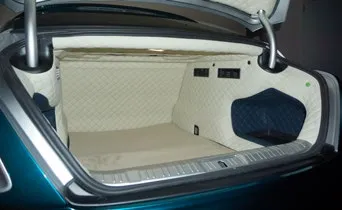
Exclusive leather trunk house decor Mansory for Rolls-Royce Spectre


Exclusive Leather Trunk House Decor Mansory for Rolls-Royce Spectre
The Spectre is a coupe, and that single fact reshapes how Mansory approaches its boot. Where saloons get a deep well behind a parcel shelf, the Spectre's load bay sits beneath a one-piece tailgate, flanked by sloping side carriages and capped at the front by a vertical bulkhead behind the rear seat backs. Those three surfaces are visible every time the boot is opened, and on a 2.97-tonne electric super-coupe whose owners often valet their own cargo, painted plastic is a poor neighbour to hand-stitched cabin hide. The Mansory Carbon Fiber Body kit set for Rolls-Royce Spectre includes a full-leather wraparound that dresses the trunk-house side panels and rear bulkhead in the same nappa specification used for the seat facings, so the boot ceases to feel like an appliance compartment and starts behaving like an extension of the cabin.
Construction & Materials
The decor is built from semi-aniline nappa hide drawn from the same European tannery that supplies Mansory's seat upholstery, allowing exact dye-lot matching to a customer's chosen seat colour. Each panel is hand-cut from a paper template lifted from the specific Spectre VIN, then stitched on a saddle machine using bonded polyester thread in a complementary aniline shade. Beneath the leather sits a closed-cell PE foam pad and an acoustic damping mat, so the new cladding does not become a drum surface that re-introduces road noise into Spectre's famously hushed cabin.
- Hide grade: 1.2–1.4 mm semi-aniline nappa, full-grain, drum-dyed for through-colour on cut edges
- Stitch density: eight stitches per inch, saddle-stitch on visible seams, double-needle on hidden seams
- Backing: 3 mm closed-cell polyethylene foam laminated to the hide, plus a 1.5 mm bituminous damping sheet on the panel face
- Substrate: ABS shell vacuum-formed to the OEM trunk-house contour, ribbed for stiffness
- Retention: hidden rare-earth magnets bonded into the substrate engaging OEM steel tabs, supplemented by hook-and-loop strips on long runs and three concealed clip pins per panel
- Embroidered crest: choose Mansory wordmark or Pantheon-style emblem, embroidered in viscose or metallic thread before panel assembly
- Edge finish: French-folded edges with skived returns; no raw cuts visible
- Colour palette: any Mansory or Rolls-Royce bespoke leather code matched to the seat hide reference number
Design & Visual Function
The visual proposition is continuity. When a Spectre owner opens the boot at a hotel kerbside, the eye should travel from the rear-seat bolster, over the parcel-shelf veneer, into the boot, and find the same hide tone, the same stitch pitch, the same thread colour. Mansory's set is designed so that boundary disappears. The bulkhead panel sits flush against the rear-seat backrest carrier, and its top edge is curved to match the natural fall of the Spectre's coupe roofline so that there is no awkward step where the headliner ends and the boot begins.
The side carriages are the largest panels, and they are where the saddle-stitch detail lives. Mansory aligns the seam axes with the OEM character lines pressed into the metal substructure beneath, so the leather appears to be skin over the existing skeleton rather than an applied wrap. Where the Spectre's tail-light loom passes through the side panel, Mansory cuts a cable boot lined with the same hide, then closes it with a magnetic flap so service technicians can still reach the connector without dismantling the entire decor.
The embroidered emblem is the focal piece. It sits high on the rear bulkhead, centred on the tailgate aperture so it is the first crest a viewer reads when the boot is open. Owners who have specified Mansory monograms on their seat headrests typically repeat the same monogram here for cabin-to-cargo coherence; owners who prefer restraint choose a single Pantheon-style figurine in a thread colour that contrasts only by half a shade.
Compatibility & Fitment
Rolls-Royce Spectre, MY2024+ production, both LHD and RHD. The coupe boot architecture differs from the Wraith it replaces — the Spectre's tailgate is a single hinged panel rather than a saloon lid, and the trunk house dimensions are tailored to that geometry. Mansory's templates are dedicated to the Spectre VIN range and are not interchangeable with Wraith, Ghost, Dawn or Cullinan parts. The set leaves the OEM 12-volt socket, first-aid recess and emergency tool compartment fully accessible — service flaps in the leather are colour-matched and edge-bound, retained by the same hidden magnets used on the main panels.
Installation & Reversibility
Installation is a low-tool, two-hour job for a trim specialist. The OEM plastic decor is unclipped from its tabs (no fasteners are drilled into the body), the new substrate is offered up dry to confirm magnet engagement, then the panels are seated one by one — bulkhead first, then long side carriages, then the lower closing pieces. Hook-and-loop strips along the upper edges absorb any tolerance variance between cars. Because the hide is mounted to a separate substrate rather than to the Spectre's painted metal, removal is fully reversible: lift the panel away from the magnets and the original OEM decor goes back in untouched, preserving warranty optics if the car is ever returned to standard. Mansory recommends a certified upholstery installer for the first fit so that magnet alignment and stitch tension are verified, but subsequent removals for cleaning are owner-friendly and require no tools.
Pairing within the Mansory Spectre programme
The trunk house decor is the connective tissue of a fully-leathered cabin. It is most often specified alongside the Exclusive leather trunk mat, which carries the same hide grade across the boot floor and completes the wrap, and the Exclusive velour trunk mat with leather edging for owners who prefer a softer floor contact while keeping leather on the verticals. Owners commissioning a turnkey bespoke cabin add the Individualized Interior Kit so that thread colour, monogram font and hide reference number are coordinated in a single specification document covering seats, headliner, door cards and boot.
Maintenance & Durability
Treat the boot leather exactly like seat leather. Wipe with a barely-damp microfibre after every long trip to lift dust and incidental marks; avoid solvent-based wipes which strip the aniline finish. Every six to twelve months apply a pH-neutral leather cream worked in with a horsehair brush, paying particular attention to the saddle-stitched seams where dirt accumulates. Avoid placing wet luggage directly against the bulkhead panel; the hide is sealed but prolonged moisture contact will dull the topcoat. Stitching is bonded polyester rated for ten thousand abrasion cycles, and any pulled stitch can be relaid by a trim specialist without removing the panel from the car. The acoustic damping foam beneath the hide is rated for the lifetime of the vehicle and does not require service.
Lead Time & Warranty
Lead time runs four to eight weeks from the moment Mansory receives a confirmed hide reference number and emblem artwork. Bespoke monograms or unusual thread shades extend the window to ten weeks because dye-lot matching is performed at the tannery, not at the trim bench. The set carries a twelve-month Mansory warranty against manufacturing defects — substrate cracking, magnet failure, stitch unravelling, panel warpage. Wear from normal cargo loading is not covered, but the panels are repairable: a damaged side carriage can be re-skinned at the workshop without replacing the substrate, which keeps the magnet alignment intact.
FAQ
Q: Does the decor change the load capacity of the boot?
A: It reduces volume by roughly two to three litres on each side because the substrate sits proud of the OEM plastic by a few millimetres, but the load floor and the tailgate aperture are unchanged.
Q: Can I match the leather to a colour Rolls-Royce supplied that is not in the Mansory palette?
A: Yes. Provide the OEM hide reference number from your build sheet and Mansory orders a matching dye lot from the tannery. Include a small offcut from the seat workshop if one is available — physical reference always beats a code on a screen.
Q: Will the magnets affect electronic items I store in the boot, like a laptop or a key fob?
A: No. The magnets are recessed in the substrate behind the foam and the hide; field strength at the surface is well below the threshold that would interact with consumer electronics.
Q: My Spectre has the bespoke audio package with rear-bulkhead speakers. Does the decor fit over those?
A: The bulkhead panel is supplied with the speaker grille apertures cut to match your VIN spec, and the leather is laser-perforated over the apertures so acoustic transparency is preserved.
Q: Is the embroidered emblem optional?
A: Yes — owners who prefer a clean field can specify a blank bulkhead, and the emblem can be added later at any Mansory upholstery partner without removing the rest of the set.
For pricing, hide-code matching, monogram artwork or to start a bespoke specification on this trunk house decor, contact the Hodoor desk directly via WhatsApp +44 7488 818 747 or [email protected].