
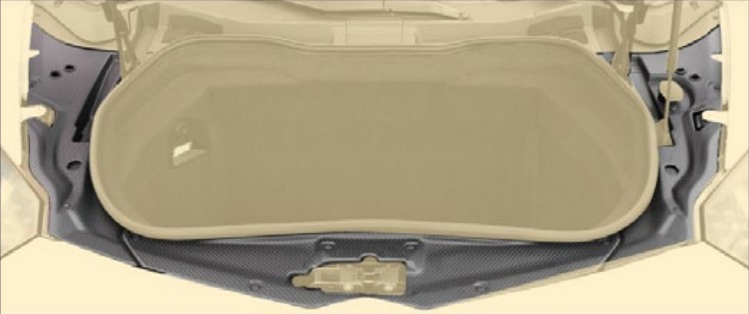
Trunk carbon cover Mansory for Lamborghini Aventador S


Mansory Carbon Trunk Cover for Lamborghini Aventador S
The Mansory Carbon Trunk Cover is a frunk-side trim assembly designed for the Lamborghini Aventador S (LP740-4 S, 2017–2021), and it forms part of the broader Mansory Body Kit for Lamborghini Aventador S programme. While most carbon items on the Aventador S sit at the rear — wrapping the naturally aspirated 6.5-litre V12, the dry-sump pickup, the lower-side exhaust outlets — this piece works at the opposite end of the chassis: the small front luggage cavity behind the nose latch. Owners who pop the frunk for a hotel valet, an airport bag, or a paddock toolbox are exposing a painted aluminium tub to repeated abrasion, and the Mansory cover converts that bay into a finished carbon vignette. It carries the same 3K twill cadence, the same lacquer depth, and the same hardware logic as the visible exterior pieces, so the front of the car is no longer a styling weak link when the hatch is up.
Construction & Materials
The cover is moulded as a multi-piece set: a floor pan, two flank panels that follow the inner-fender curvature, and a forward header strip that meets the latch carrier. Each segment is laid as a sandwich of woven prepreg with a closed-cell core in the floor pan for impact damping, then cured in autoclave. Mansory's frunk geometry on the Aventador S includes irregular knock-outs for the spare-wheel anchor, the OEM emergency kit, and the body-control module access flap — all reproduced in the moulds so the cover lies flush rather than bridging cavities.
- Outer face: 3K twill prepreg, 200 gsm, weave aligned along the longitudinal axis of the bay
- Inner laminate: unidirectional carbon spine for stiffness across the floor pan span
- Floor core: 3 mm aramid honeycomb between two CFRP skins for footstep load tolerance
- Cure: autoclave at 6 bar / 130 °C, post-cure dwell for full Tg development
- Wall thickness: 1.6 mm flank panels, 4.4 mm sandwich floor, 1.4 mm header strip
- Weight saving: ~1.7 kg vs OEM trim+carpet combination across the full set
- Hardware: stainless M5 captive nuts at OEM threaded inserts; no fresh holes drilled
- Finish: marine-grade UV polyurethane lacquer, satin or high-gloss; matte raw weave optional
Design & Visual Function
The Aventador's front hatch is theatrical in its own right — a long, scissor-hinged clamshell that lifts from the windscreen base toward the nose, exposing a shallow but wide cavity. With the OEM black felt liner in place, the bay reads as a flat dark hole; under direct sun the contrast against the painted body is harsh and the bag-rest area collects scuffs from luggage corners and tie-down hooks. The Mansory cover replaces that dark felt with a woven surface that reflects light, so the open-hatch silhouette gains the same visual language as the rear engine bay carbon trim. Photographers benefit immediately: with the front lifted at a show, the cavity now contains depth, weave geometry, and the brand watermark of the lacquer rather than a black void.
Weave alignment is the design pivot. Mansory orients the 3K twill so the diagonal cadence runs front-to-back on the floor pan, then rotates 90 degrees on the flank panels so the tunnel created between them reads as a continuous frame. Around the tie-down points and the spare anchor, the weave is hand-cut to keep the diagonal continuous through the cut-out edge, rather than letting the loom break mid-cell. The header strip near the latch carrier is the most visible element from a standing observer (it sits closest to the windscreen) and Mansory finishes its leading lip with a shallow bevel so the carbon does not appear glued onto the OEM aluminium.
Hatch geometry imposes constraints that this cover respects. The frunk lid hinges back over the windscreen, and at full open the hatch underside hovers above the cover by a tight tolerance; the flank panel height is therefore capped to keep the gas-strut throw clear, and the forward header strip is recessed where the OEM rubber bump-stops contact at close. Owners who close the hatch hard will not crush the carbon — every contact path is mapped to OEM rubber, not to the new laminate.
Compatibility & Fitment
Engineered for the Lamborghini Aventador S in coupé and Roadster body styles, model years 2017–2021, both LHD and RHD chassis. The cavity is shared between the two body styles since the soft-top of the Roadster stows behind the cabin rather than in the frunk. Pre-SVJ bumper geometry is irrelevant to this internal piece, but the cover does respect the Aventador S latch-carrier mounts and the OEM emergency-kit pocket location, which the SVJ and earlier-LP700 layouts move slightly. Lower-side exhaust outlets sit at the opposite end of the chassis and have no bearing here. The aluminium-CFRP monocoque's frunk tub is unaltered — every fastener uses an OEM-spec threaded boss already present in the tub. Parking-distance sensors, hood-open switches, and the latch microswitch operate untouched; the cover does not enter their kinematic envelopes.
Installation & Reversibility
Workshop time is 90 minutes to two hours for an experienced detailer. Required tools are a 8 mm and 10 mm socket, a Torx T25 driver, a plastic trim wedge, and a torque wrench rated for 4–8 Nm. Sequence is: pop the OEM felt liner by releasing the four front fasteners and the two side clips; vacuum the bay; clean the OEM threaded bosses with isopropyl wipe; offer up the floor pan first, hand-start the captive nuts, then progress through flanks and header strip; final torque per Mansory's printed map. Methacrylate adhesive is used nowhere on this part — the Aventador's monocoque adhesive zones are exterior and structural, while this cover is mechanically fastened only, which preserves the underlying aluminium tub for a future de-installation. Reversibility is therefore complete: removing the cover and reinstalling the OEM felt is a sub-hour job and leaves zero adhesive residue.
Pairing within the Mansory Aventador S programme
The trunk cover is most often specified alongside two visible front-end carbon items so that the open-hatch impression matches the exterior treatment. The natural pair is the Front bonnet — once the lid itself is carbon-skinned, lifting it reveals an interior that should not betray a felt-lined bay, so the cover closes the visual loop. A complementary upgrade is the Bonnet air outtake, which sits in the same hatch surface as the bonnet itself; its weave cadence and lacquer depth are matched to the cover so the front quarter of the car reads as one continuous carbon system. Owners who want every carbon-eligible surface that surrounds the windscreen pillar to participate in the programme also add the Carbon windshield wipers cover, which closes the gap between the bonnet trailing edge and the glass and ensures the wiper pivot housing matches the bay carbon below.
Maintenance & Durability
The frunk's interior position protects the laminate from UV, road salt, and stone-chip exposure that exterior carbon faces, but introduces its own enemies: sand from beach bags, grit from track tyres carried in the bay, and the corner edges of hard-shell luggage dragged across the floor pan. Recommended care is a microfibre wipe-down after each use, a quarterly application of a non-acidic carbon-safe wax, and an annual ceramic-coat top-up on the floor pan only — the flanks rarely contact luggage and benefit more from a simple lacquer inspection. Avoid alkaline cleaners, household ammonia, and abrasive sponges, all of which will dull the lacquer and, over time, expose the weave to oxidation. For chip repair, Mansory supplies a colour-matched lacquer pen; deeper gouges into the laminate require a full panel-segment exchange, which is straightforward thanks to the multi-piece moulding. Engine-bay heat from the rear-mounted V12 does not reach this front cavity, so thermal cycling is not a concern; thermal shock from cold winter starts is the only seasonal stressor and stays well within the resin's Tg margin.
Lead Time & Warranty
Production is bespoke at Mansory's facility, with a typical 4–8 week lead time once specification is locked. Mansory supplies a 12-month manufacturing-defect warranty covering laminate delamination, hardware corrosion, and lacquer adhesion. Cosmetic damage from luggage abrasion, accidental tool drops, or post-installation modification is not covered.
FAQ
Q: Does the cover fit both the coupé and the Roadster Aventador S?
A: Yes — the front cavity geometry is identical between body styles since the Roadster's soft-top stows behind the cabin, not in the frunk.
Q: Will my luggage scratch the carbon over time?
A: The marine-grade lacquer resists soft-bag sliding indefinitely; hard-shell case corners can leave faint marks after years of frequent use, polishable with the supplied lacquer kit.
Q: Is the spare-wheel anchor still usable?
A: Yes — the floor pan is moulded with the OEM anchor cut-out and the emergency-kit pocket location, both retained as functional access points.
Q: Can I run the OEM felt liner alongside the carbon cover?
A: No — the cover replaces the felt as a single layer; running both creates clearance issues with the hatch close path.
Q: What weight do I save?
A: Approximately 1.7 kg across the four-piece set vs the OEM felt-and-carrier combination — a small but measurable forward-axle weight reduction.
Pair the trunk cover with the front bonnet and bonnet air outtake to give the open-hatch silhouette of your Aventador S a fully resolved carbon character. Specify finish, lacquer level, and weave grade via WhatsApp +44 7488 818 747 or email [email protected].