
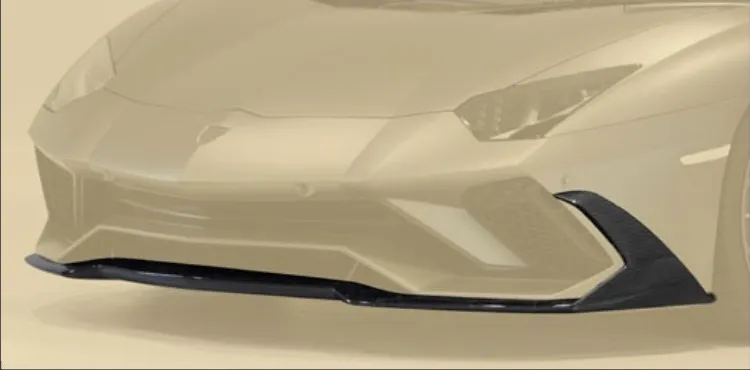
Front bumper lip - high flaps Mansory Carbon for Lamborghini Aventador S


Mansory Carbon Front Bumper Lip with High Flaps for Lamborghini Aventador S
The Mansory carbon front bumper lip with high flaps is the more belligerent variant of the front-axle aero blade developed for the Mansory Body Kit for Lamborghini Aventador S. Where the plain lip stays focused on a single sweeping splitter line, this version stacks tall vertical fences — canard-style flaps — at each outboard corner of the blade, turning the leading edge of the LP740-4 S into a vortex-generating front element borrowed from sports-prototype thinking. The car keeps its scissor-door drama, its rear-wheel-steering chassis discipline, and the howl of the 6.5-litre naturally aspirated V12 venting through lower-side exhaust outlets, but now the nose looks and behaves like it wants a pit-lane assignment. Owners who pick this lip want a measurable downforce delta and visual aggression that reads from twenty metres out.
Construction & Materials
Two structural zones define the part: the horizontal splitter blade and the upright flap fences welded into the laminate as integral CFRP fins. Both are co-cured under autoclave pressure to prevent any seam between the planar element and the vertical canards — a single-piece composite avoids the flutter and stress-riser problems that bonded-on flaps suffer at autobahn velocities.
- Layup — 3K twill on visible faces, biaxial 200 g/m² subskins, unidirectional reinforcement spine running spanwise behind the splitter leading edge
- Cure cycle — autoclave 6 bar / 125 °C, vacuum-debulked between plies, post-cure 80 °C for resin glass-transition stabilisation
- Wall thickness — 2.4 mm at the splitter trailing edge, 3.6 mm at the flap-to-blade root, 4.1 mm at the leading edge to absorb kerb strikes
- Mass — 3.05 kg complete, versus 4.7 kg for an OEM bumper-skirt arrangement
- Hardware — stainless M6 fasteners, six-point alignment with two captive nuts threading into Lamborghini's existing splitter mounts
- Surface — gloss UV-blocking lacquer standard, satin and raw-matte available; raw weave specified with hydrophobic sealer
- Edge treatment — radiused 2 mm chamfer on flap leading edges, anti-chip clear film pre-applied to lower splitter face
- QA — coupon-tested per Mansory's CFRP audit protocol, each part barcoded with cure-batch reference
Design & Visual Function
The aerodynamic story differs sharply from the plain blade. Tall vertical flaps spin trailing vortices at the front corners of the bumper, energising the boundary layer that runs down the car's flanks toward the side-skirt intakes and the rear diffuser. That vortex sheet pins flow against the bodywork, reducing separation around the front wheel arch and feeding cleaner air to the lower-side exhaust exits and rear underfloor. On a track-driven Aventador S, owners report a crisper turn-in and reduced front push at corner-entry — the blade alone delivers downforce; the flaps redirect how that downforce loads the chassis.
Visually, the vertical fences echo GT3 and Le Mans prototype language — a quick semantic cue that this Aventador is not a show-only build. The flap height is calibrated so it remains within the front-bumper envelope from a pure side profile, but reveals itself dramatically from a three-quarter angle, especially with raw-twill weave catching reflections off the Aventador's hexagonal headlamp graphics. Mansory aligns the twill bias to mirror across the centreline, so the eye reads symmetry first and the canards second — a sequence that rewards a walk-around rather than a single static shot.
For paint-matched specifications, the splitter face can be body-coloured while the flaps stay raw weave, creating a two-tone separation that emphasises the aero element rather than blending it into the bodywork. This is the spec most often paired with darker paint codes — Nero Aldebaran, Grigio Estoque, Blu Sideris — where the carbon weave reads as a graphic line rather than an applique.
Compatibility & Fitment
Engineered for the Lamborghini Aventador S (LP740-4 S, coupé and Roadster, model years 2017 through 2021). The component respects the pre-SVJ bumper geometry, the lower-side exhaust outlet positioning, and the standard front-axle ride height. OEM front parking sensors, washer jets, and any aftermarket lift-axle hardware remain operational. The blade does not foul scissor-door arc clearance and keeps a 95 mm gap to the lowest oil-cooler intake throat, so V12 thermal management stays inside Lamborghini's design envelope.
Installation & Reversibility
Plan five to seven hours for a careful first-time fit. The factory splitter or lower bumper trim must come off, mounting tabs cleaned, and a primer-key applied where adhesive contact is required. Mansory ships the lip with a methacrylate-compatible primer because portions of the Aventador's monocoque panelling are bonded with methacrylate adhesive — using an aggressive solvent on the substrate without preparation can craze the bond line. Six fasteners, two structural adhesive beads, and a torque-sequence card complete the install. Reversal is non-destructive provided adhesive is cut with a wire (not pried), and the OEM splitter can be re-fitted with new clips. Body shop with composite experience preferred; this is not a windshield-cap-level DIY.
Pairing within the Mansory Aventador S programme
The flap-equipped lip benefits from cohesive front-end carbon. Pair it with the matching front bumper air intake cover to extend the carbon graphic upward into the central duct, and with the replacement front air intake so the vortices generated at the flap tips meet a clean carbon-edged aperture rather than painted plastic. If a build calls for a quieter aesthetic, the alternative plain front bumper lip offers the same splitter line without vertical fences — useful for owners who want subtler street-leaning visuals while keeping the carbon programme consistent.
Maintenance & Durability
The flaps sit in the dirtiest zone of the car — they catch tyre kick-up, salt mist, and brake dust. Treat them like a track-prepped element, not a show piece. Rinse with deionised water after track outings, a pH-neutral wash mitt only, and a dedicated carbon-safe lacquer cleanser every fortnight. Avoid alkaline degreasers, ammonia, citrus solvents and abrasive sponges — all four blister the UV lacquer and let moisture migrate into the laminate. A ceramic coating with a UV inhibitor extends lacquer life beyond five years; carnauba waxes work but require monthly reapplication on the high-flap surfaces. Stone chips on the splitter leading edge can be repaired with a localised lacquer touch-up if caught early; structural cracks in a flap warrant a Mansory-trained composite technician for resin infusion or section replacement.
Lead Time & Warranty
Production runs four to eight weeks because the autoclave cycles and trim work are scheduled inside Mansory's bespoke composite cell. A 12-month warranty covers manufacturing defects — delamination, void content above spec, lacquer failure — and excludes impact damage, kerb strikes, and chemical attack from inappropriate cleaning agents.
FAQ
Q: How tall are the vertical flaps and do they affect approach angle?
A: Flap height is 78 mm at the tallest point, tapering to 42 mm where they meet the splitter blade. Approach angle drops by roughly 1.4 degrees versus the plain lip — most driveways remain manageable, but a hydraulic lift-axle (factory option on later Aventador S cars) is recommended for owners with steep entries.
Q: Is the flap-equipped variant a direct upgrade path from the plain lip?
A: Yes. Mounting points are identical between the two lips, so an owner running the plain version can swap to the flap variant without bumper-side modifications. Allow two hours for the swap.
Q: Does it fit the Aventador S Roadster as well as the coupé?
A: Yes — the front bumper is shared between coupé and Roadster bodies, so the flap lip bolts up identically. Roadster owners often pick this variant to balance the visual mass of an open-top profile.
Q: Will the canards generate noticeable downforce on public roads?
A: At 100 km/h the contribution is mild. The aerodynamic effect becomes meaningful above 180 km/h — appropriate for circuit days, derestricted autobahn, or high-speed straight-line runs. The element earns its keep at performance speeds rather than urban cruising.
Q: Can the splitter face be painted body-colour while flaps stay raw weave?
A: Specify the option at order. Mansory masks the flap roots in production and paints the splitter face in body code; the seam is invisible because the geometry breaks naturally between elements.
Q: Methacrylate-bonded panels worry me. Will primer ruin the substrate?
A: Mansory supplies a methacrylate-compatible primer in the install kit. Used as directed it does not attack the bond line. Aftermarket epoxy primers are not approved.
Specify the flap lip alongside the front bumper air intake cover and replacement front air intake to assemble a coherent carbon front-end on your Aventador S. Order or ask for finish samples via WhatsApp +44 7488 818 747 or [email protected].