
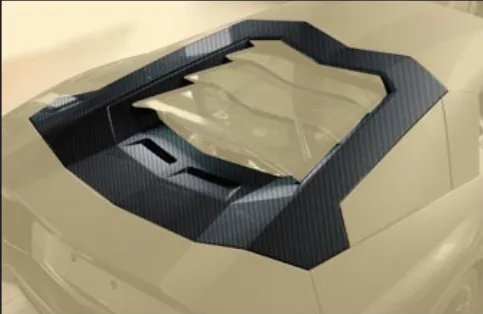
Engine bonnet Mansory Carbon for Lamborghini Aventador S


Mansory Carbon Engine Bonnet for Lamborghini Aventador S
The engine bonnet is the single most theatrical surface on a mid-engined Lamborghini, and Mansory's carbon rendition for the Lamborghini Aventador S coupé reframes that theatre without re-staging it. Sitting directly above the 6.5-litre naturally-aspirated V12, the panel cradles the factory glass louvre, channels exhaust-bay heat skywards through reshaped slots, and lets the woven twill ride continuously into the rear quarters and the buttress shoulders that flank the scissor-door cuts. This card is for the coupé variant only; Roadster owners must order the dedicated cabrio engine bonnet instead, since soft-top stowage geometry differs. The piece slots into the wider Mansory Body Kit for Lamborghini Aventador S and is most often specified by owners who want the V12's hot zone to breathe harder while the deck reads as a single carbon canvas.
Construction & Materials
Mansory builds the engine bonnet as a sandwich shell: a structural inner skin laid up in unidirectional carbon for stiffness, an outer cosmetic layer in 3K twill for the visible weave, and a Nomex honeycomb core in the broad flat zones that span the V12 valley. The OEM glass louvre is preserved — Mansory does not replace the panoramic glass — but the carbon frame around it is reprofiled, with vent gills cut and laminated shut-edges around the heat-rejection apertures. Cure is autoclave-only; vacuum-only laminates would deform under the soak temperatures the V12 throws upward at idle in summer traffic.
- Outer weave: 3K twill 2x2, 200 g/m², lacquered (gloss or matte), with a forged-look option for the central vented island
- Inner skin: unidirectional carbon, ±45° biaxial layup tuned for torsional stability across the long deck
- Core: Nomex honeycomb 4 mm in the flat valleys, solid laminate in the louvre frame and vent throats
- Wall thickness: 2.4 mm at hinge mounts, 1.6 mm in the central panel, 3.0 mm in the vent throats
- Cure: prepreg autoclave at 125 °C, post-cure 90 °C with a UV-stable two-pack lacquer
- Weight: roughly 4.4 kg trimmed, against a factory-equivalent assembly closer to 6.6 kg
- Hardware: stainless gas-strut anchors, OEM hinge inserts, OEM louvre-glass clip retention
- Finish options: gloss lacquer, satin lacquer, raw matte, painted-with-weave-window
Design & Visual Function
The visual axis is the rear glass. Mansory keeps the panoramic louvre as a quotation of the factory silhouette but rebuilds everything around it — the carbon frame thickens at the rear edge, thins toward the cabin, and grows two pairs of milled extraction gills that line up with the cylinder banks below. Those vents are not decorative. The naturally-aspirated V12 dumps a pulse of soak heat into the engine bay every time the car is shut off after a hard run, and that thermal load needs a path to atmosphere; the Mansory geometry widens the chimney effect that the OEM louvre slats already initiate.
Weave continuity is what separates the Mansory bonnet from a generic aftermarket cover. The 3K twill pattern is hand-aligned so that the diagonal axis runs unbroken from the rear-quarter shoulder over the louvre frame and into the buttress where it meets the rear bridge. Owners who specify the matching rear bridge get a single optical thread of weave that runs from the C-pillar root all the way to the diffuser shoulders — a finish detail that is invisible until the car is photographed in raking light, at which point it becomes the only thing the eye reads.
Acoustically, the redesigned bonnet is a quiet collaborator with the V12's exhaust note. The Aventador S routes its tailpipes as lower-side outlets, so the cover sits above an engine bay that breathes intake roar upward and exhaust resonance laterally. By thinning the cosmetic skin in the louvre frame and using Nomex core only where structurally necessary, Mansory reduces the panel's tendency to act as a low-frequency mute over the airbox plenums; in practice that means the intake bark on a Sport-mode upshift carries through the cabin firewall with a sharper attack than a heavier OEM-style cover allows.
Compatibility & Fitment
The bonnet is engineered for the Lamborghini Aventador S coupé (LP740-4 S, 2017–2021). Roadster cars are not compatible — their tonneau and soft-top stowage tray demand a different shutline, served by the cabrio engine bonnet listed separately. The carbon shell preserves OEM hinge geometry, factory gas-strut mounting, the original glass louvre clip pattern, and the under-deck wiring runs for the engine-bay courtesy lighting. There is no ALA aero hardware on Aventador S, so unlike SVJ-platform engine bonnets there are no central air-channel constraints to keep clear; Mansory uses that freedom to reposition the heat gills wider over the cylinder banks. Pre-SVJ deck contour, lower-side exhaust outlets and dry-sump oil-cooler routing are all retained.
Installation & Reversibility
Allow 5 to 7 hours for a clean install with a two-person crew. The OEM bonnet is removed by disconnecting the gas struts, releasing the wiring harness for the louvre courtesy lamp, and unbolting the hinge-side captive nuts. The Mansory shell drops onto the same hinge plates and is shimmed for a flush shutline against the rear quarters before the gas struts are reseated. Glass louvre transfer requires the original retainer clips — Mansory ships replacement clips in case OEM fasteners fatigue during removal, but most installs reuse the factory parts. Substrate adhesives on this panel are limited to the louvre-frame seal bead; methacrylate is the recommended chemistry, as it is across the Aventador's bonded-CFRP monocoque architecture. Reversibility is total: the OEM bonnet can be reinstalled at any point, with no permanent modification to hinge plates or the body deck. Install is well within the scope of a Lamborghini-certified body shop or a Mansory-trained technician; DIY is feasible for owners with prior mid-engine deck experience but is not recommended given the value and fragility of the panoramic glass.
Pairing within the Mansory Aventador S programme
The engine bonnet is rarely specified alone. Three pairings dominate the order book. First, the bonnet air outtake: a small carbon vent that sits within the bonnet's rear flank and complements the larger central gills, doubling the thermal-extraction footprint without adding visible bulk. Second, for owners cross-shopping the Roadster body, the cabrio engine bonnet is the geometry-equivalent piece for the soft-top car and worth referencing when configuring a two-car collection so weave batches and lacquer codes can be matched between coupé and Roadster. Third, the rear bridge closes the optical loop: bridge plus engine bonnet is the single visual statement Mansory's design language is built around for the Aventador S deck, with weave alignment carried unbroken across both panels at the buttress seam.
Maintenance & Durability
The engine bonnet sits in the harshest microclimate on the car: direct sunlight on the deck, soak heat from below, and the occasional rinse of brake-dust slipstream from the rear wheels. Lacquered carbon survives all three indefinitely if the owner avoids alkaline degreasers, ammonia-based glass cleaners around the louvre transition, and abrasive sponges on the weave. A ceramic coat is the right call for daily-use cars; carnauba is acceptable for collection cars that are detailed before each event. The vent throats accumulate dust and trace oil mist over a season and benefit from a soft-bristle brush wash twice a year. UV-stable lacquer keeps the weave from fogging for roughly seven to ten years before any rejuvenation polish becomes useful. Heat-soak from the V12 is not a concern for the laminate itself — autoclave-cured prepreg is dimensionally stable to well above any temperature the engine bay will ever produce — but the underside courtesy-lamp wiring should be inspected at every service interval. Stone-chip or impact damage on the visible carbon can be spot-repaired by a carbon specialist; full panel replacement is rarely necessary.
Lead Time & Warranty
Build lead time is 4 to 8 weeks from order confirmation, reflecting the fact that each bonnet is laid up to order with the customer's chosen weave and lacquer. Mansory provides a 12-month warranty against manufacturing defects in laminate, hardware and finish. Shutline shimming and glass louvre transfer are covered if performed by a Mansory-trained installer.
FAQ
Q: Does this fit the Aventador S Roadster?
A: No. The coupé bonnet does not match the Roadster's soft-top stowage geometry. Roadster owners must order the cabrio engine bonnet — it is a separately tooled panel.
Q: Is the original panoramic glass louvre kept?
A: Yes. Mansory reuses the OEM glass louvre and its retainer clips. Only the carbon frame and the heat-extraction vent geometry around the glass change.
Q: How much weight does the panel save?
A: About 2.2 kg against the factory-equivalent assembly. Modest in absolute terms, meaningful in polar moment because the deck sits aft of the rear axle.
Q: Will the redesigned vents change exhaust note or cabin sound?
A: Indirectly, yes. Reduced cosmetic-skin mass and a lighter Nomex core sharpen intake-side acoustic transfer, so upshift bark and overrun resonance carry into the cabin with slightly more attack. Tailpipe tone itself is unchanged — the lower-side outlets sit below the deck and are not acoustically coupled to the bonnet.
Q: Raw matte weave or lacquered?
A: Lacquered is recommended for a car driven in any kind of weather. Raw matte looks spectacular under studio light but fogs faster under UV and is fussier to keep clean across the louvre transition.
Q: Can the OEM bonnet be refitted later?
A: Yes. The Mansory shell uses OEM hinge plates and OEM gas-strut anchors with no irreversible modification. The factory bonnet can be reinstalled at any time.
Pair the engine bonnet with the bonnet air outtake and the rear bridge for a fully resolved deck. To configure weave, lacquer code and lead time, reach us on WhatsApp +44 7488 818 747 or [email protected].