
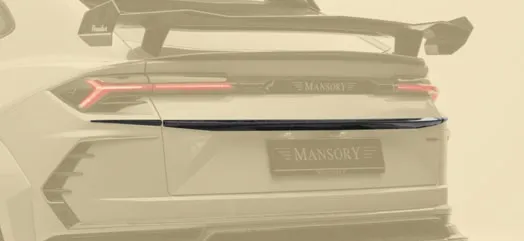
Rear splitter Mansory for Lamborghini Urus Venatus


Mansory Rear Splitter for Lamborghini Urus Venatus
The Mansory carbon rear splitter is the lower-bumper element that finishes the back of the Lamborghini Urus and frames the OEM diffuser opening from below. Within the broader Mansory Body Kit for Lamborghini Urus Venatus S, this part is the rear counterpart to the front race-flap geometry — a low carbon valance that sets the rear stance lower, frames the exhaust tips with a precise edge, and pulls the rear visual mass downward to balance the front bonnet and race-flap silhouette. On a super-SUV powered by the 4.0-litre twin-turbocharged V8, with 8-speed ZF, permanent AWD, rear-wheel-steering and adaptive air suspension, the rear splitter anchors the Venatus look at the only place a following car ever sees: the lower rear horizon, just below the bumper line, framing the diffuser fins and exhaust outlets.
Construction & Materials
The rear splitter is a single-piece carbon-fibre moulding sized to the full width of the OEM Urus rear bumper, designed to sit immediately under the factory bumper line and wrap around the rear corners with a continuous lip. Mansory produces it in autoclave-cured prepreg, with the surface ply dressed in 3K twill so the weave alignment runs symmetrically from the centre outward. It is finished in deep-gloss UV-stable lacquer; primed-for-paint variants are available for body-colour or two-tone treatments.
- 3K twill carbon surface ply, mirrored centre-out so the weave reflects symmetrically across the bumper centreline.
- Autoclave-cured prepreg lay-up, multi-axial under-plies for impact resistance against curb strikes and gravel kick-up.
- Wall thickness 2.5–3.0 mm in the visible blade, increased local thickness in the mounting flange and rear-corner wrap-around section.
- Dry weight approximately 2.2–2.6 kg depending on lacquer build and whether the optional reinforcing inner rib is specified.
- Mounting hardware — stainless socket-head bolts, captive nuts in the bumper sub-structure, butyl gasket strip along the upper mating line to seal against the bumper underside.
- Finish — Mansory deep-gloss lacquer with UV inhibitor on visible-weave specification, or two-coat primer on primed-for-paint specification supplied ready for body-shop colour.
- OEM cut-outs respected — exhaust-tip apertures, rear parking-sensor through-holes, reverse-light blanking pockets, optional tow-eye access window where applicable.
- Internal reinforcement ribs cast into the rear-corner sections to resist flex when the splitter is loaded by curb contact during low-mode parking.
Design & Visual Function
From directly behind the car, the OEM Urus rear is dominated by the diffuser fins and exhaust tips, with a relatively soft lower edge. The Mansory rear splitter rewrites that lower edge: a sharp, narrow carbon blade is now the last thing the eye reads before the road, and the diffuser fins above it become a deeper, framed feature rather than the lowest line of the rear. The splitter pulls the visual mass of the bumper down by 25–35 mm depending on ride-height mode, and gives the rear corners a wrap-around carbon edge that mirrors the front race-flap geometry — front canards and rear splitter together set up a planted perimeter that reads as a single coachbuilt language rather than a collection of bolt-ons.
The splitter is not a competition aero device — it is a coachbuilt visual element that finishes the rear-bumper graphic of the Venatus programme. At sustained motorway speed it does smooth the airflow leaving the underside of the rear bumper and reduces the slight low-speed turbulence that can rattle a loosely fitted OEM under-tray. With the exhaust tips framed inside a precise carbon perimeter, and the diffuser fins rising above a sharp carbon line rather than fading into a body-colour bumper, the rear reads as a deliberate piece of design rather than the back of a five-metre SUV. The hexagonal Lamborghini DNA in the bumper, the diffuser fins, and the carbon splitter line up into a layered rear graphic that complements the Y-DRL signature at the front.
Compatibility & Fitment
Compatible with the Lamborghini Urus, Urus S and Urus Performante from the 2018 introduction onward. The slug uses the generic Venatus naming because the part fits across the Venatus programme — the OEM rear bumper geometry is consistent enough between the pre-facelift Urus and the post-2022 Urus S / Performante that the Mansory splitter mounting flange, exhaust-tip apertures and parking-sensor through-holes all line up after the body-shop trial fit.
OEM exhaust tips are retained — the splitter wraps around the lower edge of the diffuser and frames the tips, it does not replace them. OEM parking sensors are retained, with the through-holes pre-cut to OEM diameter; sensor calibration is unaffected. Adaptive air suspension lift mode (the highest setting used for steep driveways and speed bumps) is the controlling clearance reference — the splitter sits above the lowest point of the OEM under-tray in the lowest ride mode, so curb-strike risk during normal road use is comparable to the OEM bumper, and the air-suspension lift mode gives generous clearance on driveway transitions. Rear-wheel-steering geometry is not affected; six driving modes (Strada, Sport, Corsa, Sabbia, Terra, Neve) all retain their factory aero state since the splitter is below and behind the active aero envelope. Urus does not run an active aero system on the rear bumper, so there is no active-aero conflict to design around.
Installation & Reversibility
Installation runs 1.5 to 2.5 hours at a competent body shop. The OEM rear bumper is dropped to access position (it does not need to be removed entirely on most cars), the lower OEM under-edge trim is unclipped, the splitter is trial-fitted against the bumper underside, parking-sensor through-holes and exhaust-tip apertures are checked for clearance, the butyl gasket strip is dressed along the upper mating line, and the splitter is bolted to captive nuts and self-tapping fasteners in the rear-corner wrap. Parking-sensor function is verified with the ignition cycled and a slow reverse-park test.
The installation is fully reversible — remove the bolts, lift the splitter away, refit the OEM under-edge trim, and the bumper returns to factory state. A trained Mansory installer is recommended; the rear-corner wrap is the detail that catches inexperienced fitters, and a poorly aligned corner is visible from ten metres away.
Pairing within the Mansory Urus Venatus programme
The rear splitter is the foundation of the rear-end story and pairs naturally with two or three siblings further up the rear of the car. The most common pairing is with the rear decklid spoiler — the splitter sets the lower rear horizon, the decklid spoiler caps the upper edge of the tailgate, and together they bracket the rear-glass graphic in two parallel carbon lines.
Owners who want a more motorsport-derived rear silhouette pair the splitter with the performance wing EVO instead of the decklid spoiler — the splitter at the bottom and the large-area wing at the top create a vertical performance stack that reads as a track-tuned configuration rather than a coachbuilt grand-tourer one.
For the lateral rear-flank story the splitter pairs with the air vent at the tail-light and the air splitter / rear door extensions, which carry the carbon line forward along the lower flank and into the tail-light surround, producing a continuous lower-perimeter carbon edge that wraps from C-pillar to centre-rear in a single visual run.
Maintenance & Durability
The rear splitter sits in the lowest, dirtiest zone of the car — the area that catches motorway road-spray, gravel kick-up and the worst of any wet-weather use. The lacquered carbon weave is durable in normal road use, but the leading edge is the part most exposed to stone-chip damage, so a transparent paint protection film along the front-facing 30–40 mm of the blade is a sensible specification, especially on cars used for long-distance motorway work or any gravel-driveway exposure.
Curb-strike risk during low-mode parking is the other watch-out. Use the adaptive air-suspension lift mode for steep driveways, multi-storey ramps and speed bumps; the splitter then sits well clear of curb height. On daily ride mode the clearance is comparable to the OEM under-tray, but a careless reverse into a high curb is the most common way owners damage a rear splitter, so train muscle memory to treat the rear lower edge as the new clearance reference. Maintenance is straightforward: pH-neutral pre-wash, two-bucket contact wash with a soft microfibre mitt, dry with a clean towel, and inspect the under-edge for stone chips at every wash. Avoid alkaline cleaners, ammonia-based glass cleaners running down onto the splitter, and abrasive sponges. A ceramic coating refreshed every 18–24 months keeps the lacquer reading deep; if a chip occurs, the splitter is repairable — local re-laminate, sand, re-lacquer at a Mansory-trained body shop.
Lead Time & Warranty
Lead time is 4 to 8 weeks from confirmed order, reflecting Mansory's bespoke autoclave production and the full carbon QA workflow. The part ships in foam-lined protective packaging with mounting hardware, gasket strip and fitment notes. Warranty is 12 months against manufacturing defects in the carbon lay-up, lacquer build and mounting hardware; curb damage and stone-chip damage are excluded as expected, which is exactly why the leading-edge PPF specification is recommended.
FAQ
Q: Does the rear splitter fit my Urus Performante, or only the Urus S?
A: It fits Urus, Urus S and Performante from 2018 onward — the OEM rear bumper geometry is consistent enough that the same Mansory splitter mounting flange, exhaust-tip apertures and parking-sensor through-holes all line up across the line. The slug uses generic Venatus naming for that reason.
Q: Will the OEM rear parking sensors keep working?
A: Yes. The through-holes are pre-cut to OEM diameter at the correct angles, sensor calibration is unaffected, and a slow reverse-park test after installation confirms the sensor cones read correctly through the splitter apertures.
Q: How low does the splitter sit, and will it scrape on speed bumps?
A: It sits 25–35 mm below the OEM lower bumper edge depending on ride mode. In normal ride mode the clearance is comparable to the OEM under-tray; on steep driveways and speed bumps you simply use the adaptive air-suspension lift mode, which gives generous clearance.
Q: Visible weave or primed-for-paint — which should I order?
A: Visible weave with deep-gloss lacquer is the default Mansory presentation and pairs cleanly with carbon race-flaps and a carbon decklid spoiler. Primed-for-paint is the right choice if you want body-colour or a two-tone treatment to match a custom paint scheme, in which case the body shop colours the splitter in the same booth as the rest of the car.
Q: How long does installation take?
A: 1.5 to 2.5 hours at a body shop with the right lift and trim tools. The OEM bumper is dropped to access position, the splitter is bolted to captive nuts in the bumper sub-structure, and parking-sensor function is verified before the car leaves the shop.
Pair the rear splitter with the rear decklid spoiler, performance wing EVO and the rear-flank carbon trim to complete the rear-end story of the Venatus programme. Order: WhatsApp +44 7488 818 747 or [email protected].