Air splitter for rear door extensions Mansory for Lamborghini Urus Venatus


Mansory Air Splitter / Rear Door Extensions for Lamborghini Urus Venatus
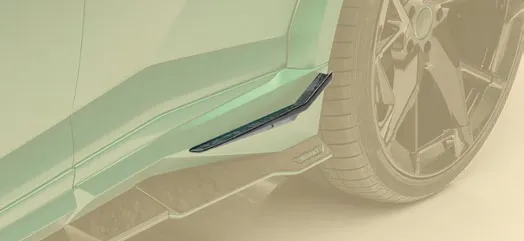
The Mansory air splitter and rear door extensions are the carbon-fibre trim pieces that finish the lower flank of the Lamborghini Urus Venatus, blending the side skirt into the rear wheel arch and adding a sculpted splitter element directly below the rear door. They sit in one of the busiest visual zones of the super-SUV — the transition between sill, rocker and arch — and on a widebody Urus, this is exactly where the eye lingers. Specified as part of the wider Mansory Body Kit for Lamborghini Urus Venatus S, these extensions resolve the geometry that the flared rear fenders open up, keep the visual weight planted, and complement the twin-turbocharged 4.0 TFSI V8, 8-speed ZF drivetrain, hexagonal Lambo design DNA and Y-shaped LED DRL signature with their own deliberate carbon weave language.
Construction & Materials
The extensions are produced from prepreg carbon fibre, layered over a precision Urus side-aperture template and consolidated by autoclave so the surface stays glassy when the panel is paired with the brushed-metal Lamborghini exterior trim. The splitter element — the small lip that protrudes below the rear-door line — is built up from extra plies in the load zone so the leading edge does not flex when the air-suspension drops the car onto Sport ride height.
- Prepreg 3K twill weave on the visible faces, mirror-matched left and right so the diagonal lines flow continuously from sill to rear arch.
- Autoclave cure under controlled pressure and temperature for void-free lamination and the deep-water gloss that Mansory specifies for its Urus Venatus programme.
- Wall thickness 2.4–2.8 mm across the main body, locally reinforced to 3.5 mm in the splitter leading-edge zone where stone-strike risk is highest.
- Panel weight per side approx. 1.2–1.5 kg — light enough to be driven by 3M VHB tape, with mechanical screw mounts at the rear-arch end where the panel curves around the wheel-house lip.
- Mounting hardware: stainless studs, EPDM-bonded washers, plus a structural bead of automotive PU adhesive along the upper join to the OEM sill.
- UV-stable clear lacquer (multi-stage Mansory deep-gloss) over the weave; alternative satin-clear finish available on request to match a satin widebody specification.
- Optional primed-for-paint sub-skin available so the extensions can be sprayed body-colour for monochrome builds.
- Edges deburred and de-glossed on the inside face to keep the panel acoustically dead — no carbon resonance over poor surfaces.
Design & Visual Function
From a styling perspective, the air splitter and rear door extensions exist to do one job extremely well: complete the lower flank. On a stock Urus, the sill ends and the rear wheel arch begins with a relatively neutral painted panel; on the Mansory Venatus, the widebody fender flares push the rear quarter outwards, and that creates a visual gap underneath the rear door that needs to be answered. These extensions answer it. The splitter ledge gives the lower flank a deliberate horizontal shadow line that ties into the rear splitter beneath the bumper, while the carbon weave picks up the same diagonal cadence as the side skirts and the front race-flap canards.
Functionally, the splitter element behaves as a passive flow tidy. It is not a downforce-generating wing — Mansory does not sell it as a track-spec aero piece — but at motorway speeds it cleans the air leaving the side skirt and helps it pass the rear arch without spilling laterally into the wake of the rear wheel. The result is a small but noticeable reduction in side-on turbulence at the rear, which on a 5.11 m, 2.2 t super-SUV is welcome.
Ground-clearance behaviour is the consideration that owners rightly raise first. The Urus rides on adaptive air suspension with several height settings; in Sabbia, Terra and lifted modes the body rises and the splitter element clears anything that would otherwise threaten it, while in Sport and Corsa the body squats and the splitter becomes a styling feature close to tarmac. We size the splitter so the lowest aerodynamic mode still keeps the leading edge above standard kerb height — but a sensible owner adopts the same habit they already use for the front lip: lift to mid-height before any sleeping policeman, ramp, or unfamiliar driveway.
Compatibility & Fitment
The extensions retrofit across the Lamborghini Urus, Urus S and Urus Performante (2018–present). Slug naming uses the generic Venatus convention, but the carbon templates accommodate the body-line revisions of the post-2022 Urus S facelift. Fitment is clear of the OEM Lamborghini side parking sensors and rear lateral radars; the panels do not cross any sensor aperture and do not cap any reflector. Adaptive air-suspension self-levelling is unaffected — these are passive trim panels, not load-bearing aero. Six driving-mode behaviour and rear-wheel-steering geometry are also unaffected, since the extensions add zero swept volume in the wheel arc.
Installation & Reversibility
Allow approximately 2–3 hours per side in a controlled workshop. The mount system pairs 3M VHB structural tape across the main bonding face with concealed screw fixings at the wheel-arch return; the screws thread into reinforced bosses behind the OEM rocker panel rather than through painted body, which keeps the install fully reversible. Surface preparation is the critical step: degrease with isopropyl alcohol, apply 3M primer 94 to both the OEM panel and the carbon flange, then bed the extension under firm hand-pressure and leave undisturbed for the cure window. The OEM sill trim does not have to be removed for fitment; the extension simply layers under its lower edge with a tight panel-gap. A Lamborghini-trained body-shop or Mansory-certified installer is recommended for first-fit on a freshly delivered Urus, especially if the car has not yet been corrected by paint protection, but a competent independent detailer can manage refit on a car already in the programme.
Pairing within the Mansory Urus Venatus programme
The air splitter / rear door extensions are most commonly specified alongside the parts that share their carbon language. The natural primary pair is the Mansory widebody kit — the extensions exist precisely because the widebody opens up the rear flank, and ordering both at once keeps the carbon batch and lacquer pass identical on the joining edges. The second sibling that almost always travels with this part is the Mansory rear splitter: it continues the splitter shadow line under the rear bumper, so the eye reads one continuous lower-edge feature from front sill to rear diffuser. As a third piece, owners going for the night-time signature add the Mansory air vent at tail-light, which closes the rear-quarter weave story above the wheel arch and gives the rear three-quarter view a fully resolved Mansory carbon perimeter.
Maintenance & Durability
Lacquered carbon on the lower flank is exposed to a slightly different threat profile than carbon on the upper body. Stone-chip from the rear tyre is the dominant risk — the rear tyre throws debris forward and outward across the lower portion of the splitter element. We strongly recommend self-healing PPF over the leading edge of the splitter and the first 80 mm of the panel face nearest the wheel; this is the single most cost-effective protection step. For washing, use pH-neutral shampoo, a soft mitt, and a dedicated wheel bucket so that brake dust and iron particles never travel onto the carbon panel. Avoid alkaline traffic-film removers, ammonia-based glass cleaners overspray, abrasive sponges and rotary buffers — all of which can micro-mar lacquered carbon weave.
Curb impact at low ride height is the failure mode to plan against. If the splitter element catches a high kerb, the laminate will absorb a surprising amount of energy before damage shows, but a deep gouge in the lacquer will eventually admit moisture; have it re-lacquered at a carbon specialist within the first wash cycle after any contact. A full panel exchange is straightforward thanks to the reversible mount system — there is no welded or bonded-to-body connection to undo.
Lead Time & Warranty
Production lead time is typically 4–8 weeks from confirmed order, in line with the rest of the Mansory bespoke Venatus programme. Each panel pair leaves with a 12-month warranty against manufacturing defects covering laminate quality, lacquer adhesion and bonded hardware integrity. Pre-order pairs of left/right panels are stock-checked first so cars already in for paint or PPF can be turned around without holding the bay.
FAQ
Q: Will the splitter element clear my driveway and speed bumps?
A: In standard and lifted air-suspension modes the panel clears comfortably; in Sport / Corsa the body squats and the splitter sits closer to the road surface. The same lift-mode habit you already use for the OEM front lip applies — lift before any obstacle of unknown height. We size the splitter to clear standard urban kerbs in mid-height ride.
Q: Does it fit Urus, Urus S and Performante?
A: Yes. The Mansory templates accommodate the pre- and post-facelift Urus body-line revisions, and the panel is clear of OEM parking sensors on every variant. Confirm your VIN at order so we ship the correct revision.
Q: Can I order it in body colour rather than visible carbon?
A: Yes. A primed-for-paint sub-skin is available; your bodyshop sprays the extensions in the body code of your Urus for a monochrome build. Most buyers stay with the lacquered weave so it speaks to the rest of the Venatus carbon programme, but the painted route is fully supported.
Q: If the splitter is damaged by a kerb, can it be repaired?
A: Light lacquer damage is re-cleared at a carbon-fibre specialist; deeper laminate damage is best handled by panel exchange under the reversible mount system. Because each side is its own panel, you do not have to replace both.
Q: How long is the lead time?
A: Mansory bespoke production runs 4–8 weeks. We confirm the production slot at order and update you when the panel pair leaves the bench for QA.
Pair these extensions with the rest of the Venatus widebody build and the rear flank reads as one resolved carbon panel from the sill to the diffuser. To configure your specification or talk through PPF, finish and lead time, message WhatsApp +44 7488 818 747 or write to [email protected].