
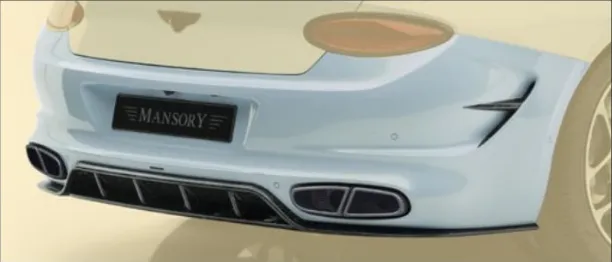
Rear bumper with diffuser I Mansory Carbon for Bentley Continental GT GTC V8


Rear bumper with diffuser I Mansory Carbon for Bentley Continental GT GTC V8
The Mansory rear bumper with diffuser I is the lower-key of the two diffuser variants for the Continental GT 2nd-gen programme — a clean three-channel layout sized around the V8 quad-tip exhaust outlets, with no auxiliary cooling vent in the lower face. It is the right pick for owners who want the Mansory rear silhouette and the carbon-diffuser theatre but prefer a tidier, more orthodox vane geometry. As a part, its job is to close the underbody airflow envelope at the rear and to give the quad tips a proper carbon picture frame instead of leaving them buried in OEM bumper plastic. Full kit context: Mansory Body Kit for Bentley Continental GT 2nd-Gen (D2A).
Construction & Materials
The rear bumper is laid up as a single shell with the diffuser strakes co-bonded as a sub-assembly during the autoclave cycle, not glued on after the fact. That matters at the rear — the diffuser is the part that loads under high-speed underbody suction and the part that catches every loading-ramp lip on a low-loader. Co-bonded strakes do not pop free.
- 3K twill visible-carbon outer skin with a 2x2 backing layer for stiffness
- Autoclave-cured epoxy, 120 °C / 6 bar; void content held under 1.5 %
- Wall thickness 2.6–3.2 mm on the main skin, 3.5–4.0 mm on the diffuser strake roots
- Approx. 9.4 kg complete (vs. ~14.0 kg OEM bumper assembly)
- Three full-depth strakes between the V8 quad tips, plus two outboard fences
- Stainless M6 captive hardware on OEM mount points; no chassis drilling
- OEM rear PDC, reverse camera, and tow-eye access preserved
- UV-stable 2K acrylic-urethane lacquer, hand-flatted, 60–80 µm
Design & Visual Function
The defining feature of variant I is the three-channel diffuser geometry: two strakes flanking the central pair of exhaust tips and one between, producing three equal-area expansion channels with a vane angle of approximately 11° relative to the underbody plane. That is a deliberately conservative angle — at the static ride height of a stock-suspension Continental GT V8, an 11° vane stays attached to the airflow at motorway speeds rather than stalling, which is the failure mode of the aggressively-vaned cheap aftermarket diffusers that look the part in photos but do nothing at speed.
The expansion area gain across the diffuser channels is in the order of 18–22 % relative to the OEM rear underbody, which translates into a measurable but not dramatic reduction in rear-axle aerodynamic lift in the 200+ km/h range, plus a tidier wake behind the car. The diffuser also tames the visual mass of the V8 quad tips by giving them clean carbon frames; OEM finishers, attractive in isolation, lose definition against the body-colour OEM bumper plastic and the diffuser geometry recovers it.
From the rear three-quarter view, the bumper drops the visual mass of the rear overhang and stretches the car horizontally — a calibrated trick of diffuser horizon-line geometry that the Mansory team uses across the entire Bentley programme. The eye reads the strake roots as the new lower edge of the body, even though the bumper proper extends slightly higher; this fools the proportion of the rear into looking longer and lower than the OEM car, despite no actual change in ride height or wheelbase.
The carbon-weave run on this variant is laid laterally across the upper bumper face and longitudinally along the strake faces. The lateral upper run is what gives the upper bumper its broad, calm reading from straight-on; the longitudinal strake run draws the eye into the diffuser channels. Mansory keeps the overlap zones inside the channel root corners so they are out of direct view, which is one of those finishing details that separate a serious carbon part from a budget aftermarket clone.
Worth noting: diffuser I is the variant that photographs better in low light and at night-time car-meet conditions. The shallower channel count and the absence of the lower vent give a cleaner, less busy rear face that reads well under spotlight and ambient lighting alike. Diffuser II is the variant that rewards bright daylight and a long lens; diffuser I rewards night ambience and side-light.
Compatibility & Fitment
The part is built for the Bentley Continental GT 2nd-generation (D2A) V8 4.0L twin-turbo, coupé and GTC convertible. It is sized around the V8 quad-tip exhaust footprint and is not a direct replacement on W12 cars unless the W12 exhaust system is converted to the V8 quad-tip pattern (a more invasive job than the bumper swap itself). Cars equipped with the OEM tow-pack: a tow-bar access cut is provided in the lower diffuser tray; the carbon section over the receiver is removable for hitch deployment.
Installation & Reversibility
Plan 5–6 hours of bench time. Remove the OEM rear bumper, transfer the PDC harness, reverse-camera connector, and tow-pack wiring (where fitted), then mount the carbon shell on the OEM M6 captive points and the rear impact-absorber bracket pair. Final alignment is set against the rear-quarter shut-line and the boot lower edge — diffuser-to-exhaust-tip clearance should be 12–14 mm to allow for thermal expansion of the exhaust system at full operating temperature. Reversibility is total: nothing on the car is cut, drilled, or permanently modified.
Pairing within the Mansory Continental GT programme
Diffuser I works particularly well with the rear decklid spoiler for a clean, understated rear theme, the Mansory carbon side skirts to continue the lower chord line forward, and the carbon engine bonnet to balance front-to-rear visual carbon mass.
Maintenance & Durability
Diffuser strakes are heat-loaded by the V8 exhaust at idle and especially at low-speed creeping; the carbon laminate is rated to 180 °C continuous which is well clear of the actual radiated temperature at the diffuser face (typically 70–95 °C), but expect the lacquer immediately downstream of the inboard tips to age slightly faster than the rest of the bumper. Plan a recoat or polish of that local zone every two to three years on a hard-driven car. Wash and wax routine matches the rest of the kit — pH-neutral shampoo, hand wash, sealant or carnauba every six to eight weeks. UV barrier is in the lacquer; do not use abrasive cleaners on the diffuser face.
Lead Time & Warranty
Lead time is 3–4 weeks from order. The part ships fully cured, lacquered, and inspected, in a foam-cradle wooden crate sized to protect the diffuser strakes. A 12-month warranty against manufacturing defects covers laminate voids, delamination, lacquer adhesion failures, and mounting-hardware faults. Heat-discolouration of lacquer adjacent to the inboard exhaust tips is a wear item and is not covered.
FAQ
Q: How does diffuser I differ from diffuser II?
A: Diffuser I has three expansion channels and no auxiliary lower vent; diffuser II has five channels and an integrated lower brake-cooling / rear-axle vent in the centre face. I is the cleaner, more conservative aesthetic; II is the more aggressive, motorsport-flavoured one.
Q: Will the diffuser strakes survive a low-loader ramp?
A: Strake roots are 3.5–4.0 mm laminate and they are co-bonded, not glued. They survive normal recovery loading. Aggressive ramp angles want a thin runner under the strake feet, same as you would do for any meaningful diffuser.
Q: Is the part heat-tolerant next to the V8 tips?
A: Yes. The laminate is rated to 180 °C continuous; the actual radiated temperature at the diffuser face is well under that. The lacquer is the wear surface, not the laminate.
Q: Can I keep the OEM rear-view camera and PDC?
A: Yes. Both are designed-in cut-outs; the harness transfers from the OEM bumper unmodified.
Q: Does it support a tow-bar?
A: Cars factory-equipped with the tow-pack are supported via a removable lower carbon section over the receiver. Retrofitting a tow-pack onto a non-equipped car is a separate job.
Q: Will the diffuser stall at low speed?
A: Diffuser stall is a function of vane angle and underbody flow attachment. At 11° vane angle and the static ride height of a stock-suspension Continental GT V8, the diffuser stays attached at typical motorway speeds. At very low speed (below about 60 km/h) the diffuser is not aerodynamically active in any meaningful sense — it is decorative — but that is true of every road-car diffuser ever fitted.
Q: How does it handle exhaust heat soak in stop-start traffic?
A: Continuous radiated temperature at the diffuser face during long idling sits in the 70–95 °C band; the laminate is rated to 180 °C. The lacquer adjacent to the inboard tips ages first; that is a known wear zone and is touchable in by a competent paint shop without a full bumper repaint.
Q: Does it change the exhaust note from inside the car?
A: Marginally. The diffuser channels create a small reflective surface area behind the V8 quad tips, which can lift the lower-mid frequencies of the exhaust note by 1–2 dB at idle. At cruise it is imperceptible against road and engine noise.
Pair this rear bumper with the carbon side skirts for a continuous lower chord line front to rear. CTA: WhatsApp +44 7488 818 747 or [email protected].