
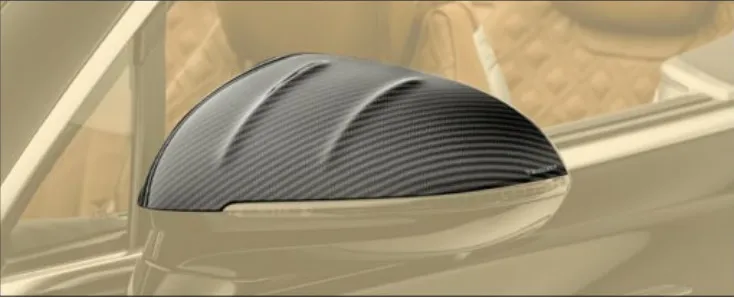
Mirror housing Mansory Carbon for Bentey Continental GT


Mansory Carbon Mirror Housings for Bentley Continental GT (3W, 2003–2011)
Door mirror housings occupy a peculiar position in carbon bodywork: physically small, yet among the most scrutinised components on any car because they sit at eye height at typical roadside viewing distance. A wrinkle in the 3K weave, a void in the laminate, or an inconsistent lacquer sheen is immediately visible in a way the same defect on a rear diffuser simply is not. Mansory's carbon mirror housings for the Continental GT 3W address this through matched-pair production — both driver and passenger housings are produced in the same autoclave run with identically oriented prepreg plies, so the weave reads consistently across both sides. Within the Mansory Carbon Fiber Body Kit Set for Bentley Continental GT, the mirror housings are the accent component that signals build quality from close range — the piece a knowledgeable observer examines first to assess whether the full carbon programme has been executed with precision.
Construction & Materials
The Continental GT 3W mirror housing presents a genuine manufacturing challenge. The housing surface divides into three distinct zones requiring different prepreg ply handling: the forward-facing convex surface, which carries the visible 3K twill face and must be cut to follow a compound curve without wrinkling; the side-blade section, a thin-wall area where the weave is visible at near-perpendicular angles; and the base transition radius, where the housing meets the door surface — the most difficult zone, where the curve changes from convex to concave within a few centimetres and the prepreg must maintain fibre continuity without bridging. Mansory uses separately cut prepreg plies for each zone, with overlap joints positioned at non-visible parting lines hidden within the assembly geometry when the housing is fitted. The assembled preform is autoclave-cured at elevated pressure to consolidate the laminate and eliminate void content. Finished outer surfaces are lacquered before the mirror glass mechanism, heating element wiring, and indicator unit are reinstalled using transferred OEM hardware.
Wall thickness across the housing body runs 1.5–2.0 mm, tapering to approximately 1.0 mm at the blade section. Each carbon housing weighs approximately 0.35 kg, against the OEM painted plastic housing at approximately 0.5 kg per side — a 150 g saving from an elevated, outboard position. The matched-pair weave orientation aligns the 0°/90° warp and weft yarns to the car's horizontal waterline on both sides, giving a geometrically coherent pattern side-to-side. Finish options are gloss and satin clear lacquer, both UV-stable, applied in multiple coats over the raw prepreg face.
- Weave: 3K twill prepreg, matched-pair production for consistent orientation both sides
- Wall thickness: 1.5–2.0 mm across housing body, 1.0 mm at blade section
- Weight: approx 0.35 kg per housing (vs OEM plastic approx 0.5 kg per side)
- Indicator: OEM position aperture retained; indicator unit reinstalled from OEM housing
- Mirror glass: OEM glass and heating element transfer to new housing
- Finish: gloss or satin clear lacquer, UV-stable multi-coat application
- Matched pair: both housings produced in the same autoclave run for weave consistency
Design & Visual Function
At arm's length — the typical proximity of someone passing on a pavement or examining the car in a car park — the weave structure of a mirror housing is clearly visible as a resolved geometric pattern. Mansory's 0°/90° twill orientation aligns warp yarns parallel to the horizontal of the door surface and weft yarns perpendicular: the result is a grid the eye reads as intentional, architectural geometry rather than a random textile pattern. Generic carbon mirror housings frequently run the weave at 45° to the car's axes, which looks visually jarring against the horizontal shoulder line. The matched-pair production ensures the same alignment appears on both sides simultaneously.
The compound-curve geometry creates a visual quality a flat carbon surface cannot replicate: as the viewer moves, reflection angles shift across the three surface zones simultaneously. The forward-facing convex zone catches direct light and produces a high-luminance reflection; the base transition radius holds a darker tone at the same moment; the blade section presents a third luminance value. The housing appears to have more visual depth than a painted unit of identical geometry — the weave is visible at multiple angles and reflections shift independently across zones. In gloss lacquer this effect is most pronounced; satin lacquer softens contrast between zones while retaining the dimensional quality of the weave. This multi-zone visual depth is intrinsic to carbon fibre on a compound-curve surface and cannot be replicated by metallic paint or vinyl film.
The housings are also visible from inside the cabin when the driver uses the door mirror. In gloss lacquer a bright peripheral reflection appears on sunlit days; in satin, the diffused finish reduces this glare without sacrificing exterior visual impact. Owners who have tried both frequently prefer satin for driver comfort while maintaining full exterior presence.
Compatibility & Fitment
Fits Bentley Continental GT 1st generation, 3W chassis, 2003–2011 — both GT coupé and GTC convertible. The door mirror assembly is identical across both body types. Compatible with the W12 6.0-litre twin-turbo and V8 4.0-litre twin-turbo late-facelift variants; the mirror system is not engine-specific. Not compatible with the 2nd-generation Continental GT (D2A chassis, from 2012), which uses a different mirror stalk geometry and housing profile. LHD and RHD versions are mirror-image pairs — specify LHD or RHD at order. Normally supplied as a matched left-and-right pair; single-side orders available on request.
Installation & Reversibility
Installation requires approximately 45 minutes per side for an experienced technician. The OEM mirror housing is retained by three to four retaining clips plus the mirror stalk trim cover. Once removed, the mirror glass, heated-element wire connector, and indicator unit transfer to the new carbon housing using OEM retaining hardware — no new fasteners or adhesives are required. The glass transfer requires a mirror-glass trim tool to avoid cracking the glass; this is the most common point of damage during the process. Indicator unit retaining clips transfer without modification. The new housing clips onto the OEM mirror stalk mounting using identical connection geometry. The installation is fully reversible: the OEM housing can be reinstalled at any time without permanent modification to the car.
Pairing within the Mansory Continental GT 3W Programme
The mirror housings carry the Mansory carbon language through the A-pillar and upper-door zone. They pair as a variant option with the mirror housing II, which offers a revised blade-section geometry — both are valid choices, and many customers request photos of both before ordering. Along the door surface they work alongside the front fender and door strip, continuing the carbon accent from the front quarter panel across the door aperture. They complement the carbon engine bonnet: the bonnet provides the large-area carbon surface at the front of the build; the mirror housings provide the accent detail at the bonnet-to-door transition.
Maintenance & Durability
Mirror housings face a specific risk profile: car-park door contacts, wing-mirror brush contact in narrow spaces, and low-speed pedestrian contact are realistic hazards for a component that protrudes at arm height. PPF applied to the side-blade outer face is a practical precaution for owners who regularly park in tight spaces. The compound-curve forward face makes PPF application challenging and requires an experienced installer with a heat gun, but the result provides effective chip and contact protection. Ceramic coating on the visible faces simplifies regular cleaning. When addressing bird droppings on the lacquered surface, rinse promptly — acidic droppings can micro-etch clear lacquer if left for extended periods. The rigid carbon structure eliminates the low-frequency resonance the OEM plastic housing develops at sustained higher road speeds. Any rattle from the mirror area after fitting indicates a loose OEM stalk retaining clip rather than a housing defect.
Lead Time & Warranty
Matched pairs ship on a 2–3 week lead time from order confirmation. Single-side orders are produced on the same lead time. A replacement from a separately produced batch may show slight weave-pattern variation in direct-light viewing — for appearance-critical builds, ordering both sides from the same run is recommended. The 12-month warranty covers delamination, structural voids, and manufacturing defects in the lacquer finish from the date of delivery. Damage to the mirror glass or heated-element wiring during installation transfer is not covered.
FAQ
Q: Do the Mansory mirror housings retain the OEM indicator?
A: Yes — the housing retains the OEM indicator aperture in its factory position. The indicator unit, wiring, and connector transfer directly from the OEM housing without modification. No additional wiring or relay changes are required, and indicator operation and brightness are unchanged. LHD and RHD indicator positions are correct per their respective housings.
Q: What is the difference between mirror housing and mirror housing II?
A: The standard mirror housing (this product) replicates the OEM 3W Continental GT housing geometry exactly in carbon. Mirror housing II has a different blade-section geometry. For owners who want the precise OEM shape in carbon, the standard housing is the correct choice. For a revised blade profile, mirror housing II is the alternative. Contact us for photos of both configurations.
Q: Should I order gloss or satin finish?
A: Both finishes work well on the 3W Continental GT. Gloss creates the highest-contrast carbon effect. Satin reduces peripheral reflectivity visible to the driver when using the door mirror and pairs well with matte-finish body wraps. On dark body colours many owners prefer satin for a more cohesive look; on light-coloured bodies gloss creates maximum contrast. Both are available at identical lead time.
Q: Are the housings available individually or only as pairs?
A: Produced and sold as matched pairs to guarantee weave orientation consistency. Single-side orders are available on request, but a replacement from a separately produced batch may show slight weave-pattern variation in direct-light viewing. For appearance-critical builds, ordering both sides from the same production run is recommended.
Q: Does the carbon housing affect aerodynamic drag compared to OEM?
A: No — the standard housing replicates OEM 3W geometry exactly, so aerodynamic drag is unchanged. The primary improvement over OEM is acoustic: the stiffer carbon shell eliminates resonant frequencies the OEM plastic develops at sustained higher road speeds, reducing high-frequency wind noise at the blade that some Continental GT owners notice.
Order your matched pair of Mansory carbon mirror housings for the Continental GT 3W — specify LHD or RHD and preferred finish via WhatsApp +44 7488 818 747 or [email protected].