
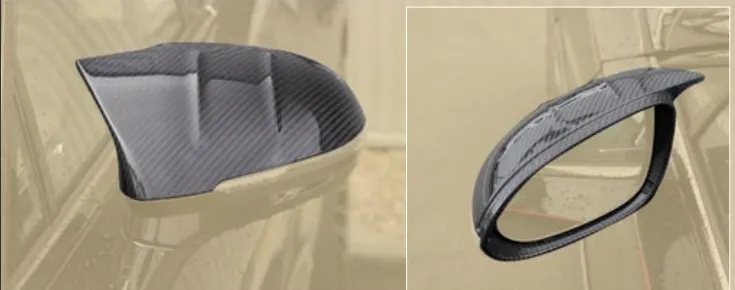
Mirror housing II Mansory Carbon for Bentey Continental GT


Mansory Carbon Mirror Housing II for Bentley Continental GT (3W, 2003–2011)
The standard Mansory mirror housing converts the Continental GT 3W's OEM body-colour plastic shell to carbon fibre while preserving the OEM housing geometry exactly. Mirror housing II represents Mansory's second-generation design for the same application: the blade section has been revised with a sharper trailing edge, creating a measurable improvement in aerodynamic drag and acoustic character at speed. The forward face carries a subtly revised crown radius compared to both the OEM and the standard carbon housing, producing a more sculpted side profile. Housing II is part of the complete Mansory Carbon Fiber Body Kit Set for Bentley Continental GT. For owners who want the carbon mirror with a design evolution beyond the OEM geometry, the II is the specification that delivers it.
Construction & Materials
Housing II shares the same fundamental manufacturing specification as the standard Mansory carbon mirror housing: 3K twill prepreg carbon fibre, autoclave cured, produced as a matched pair. The 3K twill weave produces the tight, regular pattern characteristic of Mansory's visible-carbon components. Autoclave curing ensures full consolidation and eliminates void content. Matched-pair production guarantees that both housings share identical weave orientation — the pattern reads continuously across both sides of the car. The differentiation in housing II is in the mould geometry: the trailing edge of the blade section has been revised from the OEM's blunt trailing radius to a sharper exit angle. To maintain structural integrity at the sharpened TE, a narrow unidirectional carbon tape strip is integrated into the ply schedule at the blade trailing edge interior face, providing local stiffness without meaningful weight addition. The inner housing geometry at the OEM mirror stalk interface is unchanged — all clip, glass, heating element, and indicator aperture dimensions are preserved.
Wall thickness: 1.5–2.0 mm at the housing body, 1.0 mm at the blade section at the sharpened TE zone. Finish: gloss or satin clear lacquer, UV-stable. Weight: approximately 0.37 kg per housing versus 0.35 kg for the standard — a negligible difference attributable to the UD reinforcement strip.
- Weave: 3K twill prepreg, autoclave-cured — identical to standard housing
- Blade TE: sharper exit angle versus standard housing — UD tape strip reinforcement at trailing edge interior
- Forward crown: revised radius versus OEM and standard housing — more sculpted anterior profile
- Mirror stalk interface: identical to standard and OEM (no modification required)
- OEM component transfer: mirror glass, heating element, indicator unit — all transfer as standard
- Weight: approximately 0.37 kg per housing (versus 0.35 kg standard)
- Wall thickness: 1.5–2.0 mm body, 1.0 mm blade at thinnest section
- Finish: gloss or satin clear lacquer, UV-stable
Design & Visual Function
The aerodynamic rationale for the revised blade begins with the OEM geometry. The Continental GT 3W was homologated in 2003 and its mirror housing carries a blunt trailing edge — standard practice for that production era, where manufacturing simplicity favoured the blunt exit over the more complex tooling required for a defined trailing edge. A blunt trailing edge generates a wider, deeper aerodynamic wake immediately aft of the housing — a low-pressure region that contributes significantly to mirror drag. Mirrors account for approximately 6–8% of total vehicle aerodynamic drag on a large GT car. At 100 km/h, the standard Continental GT mirror housing generates approximately 8–12 N of drag per side. The sharper trailing edge of housing II reduces the wake width and depth; Mansory's engineering analysis indicates a drag reduction of approximately 12–18% per housing — a saving of approximately 1–2 N per side. The acoustic benefit is more immediately perceptible in daily use: a blunt trailing edge creates a high-frequency tonal content in wind noise at speed from periodic vortex shedding. The sharper TE of housing II attenuates this tonal characteristic, reducing the resonant wind note that drivers familiar with the OEM mirror will recognise at motorway speeds.
Visually, the revised blade profile is most apparent from the front-three-quarter angle — the angle from which a mirror housing is most frequently observed. The sharper trailing edge creates a more defined side profile, reading as a purpose-designed aerodynamic component rather than a translated OEM form. The forward face crown revision — subtly fuller anterior aspect — complements the sharper rear, creating a cleaner leading-to-trailing-edge transition. For owners attending concours events or detailed photographic sessions, the II's blade geometry is a distinguishable detail at close inspection. Both housings maintain identical 0°/90° warp orientation, consistent with the weave reference used across all Mansory Continental GT 3W carbon components.
Compatibility & Fitment
Mirror housing II is designed for the Bentley Continental GT first generation — 3W chassis, 2003–2011 — covering the GT coupé and GTC convertible. The door mirror assembly uses a common stalk, glass, and housing architecture across both body styles, so housing II is fully compatible with the GTC without modification. Compatible with all powertrain configurations offered during the 3W production period. NOT compatible with the second-generation Continental GT (D2A chassis, from 2011). The revised blade profile does not affect mirror-glass coverage zone — housing depth and mirror positioning are unchanged from the standard housing, preserving the factory field of view. LHD and RHD configurations are available as mirror-image housings. Standard supply is as a matched pair; single-side orders available on request.
Installation & Reversibility
Installation procedure for housing II is identical to the standard Mansory carbon mirror housing replacement. Total time: approximately 45 minutes per side. The process involves: removal of the OEM housing from the stalk via clip disengagement with a trim tool; transfer of the mirror glass with a mirror glass removal tool; reconnection of the heating element connector and indicator unit in the II housing; clip-mounting of the completed assembly onto the OEM stalk. The revised blade geometry has no effect on the clip-mounting interface — housing-to-stalk connection points are dimensionally identical to both OEM and standard carbon housing. No drilling, bonding, or stalk modification is required. Fully reversible: the OEM housing can be refitted at any time. A professional technician is recommended for the mirror glass transfer step to avoid cracking. Production schedule: matched pairs 2–3 weeks from order confirmation.
Pairing within the Mansory Continental GT 3W Programme
Mirror housing II pairs most naturally with the front-quarter carbon components: the Mansory front fenders with integrated stripe, which carry the carbon graphic across the front arch and visually connect the bonnet line to the mirror zone, and the Mansory carbon side skirts along the full sill. The Mansory front bumper with front lip establishes the carbon language at the leading edge, while the Mansory carbon engine bonnet provides the largest single carbon surface. For owners comparing the standard housing to the II, the standard mirror housing documents the OEM-geometry specification — both deliver the same 3K twill prepreg construction quality; the II adds the revised blade profile and sharper visual character for owners who want the design evolution beyond a direct carbon translation of the OEM form.
Maintenance & Durability
The sharpened trailing edge is slightly more exposed to car-park contact damage than the blunted OEM-geometry trailing radius. PPF applied to the blade trailing edge — a 100–150 mm strip — is specifically recommended for housing II, particularly for owners who park in tight urban environments. In the event of a chip at the trailing edge, spot lacquer repair is straightforward but the edge needs to be filled cleanly to restore the aerodynamic geometry and visual line. For the forward face and housing body, ceramic coating is the standard maintenance approach, protecting the lacquer from UV and contamination. Carbon fibre laminate: permanent. Clear lacquer expected service life: 10–14 years. Wind noise post-installation: the sharper TE should reduce the high-frequency whistle characteristic of blunt mirror profiles at speed. If any wind noise is perceived post-installation, confirm the indicator unit is fully seated — gaps at the indicator aperture are a common secondary noise source on any mirror assembly.
Lead Time & Warranty
Standard supply as a matched pair: 2–3 weeks production lead time from order confirmation. Single-side orders available on request — confirm LHD or RHD configuration and which side is required when ordering. 12-month warranty against delamination, structural laminate voids, and lacquer manufacturing defects from delivery. Mirror glass transfer damage during installation is not covered under the manufacturing warranty. Aerodynamic performance figures are engineering estimates based on Mansory's analysis; individual results vary with installation and driving conditions.
FAQ
Q: How noticeable is the visual difference between housing I and housing II at close range?
A: At arms' length in direct light, the difference is clearly visible — the II has a defined, sharp trailing edge rather than the rounded exit of the standard housing, and the forward face crown is subtly fuller. From normal road-viewing distances beyond 5 metres, both housings present as carbon mirror upgrades and deliberate comparison is needed to distinguish them. The difference is most meaningful at close-range inspection — car shows, detailing sessions, mirror-zone photographs. For owners who appreciate engineering-evolved detail, the II is the preferred choice.
Q: Does the sharper trailing edge affect rear visibility through the mirror glass?
A: No. Mirror glass position and angle are determined by the stalk mounting geometry, unchanged in housing II. Field of view is identical to the OEM and standard carbon housings. The revised geometry is entirely in the external housing shell surfaces.
Q: Is housing II compatible with the GTC convertible?
A: Yes. The door mirror assembly on the GTC is architecturally identical to the coupé — common stalk, glass, and clip interface. Housing II installs on the GTC using the same procedure as on the coupé.
Q: Can I run one housing I and one housing II if one side needs replacement?
A: Technically possible, but visually inconsistent at close range. Mansory recommends matching specifications on both sides. Photographs of the installed housing help confirm which variant is on the car so the replacement can be specified to match.
Q: Does housing II's revised profile affect the mirror-fold mechanism?
A: No. The Continental GT 3W mirror-fold mechanism is a stalk-mounted motor assembly — fold angle and stop position are determined by the stalk mechanism, not the outer housing geometry. Housing II folds identically to the OEM and standard carbon housings.
Upgrade to the revised Mansory carbon mirror housing II for your Continental GT — discuss your specification via WhatsApp +44 7488 818 747 or [email protected].