
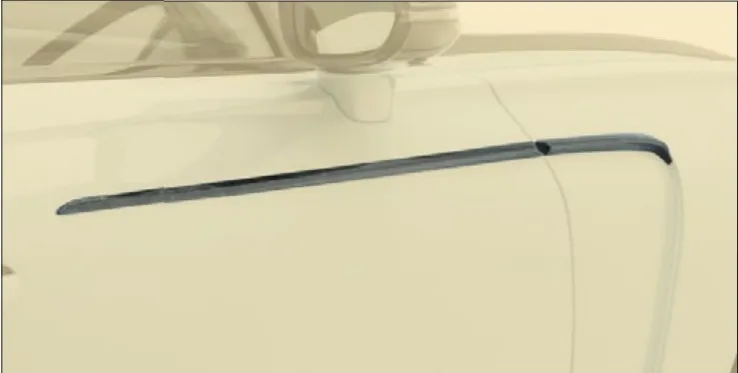
Front fender and door strip Mansory Carbon for Bentey Continental GT


Mansory Carbon Front Fender and Door Strip for Bentley Continental GT (3W, 2003–2011)
Of all the modifications available for the Bentley Continental GT 3W, few deliver as immediate a visual result as the Mansory carbon fender-and-door strip. The 3W Continental GT has one of the largest uninterrupted door panels in the grand touring segment — measuring nearly 1,400 mm from the front fender edge to the door trailing edge. That expanse of body panel reads as an imposing but undifferentiated slab in standard form. The Mansory carbon strip cuts a precise horizontal graphic into this mass: a speed line that visually lowers the car, increases perceived width, and signals bespoke specification to anyone who encounters it. This strip is part of the complete Mansory Carbon Fiber Body Kit Set for Bentley Continental GT programme and may be specified independently.
Construction & Materials
The strip is a narrow-section carbon fibre laminate, 65–75 mm wide, running the full fender-to-door length. Mansory specifies 3K twill prepreg with warp yarns oriented horizontally — parallel to the waterline — the standard Mansory alignment for horizontal accent elements. The horizontal warp orientation means the weave's directional reflectivity reinforces the speed-line effect: when light strikes along the strip's length, the woven structure generates a shimmering linear texture that amplifies the longitudinal graphic. Autoclave cure at 130 °C under 6 bar produces a void-free laminate; edges are CNC-trimmed to ±0.5 mm. Mounting uses 3M VHB structural tape on the reverse face and stainless clip pins at each end.
Despite the strip's narrow section, the carbon laminate maintains full rigidity over the 1,400 mm span — aided by a stiffening rib on the reverse face. Total weight per strip is approximately 0.6 kg — negligible. The clear lacquer system is a two-component UV-stable polyurethane applied in two coats, available in gloss or satin matte finish.
- Weave: 3K twill prepreg, warp yarns horizontal (parallel to waterline), autoclave cure
- Width: 65–75 mm across the strip profile, varying with door contour
- Wall thickness: 1.4 mm main face, 1.0 mm at edges
- Weight: approx 0.6 kg total for fender-to-door run
- Mounting: 3M VHB structural tape on reverse face + stainless clip pins at fender and door ends
- Finish: gloss clear lacquer or satin matte lacquer, UV-stable two-component system
- Reverse face: matt carbon, no additional finish required
Design & Visual Function
The Gestalt effect of the horizontal strip on the GT's proportions is substantial relative to the component's modest size. The Continental GT 3W is a tall car in relation to its wheelbase — a consequence of its raised floor and all-wheel-drive architecture, and its high arched roofline. The Mansory carbon strip, positioned along the lower shoulder zone at approximately door-handle height, creates a visual division between the upper painted greenhouse and the lower body volume. This functions exactly as a "speed line" in full-size automotive design: it presses the visual centre of gravity downward, making the car read as lower, wider, and more planted. The carbon weave provides both tonal contrast and directional reflectivity that the painted panel cannot replicate, giving the strip a dynamic quality that changes with the angle of light.
At the fender-to-door body gap — nominally 5 mm on the 3W — the strip transitions from fixed fender to opening door. Mansory resolves this through a two-section approach: a fender section and a door section, each ending with a precisely mitered profile at the body gap, matched to the OEM gap angle. When the door is closed, both sections align to within 0.5 mm, and the visual read is of a continuous line interrupted by the known body gap — an industry-standard approach for accent strips on multi-panel surfaces. In the coupé, the trailing-edge terminal is mitered to 45°, creating a clean endpoint at the rear quarter panel transition. In the GTC, the same terminal geometry applies.
The strip's visual character changes with body colour. On Beluga Black, the carbon reads as a subtly differentiated plane until direct sunlight reveals the shimmering weave structure. On Glacier White or Starlight, it creates maximum contrast. On Magnetic Grey or Granite, it reads as a tonal accent — darker than the body metallic but sharing its depth — producing a sophisticated same-family contrast that works well at low viewing angles.
Compatibility & Fitment
Fits Bentley Continental GT 1st generation (3W chassis, 2003–2011) coupé and Continental GTC convertible. Engine variant does not affect fitment — the door and fender surfaces are identical across W12 6.0L twin-turbo and V8 4.0L twin-turbo specifications of the 3W. The strip profile is engineered for the 3W body surface curvature and is not compatible with the 2nd-generation D2A platform, which has a different shoulder line profile and door contour. Both LHD and RHD cars have symmetric door and fender surfaces; this strip suits both. Standard supply is a complete left-and-right pair; individual sides are available on request for replacement purposes.
Installation & Reversibility
Installation time is approximately 1.5 hours per side for an experienced detailer. Clean and degrease the mounting surface with isopropyl alcohol, apply adhesive primer to both the car panel and the 3M VHB reverse face, allow to flash off, then position and press progressively from centre to each end for 60 seconds. Stainless clip pins at each end — requiring a 2 mm pilot hole into the fender/door panel edge — provide long-term anti-peel security. Full VHB bond strength is achieved at 72 hours. Reversibility is retained throughout: the 3M VHB can be released with a dental-floss or piano-wire liftoff technique without paint damage, and the 2 mm clip pin holes can be plugged invisibly if the strip is permanently removed.
Pairing within the Mansory Continental GT 3W Programme
The fender-and-door strip occupies a specific position in the lateral carbon accent hierarchy of the Mansory 3W programme. The Mansory front fenders with stripe carry the carbon accent across the fender surface; this strip extends it across the body gap and along the full door — together, the two components deliver a continuous carbon horizontal graphic covering approximately 2,000 mm from the wheel arch to the door trailing edge. The Mansory carbon mirror housing adds carbon above the beltline, creating a vertical counterpoint to the door strip's horizontal emphasis. For owners wanting fender-zone carbon without full fender replacement, the cover for OEM fender completes the arch-to-door transition. The strip also pairs with the Mansory carbon side skirts to deliver a two-register lateral carbon graphic at sill and door-panel heights.
Maintenance & Durability
The strip sits in the mid-body zone, above sill height and below the shoulder line — largely sheltered from the road-spray that exposes sill-level components to the highest stone-chip loading. Primary durability risks are car-park door contacts (chipping the lacquer at the inboard edge), automated car-wash brush systems (lifting the VHB edge at an acute angle), and water pooling on the upper face. Mansory designs the strip with a slight outward convex cross-section to shed water. A PVC paint protection film (PPF) applied over the lacquered surface provides 5–7 years of impact and abrasion resistance without affecting the carbon's appearance. Ceramic coating is equally compatible. Lacquer lifespan: 10–14 years. Carbon laminate substrate: effectively indefinite.
Lead Time & Warranty
Fender-and-door strip pairs ship within 2–4 weeks of order. Single-side orders carry the same lead time. All Mansory parts carry a 12-month warranty against manufacturing defects — delamination, dimensional fitment failure, lacquer manufacturing faults — from the delivery date. The 3M VHB tape adhesive system carries a 10-year bond strength rating under normal environmental conditions.
FAQ
Q: Is this the same strip as the one integrated into the front fenders with stripe?
A: No — they are two separate SKUs on different panels. The front fenders with stripe have the carbon accent moulded as an integral part of the fender laminate. The front fender and door strip (this SKU) is a separate applied component spanning the fender-to-door gap and running the door panel length. Many owners specify both for a continuous accent from the wheel arch front to the door trailing edge.
Q: Does the strip interfere with door seals or weatherstripping?
A: No. The strip runs along the body panel face, terminating approximately 20 mm from the door shut face at both ends — entirely clear of all weatherstripping and door seal geometry. The gap between the strip terminal and the door aperture edge is part of the visual design.
Q: Can this be fitted to a GTC convertible as well as the coupé?
A: Yes. The front door and front fender surfaces are identical across both the coupé and GTC convertible on the 3W platform. The door section of the strip ends at the trailing edge of the front door in both variants. This SKU covers the front door and front fender only.
Q: What happens at the gap between the front fender and the door?
A: The strip is supplied as two sections — a fender section and a door section — each ending with a precision-mitered edge at the body gap. Both sections align to within 0.5 mm when the door is closed, reading as a continuous line interrupted by the body gap. The miter profile is CNC-cut for geometric consistency across all units.
Q: Does the strip add drag or affect high-speed stability?
A: No. A 70 mm wide, 1.4 mm thick strip along the door contributes negligible aerodynamic effect at grand-touring road speeds — it falls within instrument measurement noise. This component's function is visual rather than aerodynamic, unlike the front bumper splitter and side skirts, which have measurable lower-body airflow effects.
Transform the flank of your Continental GT 3W with the Mansory carbon fender-and-door strip — discuss your specification via WhatsApp +44 7488 818 747 or [email protected].