Roof cover cabrio Mansory Carbon for Lamborghini Aventador Competition


Mansory Carbon Roof Cover Cabrio for Lamborghini Aventador Competition
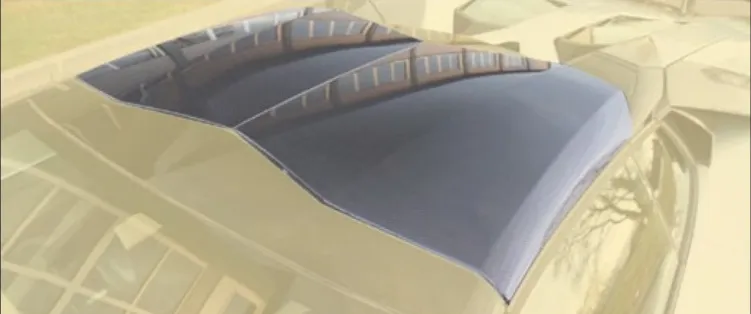
The Mansory Carbon Roof Cover Cabrio is a Roadster-exclusive finisher inside the Mansory Carbon Body Kit for Lamborghini Aventador Competition programme. Where the coupé carries a fixed glass-and-CFRP roof, the Aventador Roadster instead uses a two-piece carbon targa-top arrangement that the driver lifts off, latches together and stores upright above the naturally aspirated V12. This part addresses that exact zone: it either replaces the lacquered surface of the lift-off panels, or finishes the well above the engine where those panels are stowed, depending on the configuration the owner specifies. It is the carbon detail that lets a Roadster look as deliberate roof-up as it does roof-down, alongside scissor-door geometry, ALA channels and the high-mount twin exhaust.
Construction & Materials
Open-top usage is brutal on a horizontal carbon surface. The roof cover lives directly under the sun, sees rain run-off, and is handled by gloved or bare hands every time the targa panels are lifted, married together and placed. Mansory engineers the lay-up around that abuse: the visible weave is a high-tension 3K twill front-face with a 2K plain-weave option for clients who prefer a finer, glassier read. Behind the cosmetic ply sit four to six structural plies of unidirectional CFRP cross-stacked at 0°/90° and ±45°, then a foam or aramid honeycomb where extra dent resistance over the stowage bay is needed. Cure happens in a heated autoclave under vacuum, so resin distribution is uniform, the surface stays mirror-flat after demould, and you do not get the orange-peel print-through that dogs hand-laminated roof panels.
- Surface ply: 3K twill (default) or 2K plain weave; forged-look composite available on request
- Sub-laminate: 4–6 plies UD CFRP, cross-stacked; honeycomb core where panel-stowage area is finished
- Cure: autoclave, ~6 bar, 120°C dwell, post-cure for dimensional stability under sun load
- Wall thickness: ~2.0 mm flat sections; ~3.5 mm at clip-engagement bosses
- Lacquer: high-UV automotive 2K clear with HALS additive package, gloss or matte
- Weight: ~1.6–2.4 kg depending on coverage (panel finisher vs. stowage cover)
- Hardware: OEM Lamborghini latch carriers, dowels and Velcro pads transfer 1:1
- Edges: machined, deburred, sealed against humidity migration
Design & Visual Function
The Aventador Roadster's targa top has a very particular character. Two carbon panels lift off independently, clip together back-to-back via a central spine, and slide vertically into a recess just behind the cabin and just ahead of the V12 intake plenum. Mansory's roof cover for the cabrio embraces both faces of that ritual. With the panels in place, the upper surface reads as one continuous carbon plane between the A-pillars and the rear-bridge area, with weave aligned along the centreline so the eye travels uninterrupted from windscreen header to engine hood. Lift the panels off, and the stowage well that is exposed is also wrapped in carbon — no painted plastic, no body-colour visible — so the open-top silhouette stays graphic from every angle.
The weave is laid with deliberate intent. Mansory rotates the cosmetic ply so the diagonal of the twill bisects the central seam between the two targa panels, which makes the join read as a design line rather than an accident. UV exposure is treated as a design constraint rather than an afterthought: the lacquer system is loaded with hindered amine light stabilisers that delay the yellow-shift carbon clearcoats normally suffer when they live outside in summer sun. Reflections off the polished weave behave consistently with the engine bonnet behind it — a deliberate match so that, with the roof on, the back two-thirds of the silhouette reads as a single long carbon ribbon.
For owners who run the car roof-down most of the time, the stowage-bay variant is often the bigger statement. Looking down into the well from outside the car, you see a tray of high-gloss carbon framing the upright panels, with subtle Mansory script embossed into the corner. That single detail is what separates a stock Roadster cabin-back from a fully realised Mansory Competition Roadster.
Compatibility & Fitment
This part is Roadster-only. It does not fit the coupé under any circumstance — the coupé’s roof-line is structural CFRP bonded to the monocoque and uses entirely different mount geometry. Within the Roadster family, the cover is correct for LP700-4 Roadster, LP750-4 SV Roadster, S Roadster, SVJ Roadster (one of 63 units) and Ultimae Roadster. Mansory's CNC reference data is taken from late SVJ Roadster body-in-white, which means the latch pockets, dowel positions and clip retainers index exactly where Lamborghini placed them. The OEM targa-panel removal sequence — release inner latch, lift, mate, stow — is preserved without modification. Parking sensors, rain sensors, micro-switches in the latch loom and engine-bay sensors above the V12 are untouched.
Installation & Reversibility
Fitment time is short relative to bumper or side-skirt work: budget 90 minutes to 2.5 hours per side or per panel depending on the variant ordered, plus thermal-soak time for the structural adhesive. The replacement variant of the cover is a direct swap: undo the OEM mount fasteners, transfer Velcro and seal strips to the Mansory part, dry-fit, torque to spec. The overlay variant uses double-sided automotive structural tape combined with a methacrylate-compatible primer on the substrate so that the bond chemistry plays nicely with the Aventador's adhesive-bonded CFRP architecture. Once cured, the overlay cannot be levered off without damaging the underlying surface; the replacement variant is fully reversible if OEM panels are kept on a shelf. We recommend a Lamborghini-certified body shop or a Mansory-trained installer because the targa panel mating geometry is fussy: half a millimetre of misalignment translates to a wind-roar at 140+ km/h. After install, the latches must be exercised through twenty cycles to confirm the panels still seat and stow without fouling the new edge.
Pairing within the Mansory Aventador Competition programme
The roof cover lives in the same visual zone as several other carbon parts and benefits from being specified alongside them. Closest sibling is the Roadster-only Engine bonnet cabrio — the pair share a centreline, share lacquer batch and share weave alignment, so ordering them together is the only way to guarantee a flawless visual transition from cabin-back into engine cover. Owners who switch between roof-on and roof-off cars (or who want the visual story documented across both body styles in their collection) often also reference the coupé-only Engine bonnet for matching weave finish across vehicles. Further back, the Rear bridge closes the loop between the stowage area and the rear deck, eliminating the last painted strip that would otherwise interrupt the carbon read from windscreen to tail.
Maintenance & Durability
A horizontal carbon panel that lives outdoors is the most demanding piece of cosmetic carbon on a car. Three failure modes dominate: clearcoat yellowing under UV, water-spotting from minerals after rain dries on hot weave, and micro-scratches from grit caught between the targa panels and gloves during stow/unstow. Mansory's lacquer system addresses the first; ceramic coating addresses the second by lowering surface energy so water beads and rolls; the third is a behavioural fix — rinse hands and the panel edge before stowing on a dusty day. Avoid alkaline wheel cleaner overspray, ammonia glass cleaner and abrasive sponges; these strip the lacquer's HALS additives faster than UV does. A microfibre, two-bucket wash, pH-neutral shampoo and a quarterly lacquer inspection keep the weave reading deep-black for the long term. Heat from the V12 thermal stack rises directly into the stowage area when the car shuts down, so the stowage-cover variant uses a core that tolerates a 90°C soak without delamination — lifespan is effectively that of the lacquer, typically 8–12 years before a refresh is desirable.
Lead Time & Warranty
Lead time runs 4–8 weeks from confirmed order to despatch, reflecting Mansory’s bespoke autoclave production schedule, weave-batch matching against any sibling parts already specified, and final QC of the latch-engagement geometry. A 12-month manufacturing-defect warranty covers delamination, lacquer failure not caused by chemical attack, and dimensional drift. Wear from latch cycles, sun exposure beyond the lacquer's rated lifespan, and impact damage are excluded.
FAQ
Q: Will this fit my Aventador coupé?
A: No. This part is Roadster-only. The coupé's roof structure is a different geometry entirely — for the coupé the equivalent visual upgrade lives in the engine-bonnet area.
Q: Does it work with the OEM targa panels or do I need new panels?
A: Both options exist. The overlay variant dresses the OEM targa panels with a Mansory weave skin. The replacement variant supplies new full-carbon panels. The stowage-bay finisher works regardless of which targa option you choose.
Q: Can I still stow and re-fit the roof at the roadside?
A: Yes. The OEM stow sequence and panel mating clips are unchanged. After fitment we ask installers to cycle the panels twenty times to confirm clearance.
Q: Lacquered or raw weave for a roof piece?
A: Strongly lacquered for a horizontal sun-exposed surface. Raw weave on a roof oxidises and grey-shifts within 18–24 months of summer use; lacquered carbon with HALS additives stays graphic for many years.
Q: How does it interact with ALA?
A: ALA 2.0 lives at the rear and routes through the central wing channel. The roof cover sits forward of that and does not influence ALA flap geometry, vacuum lines or the rear-wing channel.
Q: Will it fit Ultimae Roadster?
A: Yes. Ultimae Roadster shares the Roadster body-in-white with SVJ Roadster, so latch and stow geometry are identical.
The roof cover earns its keep alongside the Roadster engine bonnet and the rear bridge; specify them together for a single weave-aligned ribbon from windscreen header to tail. To configure, request weave choice and confirm Roadster VIN: WhatsApp +44 7488 818 747 or [email protected].