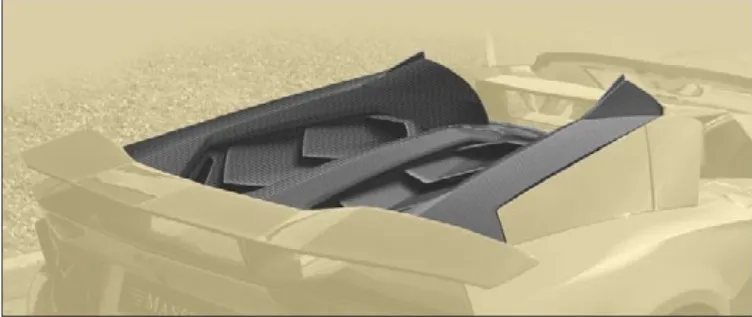
Engine bonnet cabrio Mansory Carbon for Lamborghini Aventador Competition


Mansory Carbon Engine Bonnet Cabrio for Lamborghini Aventador Competition
The Mansory carbon engine bonnet cabrio is a Roadster-only deck panel engineered specifically for the open-top Lamborghini Aventador. It belongs to the broader Mansory Carbon Body Kit for Lamborghini Aventador Competition programme — an SVJ-grade carbon overhaul of the LP-series, S, SV, SVJ and Ultimae Roadster silhouettes. Whereas the coupé runs a single fixed roof structure tied directly into its rear deck, the Roadster employs a 2-piece removable carbon targa roof; that mechanical reality changes the geometry, the acoustics and the thermal envelope of the rear engine bay. This cabrio bonnet is the carbon counterpart designed around those changes, framing the 6.5-litre naturally aspirated V12 with a deck that respects scissor-door cuts, the cabrio rollover hoops and the soft/hard panel stowage corridor behind the cabin.
Construction & Materials
The cabrio bonnet is laid up with multiple plies of aerospace-grade prepreg carbon over a CFRP core, with localised reinforcement strips around the latch points, the rear hoop seats and the leading edge that mates with the targa roof panel. Mansory's open-top piece is intentionally heavier in spec than a track-day coupé bonnet because it must integrate sound-damping inserts and a rear-bay heat barrier that protects the cabin behind a folded soft top.
- Weave: lacquered 3K twill on the show face, with a 2K plain or forged-look option for the bespoke catalogue.
- Cure: autoclave prepreg cycle, full vacuum bagging, post-cure for dimensional stability across thermal sweeps from cold-start to V12 high-load.
- Wall thickness: 1.6–2.4 mm across the visible skin, locally up to 3.5 mm at hinge brackets and roof-mating ribs.
- Weight: roughly 7.0–7.8 kg net, depending on glass content and damping pad spec — a meaningful save versus the OEM Roadster deck while keeping the acoustic substrate intact.
- Mounting hardware: stainless studs, captive nuts and OEM-pattern hinge inserts, supplied with EPDM seals matched to the cabrio aperture.
- Underside: matte black gel-coat with a bonded heat-reflective foil over the V12 hot zone and a felted acoustic mat above the air-box pulse path.
- Finish options: high-gloss UV-stable lacquer, satin, or raw weave with anti-fingerprint matte clear.
- Quality control: white-light scan and harmonic tap test before shipment to validate panel rigidity and resonance.
Design & Visual Function
Visually, the cabrio bonnet keeps Mansory's Carbonado vocabulary — broad shoulders, sharp peripheral creases, the hexagonal Lamborghini cues at the louvre cluster — but its rear edge is recut to clear the targa roof seal and the rollover hoop fairings. Where the coupé bonnet runs a continuous shoulder line into a fixed rear glasshouse, the Roadster panel has to terminate at the rollover bar trims and the upper edge of the soft-top tonneau. Mansory shapes the trailing edge so that, with the targa panels stowed in the front compartment, you still read one uninterrupted carbon surface from the cabin back to the engine louvres.
Functionally, the louvres above the V12 retain their job: they evacuate hot air pulled across the dry-sumped 6.5-litre block and the side-mounted oil radiators. On the Roadster the path matters more than on a coupé, because heat that fails to escape upward will thermo-soak the bulkhead behind the seats and warm the cabin envelope under a folded soft top. Mansory cuts the louvre slats with sharper internal radii and a slightly steeper exit angle than the OEM cabrio panel, so static pressure under the deck stays low at idle and crawling speeds — the regime where a Roadster, with its open cabin, is most exposed to bay heat.
For open-top acoustics the panel performs a second, less obvious task. The undersurface carries an engineered felt pad and a thin viscoelastic damping film behind the show carbon, tuning out the sharp transient knock that bare composite would otherwise telegraph forward into the cabin. The aim is not to muffle the V12 — owners want the intake roar — but to suppress the brittle structure-borne tick and shut out resonance while the targa roof is off. Owners specify this piece when they want the full carbon look behind the cabin without sacrificing the conversational, top-down character that defines the Roadster.
Compatibility & Fitment
This bonnet fits Lamborghini Aventador Roadster variants only — LP700-4 Roadster, LP750-4 SV Roadster, S Roadster, SVJ Roadster (63-unit run) and Ultimae Roadster. It does not fit the coupé; for coupé spec see the dedicated engine-bonnet piece. The Roadster mounting profile sits inboard of the rollover hoops, with the leading edge sculpted to seat against the rear targa-panel weather strip; OEM hinges, latch geometry, gas-strut anchors and parking-sensor harness routing are preserved. On SVJ Roadsters the central twin-exhaust heat shield and ALA 2.0 plumbing are untouched — Mansory's bonnet sits above and forward of the ALA central channel and never blocks the rear-wing flap actuator. Pre-SVJ cars and the Ultimae Roadster all share the same hinge pattern; visible gap and shut-line tolerances are held to OEM band.
Installation & Reversibility
Plan on 3.5–5 hours at a Lamborghini-certified body shop or Mansory-trained installer. The job involves removing the OEM Roadster engine bonnet, transferring hinge brackets, gas struts and the latch carrier, dressing the EPDM seal into the cabrio aperture, dropping the new panel onto the hinge studs, and walking around the car to set shut-lines against the rollover hoop trims and the targa-panel landing zone. Critical checks are the rear weather seal against the soft-top tonneau cover and the targa panel itself when stowed in the frunk — a poor leading-edge alignment will whistle at speed or pull water into the bay during a wash. The Aventador's CFRP monocoque uses methacrylate adhesive on certain bonded panels, but the engine bonnet is a hinged assembly with mechanical fasteners only, so the fitment is fully reversible: the OEM panel can be re-fitted at any future point without trace. Recommended toolset: T30 Torx, stubby 10 mm and 13 mm sockets, alignment wedges, panel-gap feeler set and a torque wrench at 8–22 Nm depending on fastener.
Pairing within the Mansory Aventador Competition programme
The cabrio engine bonnet is rarely specified in isolation. The most natural pairing is the roof-cover-cabrio — the matching Roadster-only carbon roof element that closes the visual loop above the targa aperture and keeps the carbon weave continuous from windshield header through to the engine louvres. Owners coming from a coupé build often cross-reference the engine-bonnet coupé spec to understand how the Roadster panel diverges in geometry and acoustic treatment. To complete the rear-deck stack, add the bonnet-air-outtake — the dedicated carbon louvre-vent sub-assembly that unites visually with the cabrio bonnet's slat geometry and intensifies hot-air evacuation above the V12. These three pieces together form the complete Roadster rear-deck carbon set.
Maintenance & Durability
Lacquered carbon under repeated UV is the main durability question on any open-top supercar — and on a Roadster the bonnet sees more sun than on a coupé, because the targa panels are routinely off and the bonnet is no longer shaded by a fixed roofline at low sun angles. A modern ceramic coat applied over fully cured lacquer extends gloss life materially; carnauba is acceptable but needs more frequent reapplication. What kills lacquered carbon: alkaline degreasers used on hot panels, ammonia-based glass cleaners running off into the weave, abrasive yellow sponges that micro-mar the clear, and high-pressure jets held square at chip edges. Wash cool, two-bucket method, soft microfibre, neutral pH shampoo. The under-deck heat shielding and acoustic pad require almost no service; inspect the foil for delamination at every annual service and re-bond with high-temperature adhesive if any edge lifts. Stone chip workflow is conventional: wet-sand the chip edge to feather, build clear in 2–3 layers, flat-sand and machine-polish to match the surrounding gloss. Properly maintained, this panel holds OEM-grade gloss for 8–10 years before any meaningful re-clear is required.
Lead Time & Warranty
Lead time is 4–8 weeks from confirmed order, reflecting Mansory's bespoke production cadence — each cabrio bonnet is laid up to order, scanned for fit, finished in the chosen weave/lacquer combination and trial-fitted to a reference Roadster jig before crating. A 12-month warranty covers manufacturing defects (delamination, lacquer micro-cracking under normal use, hardware failure under spec load). Stone chips, accident damage and improper installation are excluded; chip repair and re-clear can be quoted independently.
FAQ
Q: Does this fit the Aventador coupé?
A: No. This is the cabrio-specific bonnet for Roadster variants only. The coupé runs a different rear-deck geometry — see the engine-bonnet (coupé) part for that build.
Q: How does it differ from the coupé engine bonnet?
A: The trailing edge is recut to clear the targa-roof seal and the rollover hoop fairings; the underside carries a heavier acoustic and heat barrier package because, with the soft top folded, bay heat and structure-borne sound have a much shorter path to the cabin.
Q: Can I drive with the targa panels off and the bonnet open?
A: Functionally yes for service access, but the targa panels and the bonnet share the front frunk stowage corridor. Plan the sequence at home or at a workshop, not roadside, so you don't conflict the two stowed pieces.
Q: Will it interfere with ALA 2.0 on an SVJ Roadster?
A: No. The bonnet sits above and forward of the central ALA channel; the rear-wing actuator and ALA flap are untouched.
Q: Does it dampen V12 sound?
A: It removes the brittle structure-borne tick and tames upper-band resonance, but the intake roar and exhaust note remain front-and-centre — open-top character is preserved, not muted.
Q: Raw weave or lacquered finish — which holds up better on a Roadster?
A: Lacquered with a ceramic top-coat is the long-life choice for a daily-driven open-top car. Raw matte weave is feasible but demands more disciplined washing and shaded parking.
Pair this Roadster-only deck with the matching roof-cover-cabrio and the bonnet-air-outtake for a full rear-cabin carbon refresh on the open-top Aventador. To order, talk to us on WhatsApp +44 7488 818 747 or write to [email protected].