Rear bridge Mansory Carbon for Lamborghini Aventador Competition


Mansory Carbon Rear Bridge for Lamborghini Aventador Competition
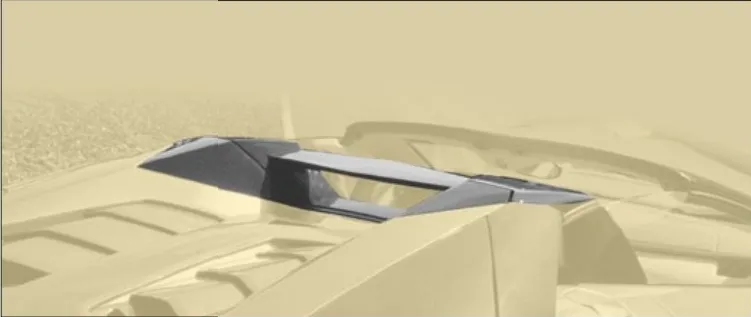
The Mansory Carbon Rear Bridge is the horizontal woven crossmember that sweeps from one rear pillar to the other, riding above the V12 engine cover and tying the Competition silhouette together at its highest visible point behind the cabin. Where many tuner programmes treat the rear deck as background, Mansory pulls a deliberate woven span across it — a structural-looking carbon stripe that visually closes the gap between the B/C-pillar terminus on either flank. It belongs to the larger Mansory Carbon Body Kit for Lamborghini Aventador Competition programme, which retools the SVJ-derived shell around dry-sump V12 thermal needs, scissor-hinge clearance, and the ALA 2.0 active aero stack on the centreline of the rear deck. Placed where helmet-cam shots love to linger, the bridge is the piece you spot first when the car rolls past from three-quarter rear.
Construction & Materials
The bridge is laminated as a single bonded carbon piece with internal bracing ribs that prevent the long span from flexing or drumming at autobahn velocity. Mansory specifies a 3K twill outer skin for the visible face and a 2x2 sub-layer for the underside that nobody will ever photograph. Cure happens under autoclave pressure to keep void content at workshop-grade levels, and the part exits with a UV-stable lacquer that resists the pillar-shadow heat-soak that bakes the rear deck after a hard V12 pull.
Internally, the cross-section follows a closed box near the centre and tapers toward the pillar fixings, where stainless threaded inserts are bonded into the laminate so the bridge meets factory body brackets without any drilling of the painted pillar tops. The fasteners themselves arrive as a labelled hardware sachet — class-10.9 stainless cap-heads with carbon-friendly washers.
- Outer fabric: 3K twill, weave alignment biased to follow pillar-to-pillar visual flow
- Sub-layer: 2x2 plain weave for inner shell rigidity and clean light return
- Cure cycle: autoclave-pressed prepreg, post-cured for thermal stability
- Wall thickness: 1.6–2.1 mm across span, ribbed centre 3.0 mm
- Weight: ~0.75–0.9 kg as a one-piece bridge (approximate)
- Hardware: stainless cap-head set, isolating washers, factory bracket capture
- Finish: UV-resistant clear lacquer (gloss standard, satin and raw weave on request)
- Edge treatment: hand-radiused inner-line trim, protective tape on all underbody contact lips
Design & Visual Function
Visually the rear bridge is a punctuation mark. The Aventador's silhouette gets its drama from the long flat engine cover and the buttressed pillars that rise out of the doors — Mansory's bridge stitches those two storytelling lines together. Run a finger from the rear quarter glass: the eye climbs the pillar, hits the woven span, and is sent straight across to the opposite shoulder. Without the bridge, the rear deck reads as an unbounded plane; with it, the deck becomes a framed stage on which the engine cover, hex grilles and ALA 2.0 mast each get their proper dramatic weight.
Functionally, the bridge is a visual trim element rather than a downforce-producing aero — there is no measurable load-cell pressure on it at speed, and Mansory does not claim a coefficient drop from fitting it. What it does provide is a clean termination plane for the pillar tops and a defined upper border for the engine bonnet glass / mesh. On SVJ donor cars where ALA 2.0 actuates a centreline channel, the bridge is dimensioned to clear the mast and its actuator throw at every operational angle — Mansory CAD'd the part directly off SVJ scan data so the central window stays free of any obstruction during ALA's high-speed channel-open mode.
Light handling is the deliberate trick. Lacquered 3K twill on the bridge picks up sky reflection and pillar-shadow contrast at the same time, giving the Competition rear a high-contrast band that reads as carbon-architectural rather than carbon-applique. Keep the surrounding paint glossy and the bridge becomes the rhythmic element. Specify the bridge in raw weave with satin lacquer and the same line reads as graphite-matte, biasing the rear toward stealth.
Compatibility & Fitment
The bridge fits Lamborghini Aventador across the lineage Mansory supports under the Competition kit: LP700-4, LP750-4 SV, S, SVJ and Ultimae, in coupé form. Roadster targa-frame geometry is different and is handled by the roof cover (Roadster) piece, not the bridge. Pillar capture brackets are shared with factory mounting points so OEM seals, drainage runs and rear-quarter-glass gaskets stay untouched. SVJ donor cars retain full ALA mast clearance because the bridge centre is deliberately notched on the underside to clear the actuator path.
Installation & Reversibility
Bench time runs 45–75 minutes for a competent body shop with both hands free. Tools: T20 / T25 Torx, 8 mm and 10 mm sockets, soft-jaw clamps, alcohol prep wipes, a long pillar-protection blanket, and a torque wrench scaled to small fasteners. The bridge drops onto factory pillar capture brackets via the bonded threaded inserts, with isolating washers between the carbon underside and the painted pillar caps. No drilling. No body adhesive on this piece — it is a fully mechanical mount, so removal is a same-afternoon reversal back to OEM appearance. The Aventador's CFRP monocoque uses methacrylate adhesive in the chassis itself, but those bond lines are nowhere near the bridge fixings, so substrate chemistry is a non-issue here. Lamborghini-certified shops handle this in under an hour; experienced owners with the right torque tools manage it in a long lunch break.
Pairing within the Mansory Aventador Competition programme
The rear bridge is a shoulder-line piece, so it pairs naturally with the parts that shape the area immediately around it. The most common bundle is bridge plus engine bonnet (coupé), because the bridge frames the bonnet's hexagonal venting and the two pieces want to share lacquer batch and weave alignment. Owners who are doing the rear in a single visit usually add the rear bumper and finish the visual stack with the designed diffuser — the bridge sets the upper rear horizon, the bumper handles the mid-band, and the diffuser closes the lower edge in a single woven sweep.
Maintenance & Durability
The bridge sits high on the body, fully exposed to pillar-top sun load, rear-deck heat radiation and the occasional swirl mark from sloppy hand-washing. Use pH-neutral shampoo, a long microfibre noodle wash mitt and rinse the upper face before washing — pillar-top dust has bite. Ceramic coat over the lacquer doubles UV resistance and helps water sheet off the long span instead of pooling. What kills lacquered carbon: alkaline traffic-film removers, ammonia-bearing glass cleaners that drift across from rear-screen wiping, abrasive sponges. Stone chips on the centre of the bridge are rare because nothing throws upward to that height in normal driving; if one happens, a touch-up clear from the Mansory aftercare kit blends it in within an hour.
Lead Time & Warranty
Lead time: 4–8 weeks, since each bridge is laid up to bespoke order with the lacquer and weave the customer has chosen. Warranty: 12 months against manufacturing defects covering laminate integrity, bonded insert pull-out, and lacquer adhesion under normal use. Crash damage, sandblasting media, alkaline cleaner stripping and aftermarket clear-coat applied over the Mansory lacquer fall outside warranty.
FAQ
Q: Does the rear bridge add downforce?
A: No — it is a visual trim element, not a load-bearing aero. ALA 2.0 on SVJ donors handles the rear-axle downforce; the bridge just frames the deck.
Q: Will it clear the SVJ ALA mast at full deployment?
A: Yes. Mansory CAD'd the part off SVJ scan data and the underside is notched on the centreline to clear actuator throw at every operational angle.
Q: Can I run the bridge on a non-SVJ Aventador (LP700-4, S, Ultimae)?
A: Yes. The pillar capture geometry is shared across coupé Aventadors. SVJ-specific clearances simply go unused on those cars.
Q: Roadster fitment?
A: No. The Roadster's targa-frame top changes the geometry behind the cabin entirely; that area is addressed by the cabrio-specific roof cover, not the bridge.
Q: Raw weave or lacquered, which ages better?
A: Lacquered for daily / road use because UV stability is built into the topcoat. Raw weave for show cars under cover — it has a deeper visual texture but wants careful UV management.
Q: Can the bridge be removed for service without leaving marks?
A: Yes. It is a mechanical mount on factory brackets; remove, clean the pillar caps, refit. No drilling, no adhesive, no body paint disturbance.
Pair the bridge with the coupé engine bonnet and rear bumper to lock in the full Competition rear horizon. To configure weave, lacquer and lead time, contact us on WhatsApp +44 7488 818 747 or [email protected].