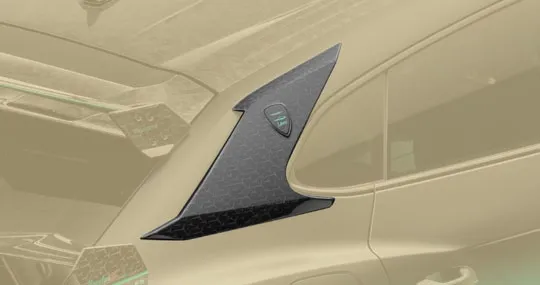
C-Pillar panel with logo emblem Mansory for Lamborghini Urus Venatus


C-Pillar Panel Mansory Carbon for Lamborghini Urus Venatus
The Mansory C-pillar panel is the small overlay carbon piece that finishes the rear-quarter window line of the Lamborghini Urus, Urus S and Urus Performante. It sits at the back end of the daylight opening, where the side glass meets the C-pillar and the roof spoiler cascades down toward the tailgate. Despite its modest surface area it is one of the most influential pieces in the Mansory side-profile vocabulary. As part of the wider Mansory Body Kit for Lamborghini Urus Venatus S programme, this panel ties the carbon weave on the mirror housings, roof cover and rear hatch into a single continuous narrative — harmonising the Urus’s hexagonal Lambo DNA, Y-DRL front mask and twin-turbocharged 4.0 V8 character with bespoke coachbuilt detailing.
Construction & Materials
The C-pillar panel is small but technically demanding. It curves in three planes, follows the kink at the back of the rear-door window line, and must sit flush with the OEM glass and pillar trim without trapping water. Mansory builds it as a thin pre-preg laminate, autoclave-cured against a polished tool, then trimmed and lacquered. The result reads as cast carbon furniture, not a stuck-on overlay.
- Reinforcement: aerospace-grade 3K twill carbon-fibre cloth in a 2×2 weave, oriented so the diagonal aligns with the natural rake of the C-pillar — visible weave matches the mirror housings and roof cover.
- Resin system: high-Tg epoxy pre-preg, autoclave-cured under controlled temperature and pressure to eliminate voids and give a perfectly flat optical surface beneath the lacquer.
- Wall thickness: approx. 1.6–2.0 mm laminate stack — thin enough to follow OEM contour without standing proud, thick enough to resist flex and stone-flick from the rear wheels.
- Weight: ~140–180 g per side as supplied — negligible against the visual return; no impact on rear-axle balance or air-suspension self-levelling.
- Mounting: die-cut 3M VHB acrylic foam tape pre-applied to the underside, plus one or two locating clips that engage the OEM blanking aperture, so the panel self-jigs against the pillar.
- Finish — standard: Mansory deep-gloss UV-stable clear lacquer, hand-flatted and polished to mirror, identical in tone to the rest of the Mansory Venatus carbon programme.
- Finish — alt: exposed weave with matt UV clear available on request, for owners running a satin-PPF Urus where matt-on-matt continuity matters more than wet-look gloss.
- Pre-fit QC: every panel is laser-scanned against the master tool and trial-fitted to a reference Urus quarter panel before it leaves the Mansory atelier — no field trimming required.
Design & Visual Function
The C-pillar is a quietly load-bearing piece in any SUV silhouette — it is where the eye rests in three-quarter rear photography, and where the daylight-opening line either resolves cleanly or trails off. On a stock Urus the C-pillar is body-coloured and reads as a continuation of the rear quarter; the Mansory carbon overlay deliberately breaks that continuity, drawing a dark vertical termination behind the rear door glass and giving the side window line a finished, framed quality. A small contrast detail at the right point of the composition does more than a large dramatic surface elsewhere.
Visually the part is engineered to harmonise with two neighbours. Above it, the Mansory roof cover wraps the upper greenhouse in the same 3K twill; ahead of it, the Mansory mirror housing II picks up the same weave on the side mirrors. The C-pillar panel sits between them as the connective tissue — without it, the mirror caps and roof cover read as floating unrelated carbon islands; with it, the entire side profile becomes a single carbon corridor running from A-pillar mirror base, along the roof, down the C-pillar and into the rear hatch. That is the high visual ROI the part is famous for: a piece that costs a fraction of a bonnet but unlocks the perceived value of every other carbon panel on the car.
Weave alignment is deliberately set so the diagonal of the twill follows the slight rake of the C-pillar rather than running orthogonal to the waistline — the signature Mansory tell, the same alignment used across the Venatus programme on roof cover, rear hatch trim and mirror housings. Under the standard deep-gloss lacquer the weave reads near-black at most angles, then catches the diagonal highlight when sunlight rakes across, giving the side profile a kinetic, in-motion character even when the Urus is parked at a hotel forecourt or studio backdrop.
Compatibility & Fitment
The C-pillar panel is engineered for the Lamborghini Urus, Urus S and Urus Performante (2018–present), covering pre-facelift and post-facelift body shells. The panel sits over the OEM C-pillar surface and does not interfere with the OEM rear quarter glass, the rear-door rubber seal, the third brake-light housing in the roof spoiler, or any OEM trim clip. Adaptive air-suspension self-levelling, rear-wheel-steering geometry and the six driving modes (Strada, Sport, Corsa, Sabbia, Terra, Neve) are unaffected — this is a passive trim panel adhered to the pillar surface, not a chassis component. The slug carries the generic venatus naming because the part retrofits across the Venatus / Venatus S / Venatus EVO line; the bonding surface and pillar geometry are common to all three.
Installation & Reversibility
Installation is one of the simplest in the Mansory Urus catalogue and is squarely in DIY territory for an owner who is comfortable with PPF or vinyl-wrap surface prep. Allow 30–45 minutes per side, working unhurried. The OEM C-pillar surface is degreased with isopropyl alcohol, ambient temperature is brought to roughly 18–24 °C (a warm garage, not a cold driveway), and the panel is dry-fitted first using the locating clip to confirm the kick-line at the back of the rear-door glass aligns flawlessly. The release liner on the 3M VHB tape is peeled progressively from the leading edge, the panel is offered up against the clip, and gentle but firm hand pressure is rolled along the bonding line to wet out the adhesive. Final cure of the VHB is 24 hours at room temperature; avoid car-wash, rain or polishing during that window. Reversibility is straightforward: warm the panel with a heat-gun on low, work a plastic trim wedge under the lower edge, and peel slowly — the OEM paint is unaffected, residual adhesive lifts with citrus-based residue remover. A Lamborghini-certified body shop is only needed if the owner wants the panel colour-keyed in a custom Mansory paint instead of carbon.
Pairing within the Mansory Urus Venatus programme
The C-pillar panel is rarely specified in isolation — its visual ROI multiplies when neighbouring carbon pieces are present. The natural pairing is with the Mansory roof cover, which extends the same 3K twill across the upper greenhouse and lets the C-pillar resolve the roof-cover line down to the waist. The second classic pairing is with the mirror housing II — together they form a continuous side-profile carbon corridor, mirror cap to roof to C-pillar. Owners who want the whole side profile to read as a single carbon language commonly add the front fenders emblem with logo to bracket the C-pillar with carbon punctuation at the front fender, completing the side-profile narrative with deliberate accent points instead of one isolated overlay.
Maintenance & Durability
Lacquered carbon at C-pillar height lives an easy life compared with bonnet or front-bumper carbon — no road-debris exposure, no front-of-car stone-chip risk and no exhaust heat. The two enemies are UV and chemical aggression. UV exposure over years can soften unprotected lacquer; the simplest insurance is a 9H-grade ceramic coating applied twice in the first year and topped up annually, which locks in the wet-look gloss. On the chemical side, alkaline traffic-film removers and ammonia-based glass cleaners must be kept away from the lacquer — they cloud the clear and dull the diagonal weave highlight. Use a pH-neutral shampoo, soft microfibre, the two-bucket method, and dedicated glass cleaner only on the actual quarter glass. If the panel takes a deep scratch, the part is repairable: a Mansory-trained refinisher wet-flats the lacquer and re-buffs to factory gloss without replacing the laminate. If the laminate itself is cracked, the panel debonds in minutes and a replacement re-bonds onto the same OEM surface — downtime hours, not days.
Lead Time & Warranty
The C-pillar panel is built to order in Mansory’s atelier alongside the rest of the Venatus carbon programme. Lead time is typically 4–8 weeks from order confirmation, depending on current Urus production queue and on whether the panel ships standalone or as part of a wider bundle (mirror housings, roof cover, rear hatch trim, fender emblems). A 12-month manufacturer warranty covers laminate defects, lacquer integrity and pre-applied 3M VHB tape adhesion under normal road use. The warranty does not cover lacquer damage from harsh chemical cleaners or panels removed and re-bonded with non-OEM tape.
FAQ
Q: Is this a job I can do myself, or does it need a body shop?
A: For the standard carbon finish, this is one of the most DIY-friendly parts in the entire Mansory Urus catalogue — 30–45 minutes per side, no drilling, no cutting, no electrical splice, no paint. A clean garage at 18–24 °C, isopropyl alcohol and a steady hand are enough. A body shop is only suggested if the owner wants the panel colour-keyed in a bespoke Mansory paint instead of carbon.
Q: Will it fit my Urus Performante or pre-facelift Urus the same way as a 2023 Urus S?
A: Yes. The C-pillar bonding surface is common to Urus, Urus S and Urus Performante (2018–present). The slug uses the generic venatus naming because the panel retrofits across the entire Venatus programme; you do not need to specify Urus S vs Performante at order.
Q: Standard deep-gloss lacquer or matt exposed weave — which finish should I order?
A: If the rest of the car is wet-look — gloss black wheels, lacquered mirror caps, gloss roof cover — order the standard deep-gloss lacquer for tonal continuity. If the Urus is wrapped in satin or matt PPF and the other Mansory carbon pieces are matt, order the matt UV-clear variant; matt-on-matt avoids the optical conflict where one panel reads as wet and a neighbour reads as dry.
Q: How long is the lead time?
A: 4–8 weeks from order confirmation. If you are bundling the C-pillar panel with mirror housings and a roof cover, ordering them in one production batch keeps lead time aligned and the carbon weave consistent across the three panels.
Q: If the panel is ever damaged, do I have to buy a whole new pair?
A: No. C-pillar panels are sold per side and are repairable. Light lacquer damage is wet-flatted and re-buffed; deeper laminate damage is replaced with a single-side panel bonded onto the same OEM surface. Total downtime is hours, not days, and the OEM paint underneath is unaffected throughout.
Pair the C-pillar panel with the roof cover and mirror housing II for a continuous side-profile carbon corridor. To order, request bespoke finishes or specify an exposed-weave matt clear, message us on WhatsApp +44 7488 818 747 or write to [email protected].