
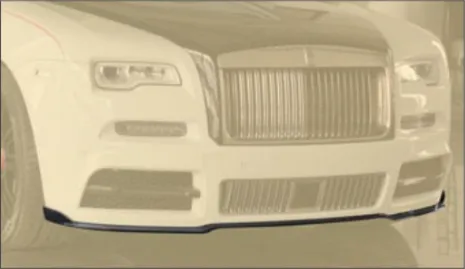
Front lip II for front bumper Mansory Carbon for Rolls-Royce Dawn


Front Lip II — Mansory Carbon for Rolls-Royce Dawn
The Mansory Front Lip II is the more reserved of the two carbon front-splitter options offered within the Mansory carbon programme for the Rolls-Royce Dawn. It threads a careful line: more pronounced than the standard lower bumper trim that leaves the OEM Dawn from Goodwood, yet noticeably more restrained than the bolder Lip III drop. It belongs to the wider Mansory Body Kit for Rolls-Royce Dawn, sitting just below the lower air dam on the front bumper of a 6.6-litre twin-turbocharged V12 drophead — and it does its work without raising its voice. Owners who specify Lip II tend to want bespoke carbon character, the unmistakable Mansory weave signature beneath the Pantheon grille, but with a profile that still defers to the coach-doored, Spirit-of-Ecstasy-led silhouette of the Dawn convertible.
Construction & Materials
The Lip II is laid up from aerospace-grade prepreg carbon and cured under autoclave heat and pressure to deliver dimensional stability across the full width of the Dawn front apron. The geometry is a single-piece blade with carefully sculpted end caps that wrap into the lower corners of the OEM bumper, so the lip reads as integrated rather than bolted-on. Mansory finishes the part with a deep-gloss UV-stable lacquer, and the weave can be specified to harmonise with — rather than fight — the bespoke RR coachwork colour above it.
The internal substrate is engineered to take the harmonic load of a 2.56-tonne convertible at motorway speeds without flexing, while remaining light enough to fit on retained OEM mount points without modification.
- Weave: 3K twill, available also in 2K plain or forged-look on bespoke order
- Lay-up: aerospace prepreg, autoclave-cured at controlled ramp
- Average wall thickness: 2.6–3.2 mm across the visible face, locally thicker at the mounting flange
- Approximate weight: 2.4 kg as a complete blade with hardware
- Hardware: stainless A2 fixings, EPDM weather seal, OEM-spec clip retention
- Finish: deep-gloss Mansory lacquer with UV inhibitor; satin lacquer available on request
- Optional: bespoke paint-break on the lower edge to match the Dawn lower coachwork accent line
- Optional: anti-stone-chip clear film pre-applied to the leading 30 mm of the splitter
Design & Visual Function
The whole point of Lip II is restraint. Where Lip III leans forward, drops the front lower edge and gives the Dawn a theatrical, almost stage-lit pose at standstill, Lip II takes a quieter approach. The blade extends only a few millimetres further than the OEM lower lip, and its forward face follows the existing bumper plane rather than introducing a new one. From three metres away, a passer-by may not consciously register that the car has been reworked at the front; from one metre, the autoclave weave reveals itself, and the bespoke nature of the build becomes plain.
This is a deliberate choice. The Dawn is a coachbuilt drophead, designed to glide rather than to be photographed mid-corner, and the Mansory programme on this car is about amplifying presence with taste, not about chasing trackday vocabulary. Lip II is, in effect, the cufflink edition of the front bumper carbon: present, considered, and only entirely visible to those who care to look. The weave alignment is set so that the twill bias mirrors the verticals of the Pantheon grille above, which means that as the eye travels down from the Spirit of Ecstasy through the chrome surrounds and into the lower bumper, the geometry stays harmonious.
By contrast, Lip III restages the front view: a deeper splitter, a stronger horizontal shadow line and a more aggressive lower edge that reads as performance-bespoke. Both pieces share the same carbon DNA, the same lacquer system and the same fitment logic — they differ only in theatre. Owners frequently choose between the two not on technical grounds but on temperament: Lip II for the Dawn that is being kept close to its coachbuilt origin, Lip III for the Dawn that is being made to announce itself at the porte-cochère.
Compatibility & Fitment
Designed for the Rolls-Royce Dawn produced 2015–2023, including all standard and Black Badge variants. The Dawn is convertible-only — there is no coupé — so this lip is dimensioned for the drophead front bumper specifically. It retains all OEM Rolls-Royce front parking sensors, the bonnet pinstripe option, the coach-door geometry and the fabric soft-top stowage path; nothing the lip touches interacts with the roof mechanism. Although the Dawn shares cues with the Wraith, the two cars have different front bumper geometry below the air dam, so this part is not a fit for Wraith or for the Ghost saloon. It is also not a fit for any Phantom-series car.
Installation & Reversibility
Plan on a half-day in a controlled workshop. The lip mounts to OEM points along the lower edge of the front bumper, with a bonded EPDM seal and stainless A2 fasteners; no body cutting is required, and the OEM lower trim is removed and retained. Allow time for paint and primer prep on any optional paint-break, plus a curing window before the car is rolled outside. Reversibility is straightforward — the OEM lower trim re-installs without modification — which matters for residual value on a coachbuilt car like the Dawn.
We recommend a Rolls-Royce-certified body shop or a Mansory-trained installer for this fitment; a-pillar covers and mirror flasher housings can be DIY work, but the front lip sits on a car with sensitive parking sensors and bespoke paint, and is best handled in a dust-controlled bay. Total chair time at the workshop is typically 4–6 hours.
Pairing within the Mansory Dawn programme
Lip II is the natural counterpoint to its sibling. Most owners pair it with subtle, complementary carbon detail on the front bumper rather than with louder pieces.
- Front lip III for the Mansory Dawn front bumper — the deeper, more theatrical alternative; choose Lip III instead if you want the front of the car to drop and announce itself, choose Lip II if you want the carbon to whisper.
- Front bumper LED fog light in Mansory carbon — pairs cleanly above Lip II, adding ambient warmth at twilight without breaking the restrained line.
- Air intake splitter in Mansory carbon — sits inside the lower air dam directly above the lip, harmonising the V12's intake aperture with the lower carbon edge.
If you are debating Lip II versus Lip III, a useful mental model is this: Lip II finishes a Dawn that is being preserved and gently elevated; Lip III recasts a Dawn into a coachbuilt statement piece. Both are correct answers to different questions.
Maintenance & Durability
The lacquered weave on Lip II is robust under normal road use, but the Dawn is an open-top car that spends meaningful time under direct sun, and lacquered carbon does care about UV exposure over the years. We recommend a high-quality ceramic coat over the lacquer rather than a carnauba paste, both for UV protection and for the depth of lustre it brings out of the autoclave weave. Wash with pH-neutral shampoo and soft microfibre only; alkaline cleaners, ammonia-based glass sprays drifting onto carbon, and abrasive sponges are all enemies of the lacquer system.
If the leading edge takes a stone chip, the layered lacquer system can be wet-sanded and re-lacquered locally without the part being removed; deeper damage to the carbon substrate is rare on Lip II because of its restrained projection — there is simply less of the part exposed to the road than on Lip III. With sensible care, the lacquer holds its depth indefinitely, and the part is fully serviceable through the lifetime of the Dawn.
Lead Time & Warranty
Lead time is 4–8 weeks from order confirmation, in line with the bespoke production rhythm of Mansory carbon parts. The lip is supplied with a 12-month warranty against manufacturing defects in carbon lay-up, lacquer integrity and hardware. Bespoke colour-matched paint-break work, where specified, is colour-keyed to the customer's RR paint code and matched in the Mansory paint shop before despatch.
FAQ
Q: How is Front Lip II different from Front Lip III?
A: Same carbon, same lacquer, same fitment logic — but Lip II is reserved and barely changes the front silhouette, while Lip III drops further and creates a clear horizontal shadow line. Lip II is the preservationist's choice; Lip III is the statement choice.
Q: Does it fit a Black Badge Dawn?
A: Yes. The same lip fits standard Dawn and Black Badge Dawn 2015–2023. Hardware and seal kit are unchanged.
Q: Will it interfere with the front parking sensors?
A: No. The lip is dimensioned to retain full OEM Rolls-Royce parking-sensor function and ride-height sensors, with no recalibration required.
Q: Can I keep raw weave instead of lacquer?
A: Lacquered is the default and recommended on a convertible due to UV. A satin-lacquer option is available on request; fully unprotected raw weave is not recommended for an open-top car.
Q: Will it fit my Wraith?
A: No. The Dawn front bumper geometry below the air dam differs from Wraith, and this lip is contoured to Dawn only.
Q: How long does fitment take?
A: A controlled workshop typically books 4–6 hours, including prep, mount, seal, and any paint-break work. Same-day collection is normal.
Pair Lip II with a quietly tailored carbon front package, or step up to Lip III if you want a more theatrical drop. To specify your Dawn's front bumper carbon, get in touch on WhatsApp +44 7488 818 747 or by email at [email protected].