
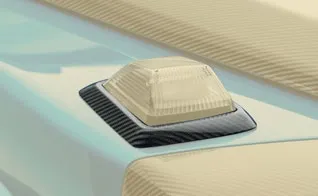
Front flasher protection cover Mansory for Mercedes G-class G500 / AMG G63 W463A


Front flasher protection cover Mansory for Mercedes G-class G500 / AMG G63 W463A
The front flasher protection cover sits at the very corner of the front fender, wrapping the LED turn-signal housing of the Mercedes-Benz G-class W463A. Visually it is a small carbon bezel; functionally, it is a sacrificial energy-absorbing shield. On a slab-sided body that lives close to gate-posts, narrow garage entries and other off-road obstacles, that corner is the part that gets clipped first. Mansory designs this cover to take the impact instead of the LED cluster, and to be replaceable as a single bonded unit. It is a natural addition to any owner already running the Mansory Carbon Body Kit for Mercedes G-class W463A G500/G63 programme, where every exposed corner is dressed in carbon.
The Cosmetic Sacrificial Cover
Two ideas live in one part. The first is cosmetic: the cover replaces the painted plastic surround of the OEM flasher with a carbon-weave bezel that ties into the bonnet, A-pillar covers and front mask of the wider kit. The weave is a 3K twill, laid up so the diagonal lines flow outward from the LED cutout, drawing the eye toward the lens rather than fragmenting around it. Edge fade into the fender is handled with a feathered laminate transition that blends under a thin film of clear lacquer.
The second idea is mechanical. The bezel is engineered as a crush-zone — slightly thicker than a pure trim part, with internal ribs that buckle in a controlled way during a low-speed knock. Owners who specify it usually do so for two reasons: the look across the front corner of the W463A becomes monolithic carbon, and the LED flasher housing — which is expensive, glued to the wing and a labour-heavy replacement — is shielded from the kind of parking knock that would otherwise crack its lens.
Energy Absorption & Crush Ribs
The internal architecture is a sandwich shell. The outer skin is a cosmetic carbon laminate, autoclave-cured for surface fidelity. Behind it sits a closed-cell foam core, and inboard of the foam, a set of vertical and horizontal stiffening ribs moulded into the inner skin. These ribs are sized to fail before the LED housing fails. In a typical low-energy gate-post tap (think 4–6 km/h scuff against a stationary post), the ribs deform plastically, the foam compresses, and the energy that would otherwise reach the polycarbonate lens of the flasher is dissipated inside the cover.
This is not a crash-rated structural part — it does not influence pedestrian-impact compliance and it is not a substitute for the OEM bumper crush structure. What it does is move the threshold at which a parking-speed contact translates into a workshop visit. Owners report the cover scuffing or cracking on the outer lacquer while the LED behind it remains intact and aligned. The cover is designed to be the cheaper, faster thing to replace.
- Weave: 3K twill, 2×2, weave lines radiating outward from the lens cutout
- Cure: autoclave at 120°C, ~6 bar pressure for void-free surface
- Wall thickness: ~1.8 mm outer skin + 3 mm closed-cell foam + 1.4 mm inner skin with ribs
- Weight: ~120 g per side
- Mounting: 3M VHB tape on prepared OEM surround + two OEM clip points retained
- Finish: glossy clear lacquer (default), matte clear or open-pore satin available
- Lens cutout: clear, no tint film, type-approval colour of the flasher unchanged
- Replaceable: yes, as a single bonded unit, no LED disturbance
Single-Unit Replacement Logic
The cover is intentionally not a multi-piece assembly. There are no separate lens trims, no screwed-on inserts, no glued-in chrome strips that would have to be salvaged after a knock. After a damaging contact the entire bezel comes off, a fresh one is bonded in its place, and the LED flasher behind it is never touched. The OEM clip channels remain occupied by the new cover’s tabs, the VHB strip is the only consumable. A body shop can do the swap in well under an hour per side, no paint, no calibration, no headlight removal.
This is deliberate. The W463A’s front flasher housing is integrated with the wing and shares a wiring loom with the side-marker repeater; pulling it for repair is hours of trim-off labour. By making the carbon cover the part that absorbs and replaces, Mansory keeps the expensive piece out of the workshop queue.
Compatibility (Pre/Post Facelift Flasher, Bull-Bar)
The cover fits the Mercedes-Benz G-class W463A generation (2018+, 4th-gen, internal Mercedes platform code), across G500, G550, G400d, G350d and AMG G63 (M177 4.0 V8 BT). It uses the OEM front flasher housing as its mounting reference, and is symmetrical-handed, so a single SKU pair covers both LHD and RHD cars. The flasher housing geometry is consistent across pre- and post-facelift W463A — the lens shape and clip pattern were not changed, so cars from 2018 through current production all accept the same bezel.
Older W463 (1979–2018, the “boxy” G) does NOT fit. Its flasher housing is round and side-mounted, the wing geometry is different, and there is no clip channel for a wrap-style cover. W464 / W465 Gronos cars use a separate bezel within their own programme. With a bull-bar fitted (such as the high front protective frame), the cover still installs without interference; the bull-bar wraps around it rather than over it, and clearance to the frame tubing is roughly 18–22 mm. Cars with electric step provisions, sunroof or spare-wheel-on-tailgate options are unaffected — the cover is a front-corner part with no relationship to side or rear hardware.
Installation, Bonding, Replacement Workflow
Installation is a clean clip-and-bond job. The OEM surround around the flasher is degreased with isopropyl alcohol, the carbon cover’s rear face carries a pre-applied 3M VHB strip protected by a release liner, and the cover’s two integrated clip tabs locate first into the OEM channels. The release liner is pulled, the cover is pressed home with firm even pressure for 30 seconds per area, and the assembly is left undisturbed for 24 hours to reach full tape strength. No drilling, no panel removal, no painting.
Time estimate: 35–45 minutes per side for a careful first-time fitter, ~20 minutes per side for a body shop that has done the part before. Tools: isopropyl alcohol, lint-free cloth, plastic trim wedge, masking tape. Reversibility: yes, fully clip-on and tape-on; the OEM clip points are not modified, the VHB residue lifts with adhesive remover. After an impact the workflow is the reverse: gentle pry of the tabs with a trim wedge, peel the bonded section, clean residue, fit a new cover.
Pairing within the Mansory G-class W463A programme
The flasher cover is most often specified alongside the rest of the front-end carbon. The two natural pairings are the Fully-carbon front mask with grill, which dresses the centre of the front face in matched 3K twill, and the Wide front mask with performance grill for owners on the widebody programme who want a unified outer corner. For owners running a low bull-bar, the Low front protective frame wraps under the cover, leaving the flasher area as the topmost protected corner of the front face.
Care, Light-Lens Cleaning Without Damage
The bezel itself accepts the same care regime as the rest of the kit: pH-neutral shampoo, two-bucket method, soft microfibre, ceramic coating recommended over the lacquer for UV stability. The risk specific to this part is the LED lens cutout — automatic-wash brushes can drag grit across the polycarbonate lens. Hand-wash is recommended. Avoid ammonia-based glass cleaners around the cover’s lacquer; they will haze the finish over time. For the lens itself, a damp microfibre and plain water is enough; never use abrasive sponges, kitchen scourers or dishwasher detergents anywhere near the carbon edge or the lens edge.
Expected service life of the cover, assuming no impact, is 6–8 years before the lacquer begins to yellow under desert UV. A ceramic top coat extends that meaningfully. Chip repair on the carbon edge is a straightforward clear-coat dab; deep cracks through the laminate are a replacement event, by design.
Lead Time, Warranty
Lead time on the front flasher protection cover is 2–3 weeks from order to ship — these are small autoclave parts produced in regular batches, faster than full bonnets or widebody panels. Replacement units after an impact are stocked, so a damaged owner is back in carbon within days rather than weeks. Warranty is 12 months against manufacturing defects: delamination, voids, fitment problems, lacquer crazing under normal use. Impact damage is by definition outside warranty — that is the part’s job.
FAQ
Q: After a parking knock, do I have to replace the whole flasher assembly?
A: No, that is the entire point of this part. The carbon cover is engineered to absorb and crack first, then be peeled off and replaced as a single unit. The LED flasher housing behind it stays in place and continues to work.
Q: Does the carbon cutout change the colour or pattern of the turn-signal?
A: No. The cutout is fully open over the lens — there is no tint film, no coloured insert, and no obstruction. The flasher emits its OEM amber pattern unchanged, so the part does not affect type-approval or MOT.
Q: Will my insurance treat this as a modification that needs declaring?
A: Most insurers treat a clip-on, tape-bonded cosmetic / protective cover as a declared modification but not a rated one — it is non-structural and reversible. Always declare it; cost is usually negligible, and an undeclared mod can complicate a claim.
Q: Does it fit both pre-facelift and post-facelift W463A?
A: Yes. The flasher housing geometry was not changed across the W463A facelift, so the cover bonds to the same OEM surround on every W463A from 2018 to current production.
Q: I run a bull-bar / front protective frame. Does the cover still fit?
A: Yes, with both the high and low Mansory carbon front protective frames. The bull-bar passes outboard of the flasher area; clearance to the cover is 18–22 mm, plenty for thermal movement and for the cover to be removed without taking the bar off.
Specify it with the front mask and a protective frame for a fully carbon-dressed front face. CTA: WhatsApp +44 7488 818 747 or [email protected].