
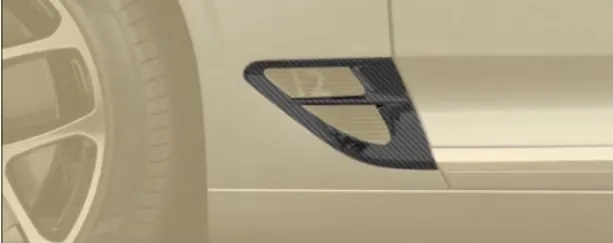
Cover for OEM fender Mansory Carbon for Bentley Continental GT GTC V8


Cover for OEM fender Mansory Carbon for Bentley Continental GT GTC V8
The Cover for OEM fender is the conservative entry into Mansory's carbon front-quarter treatment for the Continental GT 2nd-generation. Rather than swapping the entire OEM fender for a carbon panel, this cover is a precision-tooled overlay that bonds to the existing painted fender — preserving the factory metalwork, the factory paint underneath, and the factory crash structure. It is the option owners pick when they want carbon presence on the front quarter without committing to a full replacement panel. As an element of Mansory Body Kit for Bentley Continental GT 2nd-Gen (D2A), the cover sits directly aft of the front wheel and aligns the upper shoulder with bonnet, mirror, and door visual lines. The overlay approach is also the lower-risk path on cars destined for resale — every step is reversible at the body shop, and the OEM fender remains intact underneath.
Construction & Materials
The cover is a thin, autoclave-cured carbon shell tooled directly from a high-resolution scan of the OEM fender's outer A-surface. Tolerance to the donor fender is held to roughly 0.4 mm across the bonded area, which is the threshold below which the eye stops registering edge transition. Layup keeps the shell intentionally thin so as not to alter the fender's visual proportion or generate a heavy lip at its perimeter. Achieving 0.4 mm tolerance against a curved metal fender is harder than it sounds: the carbon shell shrinks slightly as it leaves the autoclave, the tool itself ages microscopically across many cure cycles, and the donor fender on any given Continental GT may be a few tenths off the original CAD because of factory tolerance stack-up. Compensating for all three drift sources is the work of QC fitment checks on a master fender buck.
Edge feathering is the single most important geometric detail. The cover's perimeter is milled to a tapered edge so the laminate steps down from full thickness to nominally zero thickness over a few millimetres. That taper is what allows the fender's painted surface to "rise into" the cover instead of presenting a sudden lip. Without the feather, the cover would read as bolted-on; with the feather it reads as the fender's outer skin in carbon.
- Outer skin: 3K 2x2 twill prepreg, 200 gsm, oriented to match adjacent bonnet weave when fitted
- Sub-laminate: one cross-ply at 90 degrees for dimensional stability
- Cure: autoclave, 6 bar, 125 C, with a ramped cool-down to suppress warpage
- Wall thickness: 1.2–1.5 mm overall
- Edge feathering: perimeter milled to a tapered edge so the cover blends into surrounding paint rather than sitting as a step
- Bonding: structural automotive urethane, applied as a continuous bead
- Mass per side: approximately 220 g
- Finish: 2K UV-inhibited clear, polished to gloss; matte on request
Design & Visual Function
The visual logic of an overlay is to read as the fender's outer skin, not as something stuck on top of it. Three factors deliver that read: the tooling tolerance against the donor panel, the edge feathering at the perimeter, and the lacquer chemistry sitting at the same gloss level as the surrounding paint. The cover is dimensioned to the fender's natural shoulder line and wheel-arch lip, with no creative contour added — the part exists to convert visual material from painted metal to lacquered carbon, not to redesign the fender shape.
From a styling standpoint the cover unifies the side profile when the build also runs Mansory carbon parts on bonnet and door. Without the cover, the front quarter remains a painted island between two carbon zones, which interrupts the longitudinal weave story along the car's flank. The cover closes that gap. Weave orientation is a deliberate choice: the diagonal pattern is set to flow from the bonnet shut-line aft into the door shut-line, so that an observer walking the car from front to rear reads a continuous lattice rather than mismatched panels. This kind of weave continuity is invisible until it is wrong, at which point it is the only thing the eye sees.
One subtle benefit of the overlay approach is that any future need to repair underlying fender damage does not destroy a structural carbon panel — the carbon cover can be removed, the metal fender repaired conventionally, and a fresh cover bonded back on. This is harder to do with a full carbon-fender swap. Insurance assessors generally also prefer overlay-style cosmetic carbon to full-panel-replacement carbon because deformation behaviour and crash performance remain unchanged from OEM specification. Some insurers will rate a full-panel carbon swap differently from an overlay; an overlay's documentation usually slots into the cosmetic-modification box rather than the structural-modification box.
Compatibility & Fitment
Tooled for Bentley Continental GT 2nd-generation (D2A), V8 and W12 variants, model years 2011 through 2017 facelift, both coupé and GTC. The cover is a left/right pair. It bonds to standard OEM fenders only — vehicles already running the Mansory full carbon front fender (a different SKU) do not need this overlay. Vehicles with prior body damage and non-OEM fender repair work should be inspected before bonding because reformed fenders may not meet the 0.4 mm tolerance to original geometry. We can arrange a fitment pre-check by photograph for vehicles whose ownership history includes any documented front-quarter repair.
Installation & Reversibility
This is a body-shop-grade installation requiring 3 to 4 hours per side. The fender surface is degreased with a panel-wipe solvent, the cover dry-fitted and tape-located, then a continuous urethane bead applied to the inboard rib pattern of the cover. The cover is set, perimeter-pressed, and tape-strapped during cure. Full bond strength is reached after 24 hours; the vehicle should not be wash-pressured or driven at high speed for 48 hours. Removal is possible with controlled heat and a fishing-line cut through the urethane, though this is a workshop-only procedure. We recommend installation by a body shop with carbon overlay experience — the urethane bead pattern and the cure-time tape strapping are the two areas where inexperienced installers most often produce visible defects.
Pairing within the Mansory Continental GT programme
The fender cover earns its visual return when paired with the Engine bonnet and the Front fender and door strip so that the front-quarter and door-flank read as a continuous carbon zone. Add Mirror housing for upper-flank consistency at eye level. Builds that go further also add the Side skirts so that the lower-flank carbon language continues from front wheel to rear wheel.
Maintenance & Durability
Once cured, the bonded cover behaves as part of the fender. Wash, wax, ceramic-coat as you would any painted panel. The feathered perimeter is the single point that wants attention — a wax pass along that line every few months keeps water from wicking under any micro-pinhole in the urethane. The 2K clear is rated for typical exterior service life, and the cover's flat-sanded edge resists chipping better than a square-edged overlay would. Stone chip risk on a fender is mostly along the lower wheel-arch edge; a discreet film-protection strip there is a good investment for high-mileage cars.
Lead Time & Warranty
Lead time runs 3 to 4 weeks from order confirmation, longer than smaller trim parts because the cover is hand-finished on a tooled fender buck for fitment verification. Twelve-month warranty covers laminate integrity, lacquer adhesion, and edge geometry. Bonding integrity post-installation is dependent on the workshop and the urethane chemistry chosen — we provide installation guidance on request. We can also recommend body shops that have previously fitted the part successfully.
FAQ
Q: Why an overlay instead of a full carbon fender?
A: It preserves the OEM crash structure and original paint. It is also reversible if the vehicle is later returned to factory specification. Buyers who want full weight savings tend to choose the carbon-fender SKU instead, accepting the higher fitment commitment.
Q: Will the perimeter edge be visible?
A: A correctly executed install — feathered perimeter, urethane bead inboard of the visible edge, lacquer matched to surrounding gloss — gives an edge that reads as a panel transition, not as an applied part. Bad installs telegraph the edge; good ones do not.
Q: Can the cover be removed later?
A: Yes, by a body shop. Heat releases the urethane and a fishing-line cut separates the cover from the fender. Residue is cleaned off mechanically. The fender paint is generally unaffected if removal is done by an experienced operator.
Q: Will it affect insurance or crash performance?
A: The cover is cosmetic and bonded to the outer skin only. It does not intrude into the crash structure of the fender or alter deformation behaviour. Most insurers categorise it as a cosmetic modification rather than a structural one.
Q: Does the cover change door-shut alignment?
A: No. The cover terminates ahead of the door shut-line and does not enter the door gap. Shut-line clearance is unchanged.
Convert the front quarter without altering the fender — pair the cover with bonnet and door-strip carbon for a continuous flank. WhatsApp +44 7488 818 747 or [email protected].