
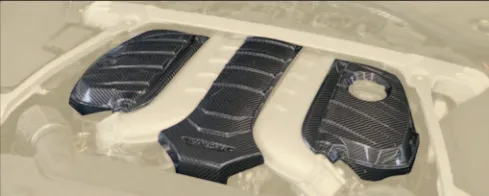
Engine carbon cover for W12 Mansory Carbon for Bentley Continental GT GTC V8


Engine Carbon Cover for W12 — Mansory Carbon for Bentley Continental GT / GTC V8
This is the under-bonnet carbon shell that turns a Continental GT engine bay into a show piece. The cover is shaped to hug the longitudinally mounted 6.0-litre twin-turbo W12 and replaces the matte-grey OEM plastic shroud Bentley installs from the factory. Within the wider Mansory Body Kit for Bentley Continental GT 2nd-Gen (D2A) programme it sits alongside the carbon engine bonnets — when the bonnet swings up, the eye lands directly on this part, so its job is finish, fit and visible weave depth rather than aerodynamics. It is bought as a bragging-rights detail for show builds, concours-prepped cars and high-spec deliveries where the engine bay is photographed as much as the exterior.
Construction & Materials
The shell is laid up in two halves over a male tool taken from the W12 cover geometry, then bonded and trimmed for a single one-piece appearance. The W-configuration block sits with cylinder banks at a tight 72° vee, so the carbon has to bridge a wider, taller dome than a conventional V-engine cover would — this is why W12 covers carry more surface area and a deeper centre crown than the V8 version. The lay-up uses aerospace-grade prepreg with elevated-temperature cure resin so it tolerates the heat soak typical of a heavily-driven W12 sitting in traffic.
Vibration isolation is taken seriously even though the cover is non-structural. The rubber grommets are not a styling decision — they are what stops the rigid carbon shell from rattling against the four ball studs every time a turbo spools or the engine drops to idle. The grommets are sized with a 0.2 mm interference against the carbon ferrules so they pre-load on installation and stay loaded across thermal cycles. Without that pre-load the cover would buzz at low rpm; with it, the part is acoustically silent across the whole rev range.
- Outer ply: 3K 2x2 twill prepreg, hand-aligned so the diagonals run square to the centreline of the cover
- Cure: full autoclave cycle, ramp to 125 °C with 6-bar consolidation pressure
- Resin: high-Tg epoxy rated to 150 °C continuous service, 180 °C peak — chosen specifically for under-bonnet use
- Wall thickness: 2.0–2.4 mm across the central dome, stepped to 3.0 mm where it bridges the intake plenum
- Weight: roughly 1.4–1.6 kg finished, against approximately 3.0–3.4 kg for the OEM plastic-and-foam cover
- Mounting: reuses the original four ball-stud locations on the intake manifold; rubber isolation grommets are retained
- Hardware: stainless ferrules pre-bonded into the carbon at each grommet, so the rubber bushes seat without crushing the laminate
- Finish: 2K automotive clear, UV-stable, flatted and polished — gloss as standard, satin matte on request
Design & Visual Function
This is a trim part, not an aero part, so the engineering work goes into how the carbon reads under the bonnet light rather than how air moves over it. The W12 cover spans a much wider footprint than the V8 equivalent — left to right it has to clear both intake banks, and front to rear it has to clear the manifold collector. That gives a generous surface for the weave to show, and the tooling is set up so the centre of the twill grid lands exactly on the centreline of the engine. When the bonnet opens the eye reads a perfectly square diagonal, not a misaligned weave drifting off to one side.
Edges are profiled with a tight radius rather than a sharp trim line, which is partly aesthetic — softer edges reflect bay light more kindly — and partly mechanical, since a radiused edge resists chipping when a hand brushes it during service. The clearcoat is laid heavy and then cut back, giving the deep wet look you see on photoshoot cars rather than the thin matte finish typical of cheaper aftermarket covers. Mansory branding is laser-etched into the lacquer over the central crown, fine enough that it does not break up the weave but still legible against bay lighting.
Visual integration with the rest of the carbon programme is the other reason customers buy this part. If the car already wears a Mansory carbon engine bonnet, the eye expects to see carbon under the bonnet too — the OEM plastic cover breaks the spell. Replacing it with a matched 3K twill cover finishes the engine bay properly and lets the bonnet open into a fully co-ordinated scene.
The geometry of the W12 cover means it is also the most photographed engine cover in the catalogue. Bonnet-up shots at a show or a delivery hand-over frame the cover almost in plan view, so any wrinkle in the weave or any haze in the lacquer would read instantly. The reason the lay-up uses a single continuous outer ply rather than overlapping panels is precisely this: an overlap shows up as a faint line under bay light, and at concours distance that line becomes the only thing the eye notices. Continuous fabric, square-aligned, is the only way to make the carbon disappear into a single uniform field.
Compatibility & Fitment
This W12 cover fits the Bentley Continental GT and Continental GTC second-generation (D2A) chassis with the 6.0-litre twin-turbo W12 powerplant — both the coupé and the convertible share the same engine and intake architecture, so the cover crosses freely between the two body styles. It does not fit the V8 cars, which use a smaller cover with different mount geometry — those owners want the V8-specific part. Model-year coverage runs across the D2A production span; the W12 intake plenum geometry remained stable through that run, so the carbon shell drops onto the OEM ball studs without modification. If the engine has been retrofitted with non-OEM intake hardware — a remote air box, a relocated MAF, or any high-flow intake kit that displaces the original cover footprint — send a photograph of the engine bay before ordering and we will check clearance against the cover's underside profile before despatching.
Installation & Reversibility
Fitment is one of the cleanest jobs in the kit. Pop the bonnet, pull the OEM cover straight up off its four ball-stud grommets, transfer or refresh the rubber bushes, and press the carbon shell down onto the same studs until each bush clicks home. No tools are strictly required, though a soft trim removal tool helps if the OEM grommets have hardened. Total bench time is around 10–15 minutes. The change is fully reversible — the OEM cover stores flat in a parts box and can be refitted in minutes if the car is ever returned to factory specification for sale or warranty work. Most customers fit the cover themselves on a sunny afternoon with the car parked outside; there is no specialist tooling, no torque sequence to worry about, and no part of the engine that has to be touched beyond lifting the cover off and clicking the new one on.
Pairing within the Mansory Continental GT programme
This cover is bought almost exclusively alongside one of the Mansory carbon engine bonnets, because the value of opening the bonnet only lands when both surfaces match. Most builds pair it with the Engine bonnet as the standard route, or step up to the Engine bonnet II for the more sculpted vented version. Owners completing a full carbon brief usually add the Logo for front bonnet so the carbon language reads continuously from the front of the car all the way through to the engine.
Maintenance & Durability
Because the cover lives under the bonnet, weather is not the concern — heat soak, oil mist and solvent splash are. The high-Tg epoxy and 2K clearcoat are specified specifically for that environment. After service work, wipe the cover with a damp microfibre and a mild pH-neutral cleaner; avoid aggressive degreasers or brake cleaner, which can haze the lacquer over time. UV is essentially absent under the bonnet, so there is no fading mechanism — the carbon will hold its colour and weave clarity for the life of the car. If the lacquer is ever scuffed during a service, it can be flatted and re-cleared by any competent paint shop. Expected service life under normal ownership is well beyond ten years.
Lead Time & Warranty
Each cover is laid up to order rather than pulled from stock, because the autoclave cycle is shared with other parts in the programme and trimming is done by hand. Typical lead time is 2–3 weeks from confirmed order to dispatch. The part carries a 12-month warranty against manufacturing defects, covering laminate voids, delamination, hardware failure and clearcoat lift; the warranty does not cover damage from incorrect installation or from chemical attack by aggressive cleaners.
FAQ
Q: Will this fit my V8 Continental GT?
A: No. The W12 and V8 engines have completely different cover geometries — the V8 cover is smaller and uses different mount points. For V8 cars use the V8-specific carbon cover instead.
Q: Does it fit both the GT coupé and the GTC convertible?
A: Yes, provided both are the W12 variant. The engine bay and intake architecture are shared between body styles for the W12 powerplant.
Q: Will the carbon survive the heat under the bonnet?
A: Yes. The lay-up uses a high-Tg epoxy rated to 150 °C continuous and 180 °C peak, comfortably above the 110–130 °C ceiling typical of a hard-driven W12 bay.
Q: How much weight does it save over the OEM cover?
A: Roughly 1.5–2.0 kg. It is not a performance modification — the gain is visual — but it is meaningfully lighter than the original moulded plastic and foam assembly.
Q: Can I order it in matte or satin instead of gloss?
A: Yes. Standard finish is high-gloss 2K clear; satin matte is offered as an option at order. The satin finish is laid down as a flatted clearcoat rather than a wax overlay, so it will not shine up over time.
Pair this carbon engine cover with one of the Mansory carbon bonnets so the engine bay reads as a single co-ordinated surface the moment the bonnet swings up. CTA: WhatsApp +44 7488 818 747 or [email protected].