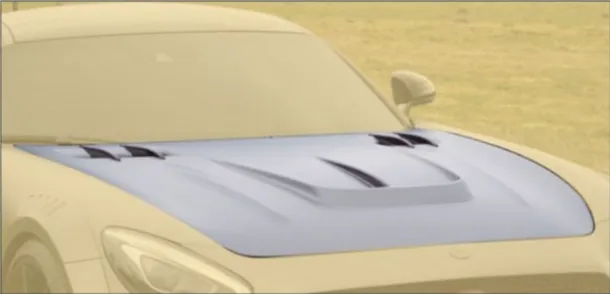
Engine bonnet primed Mansory Carbon for Mercedes-Benz AMG GT S Coupe


Mansory Carbon Engine Bonnet Primed for Mercedes-Benz AMG GT S Coupe (C190)
The Mansory carbon engine bonnet, primed, is the paint-ready front bonnet for the Mercedes-AMG GT C190 — the long, cab-rearward panel that lives over the front-mid M178 4.0L V8 BiTurbo with its hot-V architecture and dry-sump lubrication. This is the discreet half of the bonnet matrix: instead of a show-piece exposed-weave roof for the engine bay, the part ships in a primer surface, dialled in for a body-shop topcoat. The result is a carbon-cored panel that wears the car's body colour, keeps the long-bonnet proportions visually clean, and lets the M178's heat-extraction openings speak in the silhouette rather than in weave pattern. It belongs to the wider Mansory Carbon Fiber Body kit set for Mercedes-Benz AMG GT S Coupe programme — same construction language as the rest of the GT3-flavoured kit, just delivered in primer instead of lacquered weave.
Construction & Materials
The primed bonnet is built on the same autoclaved carbon shell as Mansory's exposed-weave variant — the difference is the outer skin. The visible side carries a structural cosmetic ply backed by 2K plain weave, then a body-shop primer build of roughly 80–120 microns laid over an isolating epoxy seal coat so the topcoat sits over a stable, sandable surface rather than directly on resin-rich fabric. Underneath it is identical aerospace-style hand layup: prepreg, RTM-style consolidation in tooling lifted off the original AMG bonnet, and a heat-soaked autoclave cure to lock geometry under the long unsupported front span.
- Layup: multi-axial prepreg core with 2K plain-weave outer ply, oriented to the panel centreline.
- Cure: autoclave, prepreg + vacuum bag, post-cure for dimensional stability under hot-V soak heat.
- Wall thickness: ~1.7–2.1 mm in the main field, locally thicker around hinge bosses and gas-strut anchors.
- Surface: factory-applied epoxy seal + 2K body-shop primer (high-build), dialled for a Mercedes-grade base/clear topcoat.
- Heat extraction: integrated extractor vents/louvres aligned with the M178's hot-V turbo plenum heat plume (mirroring Mansory's exposed-weave bonnet).
- Reinforcement frame: bonded carbon under-structure replacing the OEM aluminium ribbing, retaining latch geometry.
- Hardware: stainless hinge bushings, OEM-pattern striker plate, gas-strut compatibility verified against AMG GT factory dimensions.
- Weight: typically 6.5–8.5 kg vs the OEM AMG aluminium bonnet (~13–15 kg), measured before paint.
Design & Visual Function
This is the answer for owners who love the lightness and stiffness of carbon but don't want their AMG GT to advertise it. In primed/body-colour spec the bonnet reads as factory: the wide power-dome rises above the V8, the cab-rearward proportion stays intact, and the heat-extractor openings frame the engine plume as design language — not as a carbon swatch. It pairs cleanly with painted front fenders, a body-colour roof, and the OEM Panamericana grille, especially on cars where the Mansory programme is used surgically (front lip, rear diffuser, mirror caps in lacquered weave) rather than full-on theatre.
Functionally the panel still does carbon work. The reduced mass over the front axle subtly improves turn-in feel — modest in absolute terms, but real on a long-wheelbase, front-mid GT where weight ahead of the dash deck matters. The integrated heat-extraction vents help bleed soak from the hot-V turbo plenum during slow-speed re-circulation, which on a track day reduces the rate at which intake air heats inside the engine bay. Stiffness is up versus aluminium because the carbon under-structure carries closed-section reinforcement; on long, fast bumps the bonnet shimmies less than the OEM panel, which the driver reads as a tighter front end visually in the mirror line.
For the painter: the long unbroken span between the fender peaks is one of the most exposed paint surfaces on any C190 build, so this primed bonnet is engineered to behave like sheet metal under base/clear — minimal print-through, sandable high-build primer, and a panel curvature that tolerates orange-peel-correcting flow coats without distortion.
Compatibility & Fitment
Designed for the Mercedes-AMG GT (C190): GT, GT S, GT C, GT R, GT R Pro and Black Series, Coupé fitment as a baseline; Roadster fitment should be confirmed with the installer because hinge geometry and gas-strut spec can vary by year. The panel is not compatible with the 4-door AMG GT 63 (X290) — that car is a separate platform with a different bonnet, hinge layout, and engine bay. Pre- and post-2017-facelift cars share bonnet geometry, so Diamond-grille and Panamericana-grille C190s can both run this part — the grille question only matters for grille-branding components. OEM bonnet release, latch, sound-deadening felt and gas-strut mounts are retained; bonnet-up clearance to the M178 plenum and intercooler housings is preserved. AIRPANEL active underbody aero (GT R) is unaffected; OEM headlight washer apertures, where fitted, are unaffected.
Installation & Reversibility
Plan 4–8 hours of body-shop time for the carbon swap itself: hinge transfer, gas-strut transfer, latch alignment, and a panel-gap shim pass against the fenders and cowl. The bonnet ships in primer, so the proper workflow is: dry-fit on the car, mark and adjust gaps, then dismount for paint. A Mercedes-trained body shop should expect another 8–14 hours of paint-cycle work — degrease, scuff the primer, build base coat to spec, two clear coats, flat-and-buff for show-grade flow. Total real-world door-to-door, including paint cure, sits around 3–5 working days. The OEM bonnet remains fully serviceable, so reversion is trivial: re-fit the aluminium panel, recover the hinges and gas struts. Recommended installer: AMG-certified body shop, ideally one that has handled OEM aluminium replacement panels and is comfortable with carbon substrate prep.
Pairing within the Mansory AMG GT programme
This part lives at the centre of a three-way bonnet matrix. The alternative is the lacquered Mansory carbon engine bonnet (exposed weave) — same shell, finished in show-grade clear over visible weave for owners who want the bonnet to read as carbon. If keeping the OEM bonnet is preferred and only the leading edge needs a carbon accent, the splitter for OEM engine bonnet is the small bolt-on add-on. Underneath, the Mansory carbon engine cover dresses the M178 plenum so the bay matches whichever bonnet skin is chosen. To balance the front-mass story, owners often add the Mansory carbon front lip and the front fender splitter covers, which pull the visual mass forward without disturbing the body-colour bonnet line.
Maintenance & Durability
Once the bonnet is painted in body colour, day-to-day care is identical to OEM: pH-neutral shampoo, soft microfibre, two-bucket method. The substrate is more thermally stable than aluminium under hot-V soak, so paint film life over the engine bay actually tends to be better — aluminium expansion against clear coat is a known cause of micro-cracking on hard-driven AMG GTs, and a carbon substrate moves less. PPF over the leading edge of the bonnet is strongly recommended: stone chips on a long-bonnet GT collect right at the front lip line of the bonnet, and PPF protects both the topcoat and the underlying carbon laminate. Avoid alkaline degreasers and ammonia-based glass cleaners on bonnet edges where they could wick under the paint film. If a rock takes a chunk out of the topcoat, repair workflow is the same as for any composite painted panel — feather-sand the topcoat, re-prime locally, base/clear, polish. The carbon shell underneath is repairable by a competent composite shop in the rare event of a real impact.
Lead Time & Warranty
Bespoke production lead time is 4–8 weeks from order confirmation, depending on Mansory's current AMG GT slot and any spec confirmations needed against the customer's chassis number. The part is covered by a 12-month manufacturer warranty against manufacturing and laminate defects from delivery date; the warranty does not cover damage from incorrect paint preparation, accident, stone strike, or aftermarket modification.
FAQ
Q: Why pick the primed bonnet instead of the exposed-weave one?
A: Because the build is going for body-colour discretion. Many AMG GT owners want carbon's mass and stiffness benefits without turning the bonnet into a show piece — primed lets the panel disappear into the bodywork.
Q: Will it fit my GT R or Black Series?
A: Coupé bonnet geometry is shared across GT, GT S, GT C, GT R, GT R Pro and Black Series, so the panel fits all C190 Coupés. For Black Series cars with the centre-lock hood pin spec, confirm hardware with the installer before final paint.
Q: Roadster?
A: AMG GT Roadster bonnet geometry is broadly the same as the Coupé, but please confirm hinge and gas-strut spec against the customer chassis before ordering — Roadster build years can carry small hardware differences.
Q: Does it fit the 4-door AMG GT 63?
A: No. The X290 4-door AMG GT is a different platform with a different bonnet entirely — this part is C190 only.
Q: How much weight does it actually save?
A: The carbon shell is roughly 6.5–8.5 kg before paint vs an OEM AMG aluminium bonnet at around 13–15 kg. After topcoat, expect a real-world saving of 4–7 kg on the front of the car.
Q: Can the body shop just spray it like sheet metal?
A: Effectively yes — the panel ships sealed and primed, so a competent shop scuffs the primer, builds base coat, lays two clears, and finishes. No special carbon paint chemistry is required.
Pair with the alternative exposed-weave engine bonnet spec on a sister build, or with the splitter for the OEM bonnet if the customer keeps the factory panel. To order, talk colour code, chassis VIN and timeline: WhatsApp +44 7488 818 747 or [email protected].