
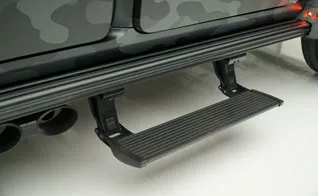
Electrical auto side steps - short for Mercedes G-class W463A Gronos


Electrical Auto Side Steps Short – Short for Mercedes G-Class W463A Gronos
The W463A G-Wagon's body-on-frame ladder chassis sits at a ride height that places the door sill approximately 550–600 mm above ground level — a step height that requires a deliberate step effort for occupants of average height, and that can be genuinely challenging for shorter passengers or for frequent entry-exit cycles in formal clothing. Power-deployed side steps eliminate this challenge with a motorised deployment mechanism: the step extends from its retracted stowed position under the body when a door opens and retracts when the door closes, presenting a step surface at a height between the sill and the ground without the permanent ground clearance reduction of a fixed step. The Electrical Auto Side Steps Short from the Mansory Body Kit for Mercedes G-Class W463A Gronos provides this power-deployment function in a shorter step format sized for the front door opening, where the step span is narrower than at the rear door position.
Construction & Materials
The Electrical Auto Side Steps use a servo-motor drive system with an aluminium pivot arm and stainless-steel deployment rail — the same mechanism architecture used across the SUV-specific side step market. The step tread surface is a carbon-fibre face panel on an aluminium substrate: the carbon face provides the Gronos programme's visual material language on the step top surface while the aluminium substrate provides the structural load capacity for entry and exit weight loading. The step is rated for dynamic loads of 120–150 kg per step cycle. The control module receives door-open and door-close signals from the W463A's door switch circuit without modification to the vehicle's body control module — the steps deploy on door-open signal and retract on door-close, with a configurable time delay before retraction to allow safe door entry and exit.
- Drive: servo motor with aluminium pivot arm and stainless-steel rail — OEM-tier deployment mechanism
- Tread surface: 3K twill carbon face on aluminium substrate — rated 120–150 kg dynamic load per cycle
- Step length: short format — sized for front door opening span
- Control: door-switch circuit signal — no BCM modification; configurable retraction time delay
- Deployment travel: extends 200–250 mm laterally from sill with downward drop of 150–200 mm
- Stow position: fully retracted under body — no permanent ground-clearance reduction
- Waterproofing: IP65-rated motor housing, sealed connectors throughout
- Supplied: pair (LH and RH front positions)
Design & Visual Function
The short step format is calibrated for the W463A's front door opening geometry — the shorter step span matches the front door's entry aperture width, providing a tread surface that is always in the correct position for a front-seat occupant's entry or exit foot placement. On the Gronos programme, the carbon tread face continues the programme's surface language to the entry zone, so that occupants boarding the vehicle step onto a Gronos-identified surface rather than a generic aluminium or rubber step. The step's retracted stow position preserves the W463A's exterior profile when steps are not deployed — from the kerb, a vehicle with power-retracted steps looks identical to a vehicle without steps, which means the Gronos side-body programme reads without interruption until the door opens and the step deploys.
The deployed carbon tread surface at the front door position sits at the precise height where the occupant's leading foot contacts the step as they pivot from the ground into the front seat. This height — typically 200–280 mm above ground in the deployed position — is calibrated to the ergonomic step-up geometry for a 160–185 cm occupant entering the W463A's front seat. For shorter occupants or those in restricted footwear, the step effectively eliminates the need for a grab-handle-assisted vault that the unassisted W463A sill height would require. The Gronos carbon tread face at this ergonomic contact height ensures that the practical benefit of the power step is delivered on a surface that maintains the programme's material identity — the occupant's first physical contact with the Gronos-specified W463A is through the carbon tread.
Compatibility & Fitment
Electrical Auto Side Steps Short fit Mercedes-Benz G-Class W463A 2018 to present, G63 AMG and G500/G550. Front-door position. LHD and RHD configurations available — confirm body configuration at order. Post-2024 facelift compatible. Not compatible with pre-2018 W463 sill geometry.
Installation & Reversibility
Installation requires mounting the deployment mechanism to the body's sill mounting points, routing the motor power harness to a fused 12V supply, and connecting the deployment signal wire to the door-switch circuit. Professional automotive electrical installation is recommended for the harness work. The step mechanism mounts at the OEM side-step mounting apertures on W463A bodies equipped with those provisions — confirm with your installer whether your specific W463A has OEM side-step mounting provisions or requires body-specific mounting brackets. Fully reversible at the mounting points.
Pairing within the Mansory Gronos programme
The short front-position steps pair naturally with the rear-position companion. The Electrical Auto Side Steps Long provides the rear-door-position step format with a longer tread that covers the wider rear entry aperture. For the sill-adjacent entrance zone framing, the Entrance Panels add Gronos carbon to the sill face that the deployed step face complements from below. The Carbon Trim Bars at the lower door face continue the carbon programme in the zone immediately above the deployed step.
Maintenance & Durability
The deployment mechanism's pivot arm and rail require lubrication every 6,000 kilometres or at every seasonal service interval. Use a lithium-grease lubricant on the stainless rail and aluminium pivot arm surfaces — the deployment action cycles the arm and rail through the full travel at every door opening event, which in daily-use vehicles represents 10–20 cycles per day. Accumulation of road grit and salt in the rail during winter use is the primary cause of deployment mechanism degradation: after each winter run, flush the exposed rail with a targeted water spray to dislodge any grit accumulation before it works into the rail bearing surfaces. The IP65 motor housing provides adequate environmental protection under normal use but should not be pressure-washed directly — maintain a minimum 30 cm stand-off if using a pressure washer near the motor housing.
In winter conditions where road salt and grit are present, deploy the steps before each drive and inspect the tread face briefly for any ice accumulation on the carbon surface — ice on the tread creates a slip hazard that the non-slip texture of the 3K twill weave alone does not eliminate. A brief application of a de-icer spray on the tread face during sub-zero conditions before the first boarding event of the day maintains safe step traction. Do not use metal ice scrapers on the carbon tread face — metal contact on the clearcoat creates microscopic abrasion marks that progressively dull the tread finish. A rubber squeegee at minimum for mechanical ice removal if the de-icer spray does not fully clear the tread.
The carbon tread face accumulates boot-sole rubber, road salt, and mud from repeated entry and exit foot contact. Clean the tread with a damp microfibre cloth at each weekly wash cycle. Do not use abrasive pads on the tread face — the clearcoat on the carbon tread is thinner than body panel clearcoat due to the tread's load-bearing function, and abrasive cleaning will degrade it faster at the tread weave surface. A thin application of ceramic tread sealant every 4–6 weeks provides protection against the foot-contact wear and the chemical exposure from boot soles and road surface contamination that the tread collects.
Lead Time & Warranty
Lead time for Electrical Auto Side Steps Short is 2–3 weeks from order. 12-month warranty against motor failure, deployment mechanism failures, tread face delamination, and waterproofing failures under normal use.
FAQ
Q: What is the maximum vehicle speed at which the steps will retract if a door is accidentally left ajar?
A: The control module includes a speed-signal input that triggers automatic retraction above a configurable speed threshold (typically 5–8 km/h) regardless of door-switch state. Confirm the speed-retraction threshold with the installer during commissioning.
Q: Can the steps be held in the deployed position without a door open signal?
A: Yes — most control modules include a manual override mode that keeps the step deployed regardless of door state. This mode is useful during extended loading operations. Confirm manual-override availability with the installer.
Q: Are the short steps and long steps mechanically interchangeable?
A: No — the short and long variants use different tread lengths and mounting bracket spans matched to the front and rear door opening widths respectively. They cannot be swapped between positions.
Specify LHD/RHD configuration and confirm sill mounting provisions with the Hodoor Mansory team: Contact us via WhatsApp +44 7488 818 747 or [email protected].