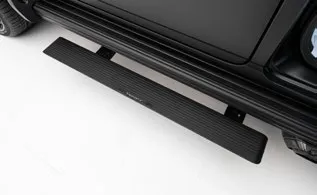
Electrical auto side steps - long for Mercedes G-class W463A Gronos


Electrical Auto Side Steps Long for Mercedes G-Class W463A Gronos
The W463A G-Wagon's rear door opening is wider than the front — the rear door span accommodates the wider rear passenger entry aperture and the longer sill zone that results from the W463A's wheelbase geometry. Passengers boarding the rear cabin — including occupants who may be taller, carrying items, or boarding in formal dress — benefit from a step that spans the full rear entry aperture width rather than a shorter step sized for the front opening. The Electrical Auto Side Steps Long from the Mansory Body Kit for Mercedes G-Class W463A Gronos provides the power-deployment function of the short-step system in a longer tread format matched to the rear door entry width, extending the Gronos carbon tread programme from the front to the rear boarding positions in a format that fits the rear passenger entry geometry correctly.
Construction & Materials
The Electrical Auto Side Steps Long share the same servo-motor deployment mechanism and aluminium pivot arm specification as the short variant, but the tread length is extended to cover the W463A's wider rear door opening span. The extended tread uses an aluminium substrate with 3K twill carbon face panel, maintaining the same 120–150 kg dynamic load rating per cycle as the short tread. The longer tread arm creates a slightly higher deployment torque demand on the servo motor — the motor specification is uprated for the long variant to maintain the same deployment speed and force margin at maximum load as the short variant at the narrower front opening. The control module wiring integrates with the rear door-switch circuit separately from the front door circuit, allowing front and rear steps to be operated independently by their respective door triggers.
- Drive: uprated servo motor for long-arm torque demand — aluminium pivot arm, stainless rail
- Tread surface: 3K twill carbon face on aluminium substrate — 120–150 kg dynamic load rated
- Step length: long format — sized for rear door opening span
- Control: rear door-switch signal — independent from front door step circuit
- Deployment travel: same lateral extension and drop as short variant
- Stow position: fully retracted under body — no permanent ground clearance reduction
- IP65 motor housing, sealed connectors throughout
- Supplied: pair (LH and RH rear-door positions)
Design & Visual Function
The long tread's extended span creates a wider deployed step surface that rear passengers step onto with a natural foot placement across the full tread width — the step width at the rear position is typically 480–560 mm on the long variant vs 360–420 mm on the short, which accommodates a wider stride step-up without requiring the passenger to precisely target a narrow tread. On the Gronos programme, the carbon face of the long tread continues the programme identity from the exterior body carbon to the boarding surface — the same 3K twill weave that runs across the door panels and trim bars appears on the tread face that rear passengers contact during boarding, creating a complete Gronos material statement from exterior to entry surface.
The rear door position presents a different ergonomic scenario from the front. Rear passengers — particularly in chauffeured or executive use — typically board with more deliberate, upright posture than front-seat occupants and benefit from a wider tread surface that allows a stable two-foot landing during entry. The long tread's 480–560 mm width provides this stable landing geometry, which is particularly relevant when the W463A is configured with rear individual seats or rear executive seating that positions the occupant's boarding vector at a more upright angle than the front seat's reclined boarding geometry. The carbon face on the long rear tread extends the Gronos executive specification from the exterior body programme to the rear-passenger boarding experience.
The independent rear door trigger for the long steps means that front and rear passengers can operate their respective steps independently — a front passenger can open the front door and deploy the short front steps while the rear passenger opens the rear door and deploys the long rear steps simultaneously. The two deployment mechanisms operate in parallel without electrical interference, which is a practical detail for multi-passenger boarding scenarios.
Compatibility & Fitment
Electrical Auto Side Steps Long fit Mercedes-Benz G-Class W463A 2018 to present, G63 AMG and G500/G550. Rear-door position. LHD and RHD configurations available — confirm at order. Post-2024 facelift compatible. Not compatible with pre-2018 W463 rear sill geometry.
Installation & Reversibility
Installation follows the same process as the short variant — sill mounting point attachment, motor power harness routing, rear door-switch signal connection. The long tread's additional weight requires a firmer press to the mounting brackets during fitment compared to the short variant. Professional electrical installation recommended. The front short steps and rear long steps can be installed concurrently as a complete side-step specification for the full four-door entry programme. Fully reversible at mounting points.
Pairing within the Mansory Gronos programme
The long rear steps are the companion piece to the Electrical Auto Side Steps Short — together they form a complete four-door power step specification. For the rear sill zone framing, the Entrance Panels extend the Gronos carbon programme to the sill face above the deployed rear step. The Illuminated Entrance Panels add an illuminated Gronos identification element to the entrance zone that the rear long steps open onto.
Maintenance & Durability
The long tread's extended arm creates a longer moment arm in the deployed position, which means any lateral load on the extended tread — such as a passenger stabilising themselves during boarding by pressing laterally on the step edge — creates a higher torque reaction at the pivot arm bearings compared to the short variant. Inspect the pivot arm bearing surfaces every 6 months for any wear evidence manifesting as deployment lag or side play in the deployed tread position. Any play greater than 3 mm at the tread outer edge under 50 kg vertical loading indicates bearing wear requiring service. Lubricate the rail and pivot arm at 6,000-kilometre intervals as with the short variant.
The rear step mechanism's stainless deployment rail is longer than the front variant and spans a greater distance between its forward and rear bracket support points. The longer unsupported span means the rail is more susceptible to deflection under heavy lateral load — if a passenger steps on the outer edge of the long tread with a lateral lean, the unsupported rail span transmits a bending moment to the bracket attachment points that is greater than the front step's shorter rail would experience. Inspect the rear bracket attachment points every 6 months for any evidence of mounting fatigue cracking or fastener loosening resulting from this higher bending moment. Retorque mounting fasteners to the specified value if any loosening is detected.
Rear step treads accumulate more mud and road debris than front treads in off-road or poor-weather use because the rear wheel arch deposits road spray directly ahead of the rear sill zone. After off-road use, deploy the rear steps and flush the tread face and deployment rail with a direct water spray before retracting — preventing dried mud from setting in the rail bearing surfaces. Allow the rail to dry in the deployed position for 5 minutes before retracting to avoid trapping wet debris in the stow position.
Lead Time & Warranty
Lead time for Electrical Auto Side Steps Long is 2–3 weeks from order. 12-month warranty against motor failure, deployment mechanism failures, tread face delamination, and waterproofing failures under normal use.
FAQ
Q: Can front short and rear long steps be ordered as a combined set?
A: Yes — order both short and long variants together for a complete four-door power step specification. Combined ordering is the standard approach for a full W463A entry specification.
Q: Is the long step compatible with rear-door child seat installation?
A: The deployed step provides a boarding assist for child seat installations — the extra tread width is particularly useful for buckling rear child seats. The step retracts automatically on door close, which means there is no risk of the step remaining deployed during a child seat boarding operation that requires an extended door-open period if the manual override mode is not activated.
Q: Does the rear step deployment affect the W463A's rear diff lock operation?
A: No — the steps are electrically independent of the W463A's terrain management systems. Diff lock operation is unaffected by step deployment state.
Specify LHD/RHD configuration and confirm sill mounting provisions with the Hodoor Mansory team: Contact us via WhatsApp +44 7488 818 747 or [email protected].