Roof wing visible carbon for Mercedes G-class W463A Gronos


Roof Wing Visible Carbon for Mercedes G-Class W463A Gronos
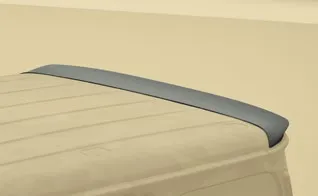
At the topmost point of the W463A G-Wagon, nearly two metres above the road surface, the Roof Wing Visible Carbon from the Mansory Body Kit for Mercedes G-Class W463A Gronos occupies a design position that is simultaneously the most elevated and among the most visible elements on the vehicle. In a fully specified Gronos exterior — where the bonnet, the front mask, the headlight covers, and the mirror housings all carry 3K twill visible carbon — the roof wing in visible carbon closes the material circuit at the vehicle's rear upper edge, ensuring that the exterior carbon programme reads as complete from every angle. The wing's chord-profiled geometry is identical to the standard Roof Wing; what changes is everything about the surface: the prepreg carbon laminate, the weave orientation, the clearcoat system, and the way the wing interacts with ambient light at roofline height where UV exposure and viewing angle are both at their most extreme.
Construction & Materials
Unlike the paint-ready GFRP variant, the Roof Wing Visible Carbon is constructed from aerospace-grade prepreg carbon fibre, autoclave-cured at 120 °C under 4 bar consolidation pressure. The wing profile's compound-curved geometry — a cambered aerofoil section with two straight-sided endplates intersecting at 90° — requires the autoclave pressure to consolidate the prepreg uniformly at the intersection radii without void formation. Void-free consolidation at the endplate-to-wing-body interface is structurally critical because this junction experiences the highest stress concentration during wind-induced bending loads on the wing at motorway speed.
The visible surface of the wing carries 3K twill prepreg in a single outer ply over the structural laminate, with weave direction set fore-aft parallel to the vehicle's direction of travel across the wing body. This orientation creates a series of longitudinal light-lines across the wing's upper (suction) face that are visible from the kerb when looking up at the G-Wagon's roofline — a specific visual characteristic of the W463A format that a conventionally roof-mounted wing on a lower car would not generate. The clearcoat system is three-layer: a UV-filter coat, a structural clearcoat at 35–45 µm DFT, and a final polish coat that seals the surface against ozone-initiated crazing.
- Laminate: aerospace prepreg carbon, autoclave 120 °C / 4 bar — structural plies in 0°/±45° sequence under visible weave layer
- Visible surface weave: 3K twill, fore-aft orientation across wing body — longitudinal light-lines visible from street-level looking up at roofline height
- Endplate laminate: same prepreg spec, weave direction vertical on endplate face for visual alignment with D-pillar carbon treatment below
- Clearcoat system: UV-filter base coat + structural clearcoat (35–45 µm DFT) + polish topcoat — three-layer system addresses the elevated UV exposure at near-2-metre height
- Wing body wall thickness: 2.2–2.8 mm — void-free at all endplate intersection radii
- Weight: approximately 1.4–1.9 kg — lighter than GFRP paint-ready variant due to lower specific density of prepreg carbon versus GFRP
- Mounting: stainless-steel M6 bolts through roofline flange, closed-cell foam weatherstrip on mounting face; elastomer seal at windscreen frame interface
- Finish options: high-gloss clearcoat standard; satin available on request — satin finish on the suction face reduces reflective glare on the rear windscreen glass in direct sunlight
Design & Visual Function
The visible-carbon wing face interacts with light at roofline height in a way that is specific to the W463A's proportions and operating environment. At nearly 2 metres above the road surface, the wing's upper face is exposed to near-overhead solar radiation without any shadow from the roofline — the sun hits the wing's suction face at a near-perpendicular angle during peak hours, filling the 3K twill weave recesses with deep shadow between the fibre bundles and creating a high-contrast texture that reads as a woven textile from below. This texture is far more apparent on a black-lacquered carbon wing at roofline height than on the lower body panels, because the sun angle to the suction face favours shadow-fill rather than the glancing light that makes bonnet weave shimmer.
From a building-to-vehicle or pedestrian-to-vehicle sightline perspective — relevant in urban environments where tall office windows and elevated pedestrian crossings provide a downward viewing angle onto the W463A's roof — the carbon wing reads as a precision architectural element spanning the roof's trailing edge. The endplate faces, with their vertically oriented weave, align optically with any D-pillar carbon cover below, creating a vertical carbon column at the rear corners of the vehicle from the D-pillar cap to the wing endplate tip. This vertical coherence at the rear quarter is a design feature specific to the Gronos programme's visible-carbon treatment and cannot be achieved with the paint-ready wing variant.
Compatibility & Fitment
The Roof Wing Visible Carbon fits Mercedes-Benz G-Class W463A 2018 to present, on both G63 AMG (M177 V8 biturbo, 585 hp / 850 Nm) and G500/G550 (M176 V8 biturbo, 422 hp / 610 Nm) variants. LHD and RHD body configurations share the same roof trailing-edge flange geometry. The post-2024 facelift W463A is compatible. Not compatible with the pre-2018 W463 roofline geometry or the W464 platform.
Installation & Reversibility
Installation time is 1.5–2.5 hours, identical to the paint-ready variant since the mounting interface and hardware are the same. No paint preparation or cure time is needed for the carbon variant — the wing arrives in finished clearcoated condition and is installed directly. After fitting, check the three-layer clearcoat at the endplate mounting holes for any micro-cracking from the torque cycle — if cracks are observed at the bolt-washer contact zone, apply a clearcoat touch-up pen to seal the exposure before washing. Fully reversible — roofline flange accepts OEM roof trim strip after wing removal.
Pairing within the Mansory Gronos programme
The visible-carbon wing pairs most naturally with a fully specified carbon exterior. The High Roof Wing Performance is the next aero step for owners seeking greater rear downforce alongside the visible-carbon material choice. The D-Pillar Cover II extends the vertical carbon column from below the wing endplate down the D-pillar face — completing the rear-corner carbon language. For front-face carbon that matches the wing's visible-weave register, the Engine Bonnet IV closes the programme's material circuit between the front bonnet apex and the rear roofline wing.
Maintenance & Durability
The three-layer clearcoat on the Roof Wing Visible Carbon requires specific protection against the elevated UV load at roofline height. Carnauba-based wax or ceramic sealant should be applied to the wing's upper suction face every 4–6 weeks during peak-UV months, and every 8–10 weeks in lower-solar seasons — more frequently than the lower body panels because the near-perpendicular solar angle to the suction face delivers more UV energy per unit area than any other surface on the W463A exterior. UV-initiated clearcoat micro-crazing first manifests on a visible-carbon wing as a haze that is visible when inspecting the clearcoat surface at 30–45° viewing angle under a single point light source. Catching this haze stage early — before it progresses to visible cracks — allows correction with a light polish-and-reseal cycle by a carbon specialist rather than a full clearcoat refinish.
The endplate outer faces are exposed to side-splash from rear tyre rooster tails at motorway speed. Stone chips at the endplate lower edges are common on high-mileage W463A builds. Inspect the endplate lower edge at each washing cycle and treat any chips promptly. The longitudinal weave on the wing body is particularly susceptible to swirl marks from incorrect wash direction — always wash the suction face in fore-aft passes following the weave, never with circular or cross-wing strokes.
Lead Time & Warranty
Lead time for the Roof Wing Visible Carbon is 3–4 weeks from order. The wing carries a 12-month warranty against delamination, void formation at endplate intersections, clearcoat adhesion failures, and mounting hardware defects. Clearcoat damage from stone impact and UV degradation beyond the design service life are not covered under manufacturing warranty.
FAQ
Q: Is the visible-carbon wing aerodynamically identical to the paint-ready version?
A: Yes. The chord profile, camber, and endplate geometry are the same. The only differences are material construction and surface finish. The carbon variant is marginally lighter (approximately 0.4–0.6 kg) due to the lower density of prepreg carbon versus GFRP, which has a negligible effect on centre-of-mass at roof height.
Q: Will the carbon clearcoat fade or yellow on the roof wing?
A: The three-layer UV-filter clearcoat system is designed specifically to prevent yellowing at elevated UV exposure levels. Standard single-coat clearcoat formulations will yellow within 2–4 years on a roof-mounted wing; the three-layer system extends the yellowing-free service life to 8–12 years with correct maintenance.
Q: Why is the wing endplate weave orientation vertical rather than diagonal?
A: The endplate faces are tall and narrow — the vertical weave orientation aligns the fibre bundles with the endplate's long axis, which maximises the visual length of the weave pattern across the endplate face. It also aligns optically with the D-pillar carbon cover below the wing, creating a coherent vertical carbon stack at the rear corner.
Q: Does the satin clearcoat option on the suction face reduce rear-view mirror glare?
A: On G-Wagons with a panoramic glass roof or where the driver has a high rearward sightline angle, a gloss suction-face wing can catch direct sunlight and reflect it forward into the rear-view mirror. Satin clearcoat on the suction face effectively eliminates this reflection path.
Q: How does the visible-carbon wing interact visually with a contrasting white or silver body colour?
A: The black 3K twill carbon against white or silver body paint creates the highest contrast ratio in the Gronos exterior programme. The wing reads as a sharp dark architectural element at the roofline, emphasising the horizontal termination of the W463A's tall profile. This contrast effect is one of the most common Gronos specification choices.
Discuss clearcoat options and delivery timing with the Hodoor Mansory team: Contact us via WhatsApp +44 7488 818 747 or [email protected].