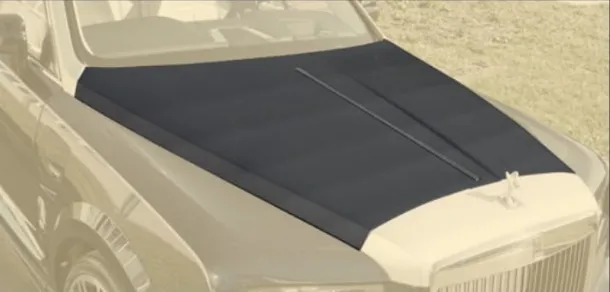
Engine bonnet with bar exposed Mansory Carbon for Rolls-Royce Cullinan Coastline


Engine Bonnet with Bar (Exposed) - Cullinan Coastline
The exposed-weave engine bonnet with central V-bar is the most committed front-end gesture in the Mansory Body Kit for Rolls-Royce Cullinan Coastline programme. It does not bolt onto the OEM aluminium clamshell and it does not sit over it - it replaces the factory bonnet entirely, in full Mansory carbon, finished in raw 3K twill weave under a UV-stable clear coat. Where a Cullinan in standard guise opens with the soft, monochrome surface of painted aluminium and the slow theatre of Spirit of Ecstasy rising over the Pantheon grille, a Coastline car with this bonnet opens with weave: a continuous, low-sheen carbon plain interrupted only by the longitudinal V-bar that stitches the surface together from cowl to leading edge. It pairs hand-in-glove with the front fenders, the exposed front-grill frame and either ambiente front-mask programme.
Construction & Materials
This is one of the largest single carbon panels Mansory produces for the Cullinan, and the brief is unambiguous: behave structurally exactly as the OEM aluminium clamshell does. That means torsional rigidity across the cowl, panel-gap stability across hot-soak/cold-start cycles around a 6.75-litre twin-turbocharged V12, and dimensional discipline tight enough to keep the Spirit of Ecstasy plinth, the illuminated bonnet pinstripe option and the gap to the front fenders all reading as Rolls-Royce.
The skin is a multi-ply prepreg layup, autoclave-cured. The outer ply is 3K twill - the diagonal weave Mansory uses on Coastline exposed parts - oriented so the twill axis runs longitudinally, mirroring the V-bar and the Pantheon grille verticals beyond. The V-bar is laminated as one with the outer skin, not bonded on afterwards, so the surface is continuous.
- Outer ply: 3K twill weave carbon, exposed
- Sub-laminate: cross-orientation prepreg with edge reinforcement bands
- Cure: autoclave prepreg, controlled temperature and pressure
- Wall thickness: ~1.4-2.0 mm in the visible field, stepped up locally around hinge/strut/latch hard points
- Weight: ~9-11 kg complete, against ~14-16 kg for the OEM aluminium bonnet (saving in the most useful place dynamically - high and forward)
- Finish: UV-stable two-pack clear coat over the raw weave - no pigmented/opaque lacquer, no painted top coat over carbon
- Hardware: OEM hinges, OEM gas struts, OEM latch and safety catch, OEM washer-jet routing, retained Spirit of Ecstasy plinth and pinstripe-light cutout if specified
- Internal heat package: factory-grade thermal blanket on the underside above the V12 / turbo zone, unchanged in spec from OEM
Design & Visual Function
The visual logic is simple and quite hard to execute. The Cullinan front mask is dominated by the upright Pantheon grille and the Spirit of Ecstasy. The exposed bonnet has to support those two icons without competing with them. Mansory's solution is the central V-bar - a single longitudinal blade whose width and shadow are tuned to match the chrome surrounds of the grille below. The eye reads grille verticals, then V-bar, then Spirit of Ecstasy, in that order. The exposed weave field does the rest of the work: it absorbs reflections instead of throwing them, so the bonnet quietens visually exactly where a painted aluminium bonnet on a 5.34 m SUV tends to flare under direct sun.
Functionally, the bonnet manages twin-turbo V12 thermal load. The 6.75-litre engine sits under a long bonnet with two turbochargers and an intercooler stack working hard at standstill - Cullinan owners idle at the kerb. Mansory keeps the OEM under-bonnet thermal architecture and liner, so heat rejection paths (across the intercooler, up around the turbo housings, out through the underside of the bonnet and the cowl louvres ahead of the windscreen) remain identical to the factory car. Heat venting is unchanged in path; it is simply happening through carbon rather than aluminium. The V-bar's geometry adds a millimetre or two of standoff over the engine centre, which on hot-soak kerb stops is quietly helpful.
And then there is the moment of arrival. The Coastline programme is built around theatre - the Pantheon grille is already a stage, the bonnet is the curtain. Raw 3K weave changes that curtain from coachwork-monochrome to graphite-on-graphite, and the V-bar gives the eye a single line to follow up to the Spirit of Ecstasy.
Engine Bonnet (Exposed) vs Bar-Only Alternative
Mansory offers two routes to the V-bar visual, and they are not interchangeable. The bar-only part - Bar for OEM Engine Bonnet - keeps the painted aluminium clamshell and adds a carbon V-bar overlay. The full exposed bonnet here replaces the entire panel in raw 3K weave with the V-bar laminated in. The first is additive and reversible; the second is a coachbuilt commitment. The bar-only suits owners who want the longitudinal line but want a bespoke RR coachwork colour bonnet - especially two-tones. The full exposed bonnet suits owners who have decided the Cullinan's front end should read in carbon, full-stop. Care also differs: lacquered-aluminium under a bar overlay washes like any painted panel; exposed weave wants UV-aware care of the clear coat.
Compatibility & Fitment
Designed for the Rolls-Royce Cullinan from 2018 onwards, in both Standard and Black Badge specification, including Series I and Series II Coastline. The part replaces the OEM bonnet 1:1 - same hinge centres, same latch, same safety catch geometry, same gas-strut mounts, same washer-jet routing, same Spirit of Ecstasy plinth interface, same illuminated-pinstripe cutout. Adjacent panel gaps to the front fenders, headlamp tops and the cowl are all governed by the OEM tolerances. This bonnet is not a fit for Phantom or Ghost - their front-mask geometry, hinge layout and bonnet length are different.
Installation & Reversibility
Allow a working day at a Rolls-Royce-certified body shop, including bonnet swap and gap-set (4-7 hours typical). Order of operations: protect the front fenders and cowl, support the bonnet on stands, transfer hinges and gas struts, transfer the latch and safety catch, transfer the Spirit of Ecstasy plinth and (if specified) the illuminated-pinstripe harness, hang the panel, set leading-edge, trailing-edge and side gaps to OEM tolerance, verify safety-catch action, verify washer-jet aim, verify pinstripe illumination if fitted, then re-PPF the leading edge. Because the part is exposed-weave and not painted, there is no paint or primer prep step. Reversibility is total: the OEM aluminium bonnet refits without any modification, with no scarring of the engine-bay structure. We strongly recommend a Mansory-trained installer for first fit, especially if the car is also receiving the front-fenders and the exposed grill frame, because all three parts share gap relationships across the front mask.
Pairing within the Mansory Cullinan Coastline programme
The natural front-mask pairing is three parts deep. Start with the alternative bar treatment for context: Bar for OEM Engine Bonnet (Coastline) for owners who want to retain a painted bonnet. Then pair the full exposed bonnet with Front Grill Frame (Exposed, Coastline) so the chrome-or-carbon question is answered consistently across the upper front mask, and with Front Fenders (Coastline) so the panel transitions left and right of the bonnet read in weave too. With one or both ambiente front-mask illumination programmes active below, the result is a coordinated, single-language front end from kerb to Spirit of Ecstasy.
Maintenance & Durability
Exposed-weave carbon is not painted carbon - the durability question turns on the clear coat, not on a colour layer. The single most important variable is UV. The two-pack clear coat used here is UV-stabilised and is engineered for outdoor life, but a Cullinan that lives outside year-round at high latitudes or under fierce equatorial sun will benefit materially from a sacrificial top layer: either a paint protection film tailored to the bonnet, or a maintained ceramic coating refreshed annually. Both are routine on Rolls-Royce coachwork and both are entirely compatible with the clear coat.
Day-to-day care matches the rest of the bespoke RR coachwork: pH-neutral shampoo, two-bucket method, soft mitts, microfibre drying, no alkaline degreasers, no ammonia-based glass cleaners drifting onto the panel, no abrasive sponges, no compound polishing without a clear-coat-aware detailer present. Carnauba waxes are fine; modern ceramic coatings are arguably better because they protect against UV as well as soiling. Cullinan SUV usage means the leading edge of the bonnet sees more rock-chip exposure than a coupe would over the same mileage, so PPF over the leading 30-40 cm is recommended from delivery. If a chip does occur, repair is a glass-clear-coat job at a Mansory-trained body shop, not a paint match - which is a meaningful long-term ownership simplification compared to a painted bonnet.
Lead Time & Warranty
Lead time is 4-8 weeks from confirmed order, in line with the rest of the Mansory bespoke production cycle. Each bonnet is laminated, cured, demoulded, finished and inspected to order; the V-bar is laminated as one with the outer skin. Twelve-month warranty against manufacturing defects from delivery, on top of the standard care advice above.
FAQ
Q: How is this different from the bar-only part?
A: The bar-only part is a carbon V-bar overlay on the OEM painted aluminium bonnet - a reversible, additive piece. This part replaces the entire bonnet in raw 3K twill carbon with the V-bar laminated in. Different commitment, different visual outcome, different care regime.
Q: Why exposed weave rather than painted carbon?
A: Exposed-weave parts in the Coastline roster are clear-coated only - the carbon is the colour. Owners specify the exposed bonnet when they want the front mask to read in weave; owners who want a body-colour bonnet take the bar-only route instead.
Q: Does the exposed clear coat yellow over time?
A: The clear coat is UV-stabilised. With reasonable care - PPF over the leading edge, ceramic coating refreshed annually if the car lives outdoors, and no compound polishing without a carbon-aware detailer - the panel ages predictably. Sustained equatorial sun without protection is the single fastest path to clear-coat amber-shift on any exposed-carbon part.
Q: Twin-turbo V12 heat under a carbon bonnet - concerns?
A: No. The OEM under-bonnet thermal architecture (intercooler position, turbo heat shielding, factory liner) is preserved. Heat-rejection paths are unchanged from the factory car.
Q: Fits Cullinan Black Badge?
A: Yes. Standard and Black Badge share bonnet aperture and hinge geometry. The 600 hp thermal load is within design envelope.
Q: Is the Spirit of Ecstasy plinth retained?
A: Yes. The bonnet is built around the OEM Spirit of Ecstasy plinth and, if specified, the illuminated bonnet pinstripe routing - all transferred from the original bonnet at fit.
Q: Reversible if I want to put the OEM bonnet back?
A: Fully. The OEM aluminium bonnet refits 1:1 with no modification to the engine-bay structure or the front fenders.
Pair this exposed bonnet with the front fenders and the exposed grill frame for a coordinated front mask, or step back to the bar-only treatment if you want to keep the bonnet painted in bespoke coachwork. To configure for your car, message WhatsApp +44 7488 818 747 or write to [email protected].