
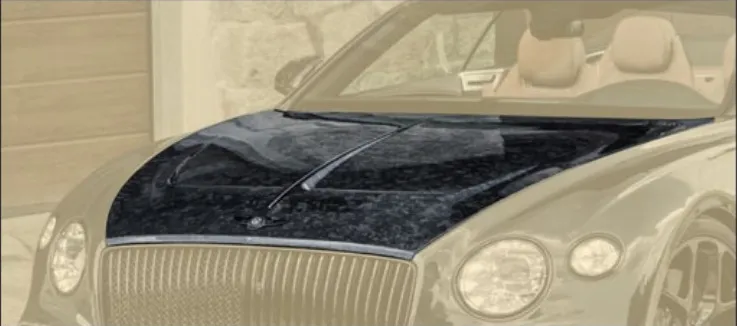
Engine bonnet II Mansory Carbon for Bentey Continental GT


Mansory Carbon Engine Bonnet II for Bentley Continental GT (3W, 2003–2011)
Mansory produces two carbon bonnet specifications for the first-generation Continental GT (3W chassis, 2003–2011). Bonnet I carries a single forward vent aperture — purposeful, effective at moderate speeds, visually restrained. Bonnet II takes a different approach: a 2–3 aperture arrangement in a V or chevron geometry that extracts proportionally more underbonnet heat, distributes extraction across a wider zone, and creates a more assertive visual statement at the front of the car. The II is the correct specification for track-day operators, owners running upgraded W12 twin-turbo output, and those who want the bonnet to communicate the same performance intent as the biplane wing at the rear. Bonnet II is part of the full Mansory Carbon Fiber Body Kit Set for Bentley Continental GT programme, orderable standalone or as part of a complete body transformation.
Construction & Materials
Bonnet II shares the same two-piece inner-outer carbon sandwich as Bonnet I — outer face in 3K twill prepreg, autoclave-cured. The divergence is in the mould tool at the vent zone. The II's more extensive vent geometry removes more structural area from the bonnet surface, directly reducing torsional rigidity. To compensate, the inner structure's stiffening rib layout is redistributed around the increased aperture area — re-engineered, not duplicated from Bonnet I. Mansory evaluates each vent geometry for modal stiffness before the tool is finalised: insufficient structural compensation produces low-frequency bonnet flutter at speed, audible and progressive. Bonnet II is validated to maintain torsional rigidity equivalent to Bonnet I despite the larger vent opening.
Weight is approximately 9–11 kg versus Bonnet I's 8–10 kg — the additional 0.5–1.0 kg from UD carbon tape reinforcement around each aperture perimeter, restoring tensile strength at the cut edge. Compared to the OEM aluminium bonnet at 14–16 kg, both carbon variants save 5–7 kg from the front of the car. Vent apertures are CNC-cut after cure; carbon louvre inserts are bonded into each opening — same 3K twill prepreg and lacquer specification as the outer face.
- Outer face: 3K twill prepreg, autoclave cure — same specification as Bonnet I
- Vent arrangement: 2–3 apertures in chevron or V geometry, each with carbon louvre insert
- Vent reinforcement: additional UD tape around each aperture perimeter
- Inner structure: redistributed stiffening ribs maintaining torsional rigidity at enlarged vent area
- Weight: approx 9–11 kg (Bonnet I approx 8–10 kg; OEM aluminium approx 14–16 kg)
- Mounting: identical OEM hinge and latch positions to Bonnet I and OEM bonnet
- Finish: gloss or satin clear lacquer; vent louvre inserts in matching finish
- Vent perimeter: high-temperature two-component clear coat on inner 30 mm of each aperture surround
Design & Visual Function
The engineering case for Bonnet II over Bonnet I under sustained high-load is direct. Total vent area governs convective heat extraction: more area, more hot air per unit time exits. Multiple apertures distributed across the bonnet surface create more uniform underbonnet pressure reduction — extraction is spread across the bonnet's forward and mid zones rather than concentrated at a single point. For the W12 6.0L twin-turbo at sustained high-load — track day, prolonged motorway overtaking, mountain pass climbs — the additional vent area reduces underbonnet temperatures by approximately 12–18 °C versus OEM, compared to approximately 8–14 °C for Bonnet I. That differential matters for the twin-turbo's intercooler: cooler bay air sustains better charge-air density through long high-load periods.
At low vehicle speed — car park crawl, pit lane idle — the ram pressure differential driving Bonnet I's single vent is reduced. Multiple apertures also respond to natural convective rise of hot engine air, maintaining useful extraction rates at near-zero vehicle speed. For static show appearances, engine bay temperature management continues even when parked.
Visually, the V-geometry or chevron vent arrangement creates a bold graphic centre-piece on the bonnet surface. The V-geometry echoes the W12's cylinder bank angle viewed from above — a deliberate design reference. From elevated viewpoints the vent arrangement dominates the bonnet's visual identity in a way that Bonnet I's single vent cannot. Against dark body colours the louvre inserts read as shadow-within-shadow; against light bodies the carbon creates a graphic anchor at the bonnet centre. Bonnet II's visual language pairs directly with the biplane performance wing at the rear and the rear bumper with diffuser II — all three communicate the same performance vocabulary.
Compatibility & Fitment
Bonnet II fits the Continental GT first generation, 3W platform, model years 2003–2011, including mid-cycle facelift variants. Compatible with both the Continental GT coupé and the Continental GTC convertible — bonnet geometry is identical across body styles. Engine specification does not affect fitment: both the W12 6.0L twin-turbo and the V8 4.0L twin-turbo (late facelift) are accommodated. The vent position is forward of both engines' intake manifold zones, which occupy the same physical location on the 3W platform. Strictly 3W-specific — not compatible with the second-generation Continental GT or the Flying Spur. OEM hinge positions, safety catch, and pull-cable mechanism all retained. Gas strut bracket adaptation required — new brackets supplied. LHD and RHD symmetric.
Installation & Reversibility
Installation is functionally identical to Bonnet I: approximately 2–3 hours at a body shop — OEM bonnet removal, gas strut bracket adaptation using the supplied new brackets, new panel mounting, and panel gap adjustment. Multiple vent apertures do not complicate the process — all apertures are pre-cut, perimeter-reinforced, and louvre inserts are factory-fitted before shipping. The only additional step is confirming each louvre insert is correctly seated before final gap closure — a five-minute visual check. For paint-matched units, the body shop coats the outer face in the vehicle's colour code and leaves the vent surround and louvre areas in the clear-lacquered carbon finish — the standard Mansory contrast treatment. The OEM bonnet is retained for reinstallation; no permanent vehicle modification occurs.
Pairing within the Mansory Continental GT 3W Programme
The natural counterpart within the programme is the Mansory Engine Bonnet I — identical carbon construction, identical mounting, same finish options. The choice between them is one of intent: Bonnet I for effective single-vent extraction with a restrained signature; Bonnet II for maximum extraction and the most assertive bonnet graphic in the programme. Both are engineering upgrades over the OEM aluminium panel. Externally, Bonnet II pairs with the front bumper with front lip and side skirts. At the rear, the biplane performance wing and rear bumper with diffuser II carry the multi-element language Bonnet II establishes at the front. Inside the bay, the engine carbon cover for W12 completes the transformation — Bonnet II on the exterior, the W12 cover on the interior of the same space.
Maintenance & Durability
Multiple vent apertures introduce more exposed perimeter edges than Bonnet I's single vent — and these edges are the primary vulnerability for lacquer chipping and moisture ingress. Annual inspection of each aperture perimeter is recommended, with particular attention to rearmost apertures: closest to the engine bay, highest thermal cycling, most exposed to upward debris. Any lacquer chip at a vent perimeter should be addressed promptly with spot lacquer — an unaddressed chip allows moisture under the lacquer from the edge, eventually causing delamination of the lacquer from the carbon substrate. Carbon louvre inserts should also be checked at the same interval for loosening. A loose insert produces a faint rattle at specific RPM; re-seat with structural epoxy at each corner. The high-temperature two-component clear coat on the inner 30 mm of each vent surround must not be refinished with standard lacquer — use heat-stable lacquer only in those zones. Standard outer surface maintenance: ceramic coating, pH-neutral shampoo, microfibre wash. Carbon substrate: permanent.
Lead Time & Warranty
Clear-lacquered: 4–6 weeks from order confirmation — marginally longer than Bonnet I (3–5 weeks) due to additional CNC vent cutting, louvre insert manufacture, and vent perimeter reinforcement in production. Gas strut brackets included. Paint-matched option: add approximately 2 weeks. Warranty: 12 months from delivery against delamination, structural rib failure, vent perimeter delamination, louvre insert de-bonding, and lacquer defects identified at delivery. Thermal discolouration of lacquer within 30 mm of vent apertures under normal operation is a normal characteristic of a functioning vent bonnet and is not a warranty claim.
FAQ
Q: Is Bonnet II heavier than Bonnet I?
A: Marginally — approximately 0.5–1.0 kg more due to additional UD tape reinforcement around each vent aperture perimeter. Both are substantially lighter than the OEM aluminium bonnet, saving approximately 5–7 kg from the front of the vehicle. The weight difference is negligible in the context of the car's overall mass.
Q: How many vent apertures does Bonnet II have?
A: A 2–3 aperture arrangement in a V or chevron geometry, positioned forward of the W12 intake manifold zone. The precise number may vary by production run — specify your preference at order stage and Mansory's configuration team will confirm the current production geometry. All configurations are structurally validated for torsional stiffness equivalence to Bonnet I.
Q: Does Bonnet II fit the V8 facelift variant?
A: Yes — the bonnet geometry is identical for both engine specifications. The twin-turbo V8 also generates significant underbonnet heat in sustained high-load operation; V8 owners benefit from the same thermal extraction improvement as W12 owners. No engine-specific modification is required.
Q: Can Bonnet II be combined with the engine carbon cover for W12?
A: Yes — the engine carbon cover for W12 mounts inside the bay independently. Bonnet II and the engine cover do not interfere mechanically. Bonnet II transforms the exterior and thermal management; the engine cover transforms the under-bonnet visual when the bonnet is raised.
Q: Bonnet I or Bonnet II for road use only?
A: Both are fully suitable for road use. Bonnet I suits owners who want effective venting with a restrained visual signature. Bonnet II suits those who want the maximum performance statement — many road-only owners choose it primarily for visual character, with enhanced thermal performance as a secondary benefit. Neither requires any change in driving behaviour.
Choose your bonnet specification and configure your order via WhatsApp +44 7488 818 747 or [email protected].