
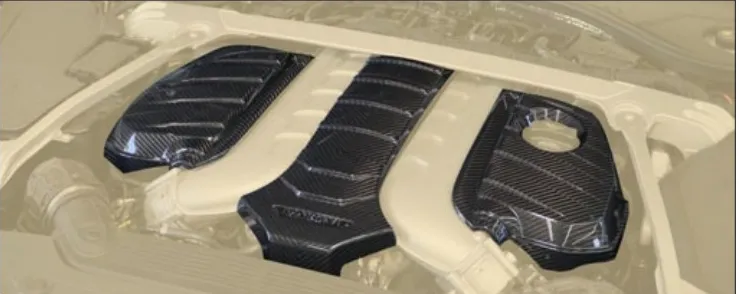
Engine carbon cover for W12 Mansory Carbon for Bentey Continental GT


Mansory Carbon Engine Cover for W12 6.0L — Bentley Continental GT
When the bonnet of a Bentley Continental GT opens, the engine bay is the first thing eyes seek. The factory cover over the 6.0-litre W12 twin-turbo is functional plastic — adequate, forgettable. Mansory replaces it with a precision-laid 3K twill carbon fibre panel that turns the W12's mechanical mass into a deliberate visual statement. Designed as part of the Mansory Carbon Fiber Body Kit Set for Bentley Continental GT, this engine cover is engineered specifically for the W12 6.0L twin-turbo unit fitted to the 3W-chassis Continental GT (2003–2011). It is the centrepiece of an engine bay built to be seen at concours displays, track days, and dealership appraisals alike.
Construction & Materials
Every panel is hand-laid using aerospace-grade 3K twill carbon fibre fabric — three thousand individual filaments per tow, woven in a 2×2 twill pattern that produces the characteristic diagonal weave visible under any lighting angle. The lay-up is autoclave-cured at 120 °C under 6 bar, eliminating micro-voids and locking the resin matrix into a uniform, bubble-free surface.
Wall thickness is held to 2.5–3.0 mm, yielding a finished piece weighing approximately 1.1 kg, against 2.4 kg for the OEM plastic cover.
- Weave: 3K twill, 2×2 pattern; gloss, satin, or matte lacquer available
- Cure: Autoclave at 120 °C, 6 bar
- Wall thickness: 2.5–3.0 mm nominal
- Weight: approx. 1.1 kg (saves ~1.3 kg vs OEM)
- Heat resistance: resin rated to 150 °C continuous; W12 bay peaks at 90–130 °C near turbo housings — within limits
- Turbo clearance: minimum 18 mm from turbo outlet housings at OEM mount positions
- Mounting hardware: stainless-steel M6 captive nuts and OEM-pattern bayonet clips — no drilling, no adhesive
Design & Visual Function
The Bentley Continental GT W12 engine bay is a broad, architecturally proportioned chamber. The W12 block sits low and wide, twin turbochargers flank the intake manifold, and substantial clearance surrounds the cam covers. Mansory's cover contours follow the rise and fall of the W12's cylinder bank angles — the narrow-angle W configuration is echoed in the panel's raised centre spine and recessed flanking surfaces.
The 3K twill weave runs diagonally at 45° across the panel's long axis, creating a visual rhythm that reads as dynamic from any viewing angle. At motor shows with the bonnet propped, the weave shifts from near-black in shadow to a silver-bronze lattice in direct light — a behaviour of twill geometry that distinguishes genuine autoclave carbon from printed-film alternatives.
Against the OEM plastic cover, the Mansory panel introduces a material hierarchy that signals the full Mansory programme. Paired with Mansory carbon bonnets, the engine bay transition from body panel to powerplant becomes seamless: identical weave direction, identical lacquer sheen, unified Mansory aesthetic from exterior to W12 block face.
Compatibility & Fitment
This cover is manufactured exclusively for the W12 6.0L twin-turbo engine (code CWB) in the Bentley Continental GT 1st-gen (3W chassis, 2003–2011) and GTC convertible with the same W12 powertrain. It mounts to the W12's intake manifold superstructure and forward cam cover rail — positions unique to the W12 block geometry.
It is not compatible with the 4.0L V8 twin-turbo (engine code CST). The V8 bay has different block height, cam cover profile, and mounting point positions. A dedicated carbon cover for the V8 is available separately: engine-carbon-cover-for-v8. Verify engine code before ordering — VIN position 5 indicates engine family: "B" = W12 (CWB), "S" = V8 (CST). Do not attempt to fit the W12 cover to a V8 car.
Installation & Reversibility
The swap requires no specialist fabrication and leaves the OEM cover intact. Allow the engine to cool fully (minimum 2 hours), remove the three OEM bayonet clips, lift the factory cover clear, and locate the Mansory panel onto the same mounting points using the supplied stainless-steel M6 captive nuts. Total labour time is 30–60 minutes. The cover is fully reversible — OEM reinstallation needs no additional tools.
One firm recommendation: a professional technician should handle fitment. The W12's twin turbocharger housings reach 400–500 °C surface temperatures under load and retain heat for hours. Accidental contact during a warm-engine fitment is a serious burn hazard. The 18 mm clearance specification is valid only at OEM engine mount positions — verify mount condition before installing.
Pairing within the Mansory Continental GT 3W Programme
The engine cover reaches its full potential paired with other Mansory carbon elements. Three combinations are particularly effective for W12 cars:
Engine bonnet II (vented): The Mansory engine bonnet II has integrated vent channels drawing hot W12 air upward — with the carbon engine cover fitted, the same 3K twill weave is visible through the vents when the bonnet is closed. Most coherent pairing for track and display use.
Standard carbon bonnet: The Mansory engine bonnet I provides an unvented carbon surface — the full open-bonnet view becomes unbroken carbon from leading edge to block face.
V8 sibling cover: W12 and V8 Continental GT owners sometimes run both cars. The companion V8 engine cover uses the same carbon specification for the CST engine bay. All items are available as part of the complete Mansory Carbon Fiber Body Kit Set for Bentley Continental GT.
Maintenance & Durability
The W12 twin-turbo runs measurably hotter than a comparable V8 installation — the second turbocharger sits deeper in the bay with reduced natural airflow at low road speeds, meaning the engine cover lacquer sees more heat cycling than an exterior body panel. Over 10–14 years of regular use, yellowing or micro-crazing near turbo-adjacent areas can develop if maintenance is neglected.
Care routine: avoid ammonia-based engine bay cleaners entirely; use pH-neutral degreaser diluted 1:10 for routine cleaning; apply carnauba paste wax or ceramic coating rated to 200 °C twice per year. Avoid abrasive polish — scratching the lacquer layer requires a full re-lacquer to restore. Fuel splash should be wiped immediately; hydrocarbon contact softens some lacquer formulations. Inspect captive nuts annually. If delamination appears at panel edges, contact [email protected] to assess warranty eligibility.
Lead Time & Warranty
Standard lead time is 2–6 weeks from order confirmation to dispatch. Rush requests for specific show dates can be discussed at the order stage. Each cover carries a 12-month warranty against manufacturing defects: structural delamination, surface voids visible under normal lighting, and demonstrable fitment failure at OEM mounting points. Warranty does not cover impact damage, incorrect installation, or lacquer damage from chemical contact. Contact WhatsApp +44 7488 818 747 or [email protected] with photo documentation for warranty claims.
FAQ
Q: Will this fit my Continental GT if I have the V8 engine?
A: No. This cover is for the W12 6.0L twin-turbo (code CWB) only. The V8 (CST) engine has different block height and mounting rail geometry — the W12 cover cannot be fitted without modification. A dedicated V8 carbon cover exists as a separate SKU. Check VIN position 5 before ordering: "B" = W12, "S" = V8.
Q: How heat-resistant is the cover given the W12's thermal output?
A: The autoclave resin system is rated to 150 °C continuous. Normal W12 bay temperatures run 90–110 °C at the manifold and up to 130 °C near turbo housings. With 18 mm clearance from the turbo outlet housings, the cover surface does not see peak turbo temperatures. The rating has a comfortable margin over typical operating conditions. Cooling system faults or sustained maximum load in extreme ambient heat are outside the design envelope and constitute a vehicle-level fault, not a cover limitation.
Q: Which finish do you recommend for engine bay use?
A: High-gloss clear lacquer is the most popular choice — it reflects light most dramatically in a dark bay and is easiest to wipe clean. Matte suits owners who prefer a stealth aesthetic or find gloss lacquer difficult to maintain fingerprint-free during service. Satin (semi-gloss) is the middle-ground option. All three finishes carry the same heat rating, UV stabilisation, and 12-month warranty.
Q: How much weight does it save over the OEM cover?
A: Approximately 1.3 kg — the Mansory cover weighs ~1.1 kg against ~2.4 kg for the OEM piece. As a standalone saving on a 2,350 kg car, this is imperceptible in dynamic terms. The value of this component is the material upgrade and the visual transformation of the engine bay, not meaningful mass reduction.
Q: Can I install it myself?
A: Mechanically, yes — three bayonet clips, no drilling, 30–60 minutes. However, we strongly recommend a professional technician for this job. The W12 turbocharger housings retain temperatures of 400–500 °C for several hours after shutdown, and accidental contact is a serious burn hazard. If you proceed independently, allow the engine to cool overnight and confirm the bay is fully cold before touching any components near the turbo housings.
Ready to transform the W12 engine bay? Contact us via WhatsApp +44 7488 818 747 or [email protected] to confirm availability, finish, and lead time for your Continental GT build.