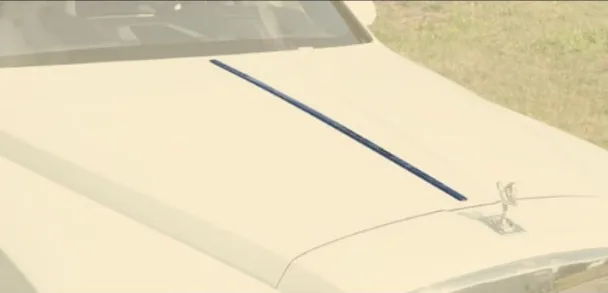
Bar for OEM engine bonnet Mansory Carbon for Rolls-Royce Cullinan Coastline


Bar for OEM Engine Bonnet — Mansory Carbon Cullinan Coastline
The Bar for OEM Engine Bonnet is the most disciplined way to introduce the Mansory front-end signature to a Rolls-Royce Cullinan without re-engineering the panel that lives over the twin-turbocharged 6.75 L V12. It is a standalone carbon central V-bar — a single sculpted blade that bonds directly onto the existing factory bonnet, picking up the same visual axis that runs from the Pantheon grille up to the Spirit of Ecstasy. Within the wider Mansory Body Kit for Rolls-Royce Cullinan roster — all 18 carbon parts in the Coastline sub-edition — this is the part owners reach for when they want the Mansory gesture to read at the kerb, but refuse to touch a panel that already wears bespoke RR coachwork colour, the illuminated bonnet pinstripe loom or a freshly indexed set of dampers and hinge stops.
Construction & Materials
The bar is laid up as a self-contained shell — a sculpted carbon blade with an engineered bonding flange on its underside. It carries no structural responsibility for the bonnet itself; the OEM steel skin still does that work. What the bar provides is a continuous, void-free carbon surface that resists thermal cycling above the V12, plus a flange geometry that mates exactly to the factory crown of the Cullinan Coastline bonnet without packing shims.
Every blade is built to Mansory's bespoke programme tolerances, with a deep-gloss lacquer finish keyed in by hand and matched against a Rolls-Royce paint chip the owner specifies — or left in exposed twill where the brief calls for raw material drama against a darker coachwork.
- Lay-up: aerospace-grade prepreg carbon fibre, multi-axial schedule with 3K twill on the show face and 2K plain weave inner plies for dimensional stability across the V-axis.
- Cure: autoclave at controlled ramp and dwell, full vacuum bag, post-cure to stabilise the resin matrix against engine-bay heat soak from the twin-turbo V12.
- Wall thickness: approximately 2.4–3.0 mm through the central spine, tapering to ~1.8 mm at the bonding flange to keep the silhouette visually thin.
- Mass: roughly 1.6–2.2 kg installed — light enough that it does not alter the bonnet's gas-strut lift behaviour in any perceptible way.
- Bonding interface: an etched, primer-prepared underside designed for structural automotive adhesive (high-modulus, paint-system compatible) on a properly prepared OEM lacquer.
- Optional through-fastener tabs are concealed beneath the flange for owners who specify a belt-and-braces install on a car that lives in extreme thermal cycling.
- Finish: Mansory deep-gloss lacquer matched to coachwork, satin lacquer, or open-pore exposed weave on request — UV-stabilised against long parking spells under sun.
- Pinstripe loom: never crossed. The blade is shaped to clear the optional illuminated bonnet pinstripe channel so the Starlight-style theatre at the front of the car remains exactly as factory.
Design & Visual Function
The blade was drawn to read as a deliberate central spine — the same axis Mansory uses on the full Coastline bonnet replacement, but here delivered as a surface element rather than a panel. From three-quarter rear it is almost invisible; from the front kerb view it does the work, gathering the Pantheon grille verticals and pulling the eye up the bonnet to the Spirit of Ecstasy. Where the full carbon bonnet treats the panel as one big sculpted statement, the bonded bar is closer to a piece of jewellery — a single well-cut line laid onto an otherwise familiar surface.
This is also where the visual contrast against the full panel becomes a deliberate choice rather than a compromise. Owners who specify the bonded bar tend to want the Cullinan to still read as a Cullinan first and a Mansory second — coachwork colour intact across the bonnet, factory shutlines undisturbed, the optional illuminated pinstripe still lighting the perimeter at twilight. The bar adds presence without rewriting the front of the car.
For RR coachwork colours with strong saturation — deep blues, racing greens, ivory — the lacquered carbon spine reads as a high-contrast scribe-line. For darker coachwork or true black, exposed twill in matte lacquer keeps the texture legible at close range and turns the bar into a tactile detail rather than a graphic one.
Compatibility & Fitment
The Bar for OEM Engine Bonnet is sized for the Rolls-Royce Cullinan (2018 onwards) in Standard and Black Badge specification, including cars carrying the Coastline sub-edition cosmetic package. It bonds onto the factory steel bonnet — no fit on Phantom, no fit on Ghost. OEM operation is unaffected: bonnet release cable and safety catch geometry are untouched, gas struts remain the factory items, and the rear-hinged coach-door package, two-piece tailgate clamshell and air-suspension self-levelling sensors are all outside the part's scope. Owners who have specified the illuminated bonnet pinstripe option keep that loom and its optical channel intact — the bar is shaped to clear it cleanly.
Installation & Reversibility
This is one of the strongest arguments for this part over the full carbon bonnet variant. The bonded V-bar is a 3–5 hour job at a competent body shop: degrease and decontaminate the bonnet crown, mask the surrounding lacquer, scuff and key the OEM finish on the bonding footprint, prime per the adhesive manufacturer's data sheet, dry-fit the bar against printed indexing tape, lay a continuous bead of structural automotive adhesive, set the bar, clamp lightly with soft blocks while the adhesive reaches handling strength, then full cure overnight before the car returns to use.
Compare that to the full engine-bonnet-with-bar-exposed programme, which replaces the factory steel skin entirely: that is a 12–20 hour job, requires hinge re-indexing, gas-strut re-spec where mass changes, re-runs of the illuminated pinstripe loom into a new substrate, and a full coachwork-colour repaint of the new panel to match the rest of the car. Cost differential between the two paths is large — both in part cost and in installer hours — and so is the reversibility profile.
Reversibility on the bonded bar is honest. Adhesive removal is possible with the correct heat-and-wire technique, followed by residue cleanup and a localised polish-and-correct on the bonnet crown. The bonnet itself is not destroyed, but the OEM lacquer in the bonded footprint will need attention before the car returns to a concours-level finish. Recommended installer: a Rolls-Royce-aware body shop or a Mansory-trained technician for the bonded variant; D-pillar trims and small carbon items remain DIY-friendly.
Pairing within the Mansory Cullinan Coastline programme
The bonded bar is the explicit, low-commitment counterpart to the full carbon panel — owners typically want to see both paths laid side by side before specifying. Cross-link to the full variant: engine-bonnet-with-bar-exposed Mansory Carbon Cullinan Coastline. To complete the Mansory front-mask reading without going beyond the bonnet line, pair with front-grill-frame-exposed — a carbon Pantheon-grille frame that mirrors the bar's central axis at the lower end of the visual line. Owners who plan to widen the stance later will often add front-fenders in a second visit, which extends the Coastline silhouette outward without revisiting the bonnet decision.
Maintenance & Durability
Lacquered carbon on a bonnet crown lives in one of the more punishing thermal zones on the car: heat soak from the twin-turbo V12 below, full sun from above, salt spray and motorway grit on the leading edge. A purpose-formulated ceramic coating, refreshed on a sensible cycle, is the right answer for daily-use Cullinans; carnauba is fine for show cars that live in climate-controlled storage but does not earn its keep on a school-run SUV that sees 40,000 km a year.
What kills lacquered carbon is the usual list: alkaline traffic-film removers used neat, ammonia-based glass sprays, abrasive sponges, and pressure-washer lances held too close at a steep angle. Treat the bonded bar exactly as you treat the rest of the bonnet's lacquer, and add paint protection film over the leading 30–40 mm if the car covers serious motorway distance — Cullinan SUV usage sees more rock-chip exposure than a coupé. If a chip lands, the bar is repairable in situ without removal: localised wet-flat, polish, refresh of the lacquer film. Adhesive line longevity is decades with a properly prepared bond — the failure mode to design out is moisture ingress at the leading edge, which is why the flange geometry is feathered and sealed at install.
Lead Time & Warranty
Lead time is 4–8 weeks from order to dispatch — Mansory bespoke production schedules carbon parts in batches and then individually finishes each piece against the owner's coachwork sample. A 12-month warranty against manufacturing defects covers the carbon shell, lacquer adhesion and bonding flange geometry; the adhesive and install workmanship sit with the installing body shop under their own labour warranty.
FAQ
Q: Why would I choose the bonded bar over the full carbon bonnet?
A: Three reasons, in order of how often owners cite them. First, you keep the factory bonnet — its coachwork colour, its illuminated pinstripe loom, its hinge indexing, its gas struts. Second, the install is 3–5 hours rather than 12–20, and the cost differential between the two paths is large in both parts and labour. Third, the change is more reversible — the panel itself is not destroyed.
Q: Is the bond strong enough to survive long-term ownership?
A: Yes, when the install follows the spec. Structural automotive adhesive on a properly prepared OEM lacquer with a feathered, sealed flange edge is a multi-decade bond in normal road use. The failure mode worth designing out is moisture ingress at the perimeter, which is exactly what the flange geometry and install procedure address.
Q: Will it foul the illuminated bonnet pinstripe option?
A: No. The bar is shaped to clear the pinstripe channel cleanly, so the twilight-to-night theatre of the front pinstripe stays exactly as factory.
Q: Can I have the bar painted to coachwork instead of carbon-finished?
A: Yes — Mansory will lacquer over a body-colour basecoat to your RR sample, or deliver the bar in deep-gloss carbon, satin carbon or exposed open-pore weave. Two-tone finishes are also possible on request for owners coordinating with painted-lamel ambient grilles.
Q: Does fitment differ between Standard and Black Badge Cullinan?
A: No. Both Standard (~563 hp twin-turbo V12) and Black Badge (~600 hp) share the same bonnet panel and crown geometry, so the bar bonds identically. Coastline sub-edition cars are likewise covered.
Q: If I want to remove it later, what does that look like?
A: Removal is a heat-and-wire de-bond followed by adhesive residue cleanup and a localised polish-and-correct on the bonnet crown. The factory steel skin is not destroyed; the lacquer in the bonded footprint will need attention before the car returns to concours condition. Honest reversibility, not zero-trace reversibility.
Pair it with the full bonnet variant for a side-by-side decision, then add a Pantheon-grille carbon frame and front fenders to complete the Coastline front mask. To specify finish, sample coachwork colour and book an install, contact us on WhatsApp +44 7488 818 747 or [email protected].