
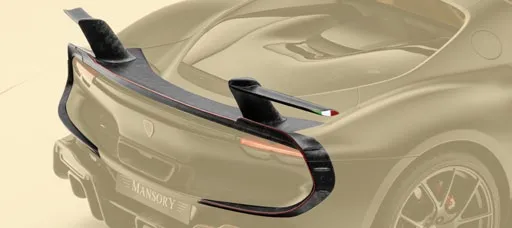
Rear wing with air splitter Mansory for Ferrari 296 GTB


Rear Wing with Air Splitter Mansory for Ferrari 296 GTB
At the summit of the Mansory 296 GTB aerodynamic programme sits the Rear Wing with Air Splitter — a two-element, high-mounted assembly that combines the base Rear Wing's NACA aerofoil profile with a forward-mounted splitter element to produce the maximum achievable rear axle downforce within the kit's engineering envelope. Where the single-element Rear Wing delivers substantial downforce for track-day use, the Air Splitter variant adds a second lifting surface ahead of the main element, exploiting slot-flow acceleration between the two aerofoils to maintain attached, high-velocity flow over the main wing's suction surface at angles of attack that would induce stall in a single-element configuration. The result is a rear aero assembly whose peak downforce coefficient exceeds the base wing by a measurable margin, translated at circuit velocities into rear axle grip that directly enables higher cornering speeds on a 296 GTB running the full 830 hp of its PHEV twin-turbo V6 and electric motor drivetrain. This part forms the maximum-downforce bookend of the Mansory Carbon Fiber Body kit set for Ferrari 296 GTB, and is conceived for owners who treat the circuit as the primary operating environment.
Construction & Materials
The main aerofoil element is identical in section to the base Rear Wing — NACA 6412-derived, 220 mm chord at midspan, 3K twill pre-preg, autoclave-cured at 120 °C. The air splitter is a secondary element of 110 mm chord, mounted 22 mm forward of the main element's leading edge on paired carbon-fibre forward stanchions attached to the main upright structure. The slot gap between the splitter trailing edge and the main element leading-edge underside is maintained at 20 mm midspan, ±0.5 mm, by the stanchion geometry — a tolerance matched-manufactured against the main element's leading-edge profile to ensure the slot dimension is consistent regardless of thermal expansion at operating temperature. The splitter element is 1.8 mm thick at midspan with a 0.6 mm ground trailing edge. The main uprights are the same CNC 6082-T6 aluminium as the single-element wing, with extended forward-stanchion mounting bosses machined as integral features of the upright casting. Total assembly weight is approximately 4.6 kg.
- Main element: NACA 6412-derived, 220 mm chord, 3K twill pre-preg, autoclave 120 °C / 6 bar
- Splitter element: 110 mm chord, 3K twill pre-preg, matched-pair cure with main element
- Slot gap: 20 mm at midspan, ±0.5 mm, thermally stable via geometry-matched manufacture
- Splitter element thickness: 1.8 mm; trailing edge ground to 0.6 mm radius
- Uprights: CNC-machined 6082-T6 aluminium, forward-stanchion bosses integral
- Assembly weight: ≈ 4.6 kg complete including all hardware
- Endplates: 2.8 mm carbon laminate with full-span blade fences on both elements
- Finish: UV-stable gloss lacquer on all carbon faces; hard-anodised matte black aluminium
Design & Visual Function
The addition of the splitter element to the wing assembly creates a multi-element aero architecture that visual observers will immediately associate with endurance racing machinery. The forward-mounted blade, suspended on its carbon stanchions ahead of the main element's leading edge, forms a structural and visual frame to the main aerofoil that reads as a sophisticated engineering assembly rather than a single-piece aftermarket wing. From the three-quarter rear angle, the splitter blade appears as a second, slimmer aerofoil aligned with the main element — the geometric precision of the 20 mm slot between them communicates that this assembly has been engineered to performance tolerances, not assembled decoratively.
The aerodynamic mechanism — slot-flow acceleration — is the same principle used in multi-element wing configurations on LMP1 and GT3 endurance racers, Formula E rear wings, and commercial aircraft high-lift systems. By accelerating the flow through the slot and directing it tangentially over the main element's suction surface, the assembly delays boundary-layer separation to a higher effective angle of attack, maintaining downforce generation at the extreme aerodynamic loads that 830 hp at circuit speeds can generate. The 296 GTB's PHEV platform operates with a substantial rear weight contribution from the central battery pack and mid-mounted hybrid drivetrain — this rear-biased mass means that aerodynamic rear instability at speed is a genuine handling consideration, not merely a theoretical one. The two-element wing addresses this directly by maximising the aero force available to stabilise the rear axle under demanding conditions.
The endplates carry blade fences on the inboard face of both the main element and the splitter, suppressing the spanwise tip vortex at both chord stations and maintaining the high effective aspect ratio that is critical to the wing's downforce efficiency. The matched-lacquer finish of all carbon faces — main element, splitter, endplates, stanchions — presents a unified assembly whose visual quality matches the performance engineering that underpins it. At full hybrid velocity, the car's rear is fully committed to the downforce regime that this assembly was designed to exploit.
Compatibility & Fitment
The Rear Wing with Air Splitter is designed for the Ferrari 296 GTB coupé (2022+) and 296 Assetto Fiorano specification. As with the base Rear Wing, confirm compatibility for the 296 GTS spider at order stage. The extended upright assembly uses the same deck-lid mounting bosses as the single-element wing — no additional mounting holes are required. Due to the greater forward projection of the splitter element, confirm that the assembly clears any fitted rear tonneau cover or luggage protector before installation. LHD and RHD configurations use the same assembly. Professional installation by a Ferrari-certified bodyshop is recommended.
Installation & Reversibility
Installation procedure mirrors the single-element Rear Wing, with the addition of the forward-stanchion positioning check for the splitter element. Torque all M8 upright bolts to 22 Nm; the forward stanchion attachment bolts (M6) torque to 12 Nm. Total installation time approximately 2–2.5 hours at a well-equipped bodyshop. Fully reversible — remove all fasteners, lift the complete assembly, and restore OEM configuration or fit the single-element wing in approximately 1 hour. Professional installation is strongly recommended for correct torque distribution across the upright mounting interface.
Pairing within the Mansory 296 GTB programme
This assembly is the maximum-downforce bookend of the programme and pairs most effectively with the Rear Diffuser with Brake Light Mansory for Ferrari 296 GTB to balance underbody and overwing downforce at the rear axle. The Rear Wing Mansory for Ferrari 296 GTB is the single-element alternative for owners who want the upright-wing visual statement with slightly lower downforce and drag. For owners specifying the full lower-body aero package, pair with the Rear Spoiler with Air Splitter Mansory for Ferrari 296 GTB only after confirming with Mansory that the combined aero balance is appropriate for your specific application — stacking maximum rear downforce from two independent sources may require front-axle aero adjustment to maintain neutral balance.
Maintenance & Durability
All maintenance requirements of the single-element Rear Wing apply equally here, with additional focus on the splitter blade and slot area. The 20 mm slot accumulates debris — tyre rubber, insect matter, and road film — at high rates on track-used cars; clean the slot after every session with a detailing brush and compressed air. Inspect stanchion bonds at the main upright interface at each annual service; the forward-projecting stanchion geometry concentrates bending moments at the upright attachment that increase with assembly speed and angle of attack. The splitter trailing edge is exposed to high-velocity air at circuit speeds and should be protected with a clear edge film; replace the film at each annual service or when chip damage is visible. Torque-check all 14 fasteners (6 × M8 per upright, 2 × M6 stanchion) every 5 track sessions using a calibrated torque wrench.
Lead Time & Warranty
The two-element wing assembly — with its matched-pair aerofoil manufacture and extended upright machining — carries a lead time of 5–6 weeks from order confirmation. The 12-month manufacturer's warranty covers both aerofoil elements, endplate integrity, slot dimensional tolerance, upright structural integrity, and all fitment interface dimensions. Impact damage, abrasion, and chemistry-related lacquer degradation are excluded. Contact Hodoor with order reference and photographic documentation for warranty claims.
FAQ
Q: Can I install the Air Splitter element on an existing single-element Rear Wing already fitted to my car?
A: No — the Air Splitter element and its forward stanchions are integral to the upright casting design of the two-element assembly. The single-element upright does not carry the stanchion bosses required to mount the splitter. A full wing assembly replacement is required to upgrade from the single-element to the two-element configuration.
Q: Is the two-element wing approved for use in any specific motorsport regulations?
A: Mansory does not supply FIA homologation documentation as standard for this part. Owners intending to use the wing in regulated motorsport events should contact Hodoor at order stage to discuss whether Mansory's technical documentation package can support a specific series' homologation process.
Q: How much heavier is the Air Splitter variant versus the single-element Rear Wing?
A: The two-element assembly weighs approximately 4.6 kg versus approximately 3.8 kg for the single-element wing — an increase of 0.8 kg attributable to the splitter element, forward stanchions, and extended upright bosses. This additional mass sits at the same height as the main assembly; the incremental effect on centre-of-gravity height is small relative to the aerodynamic benefit gained.
Q: Does the splitter element obstruct rear boot lid access?
A: The splitter element projects forward of the main wing leading edge but remains within the span of the main uprights. Boot lid access requires lifting clear of the main element height — the same constraint as the single-element wing. Confirm clearance for any specific luggage or tonneau arrangement before installation.
To configure the maximum-downforce rear aero package for your 296 GTB, reach us via WhatsApp +44 7488 818 747 or [email protected].