
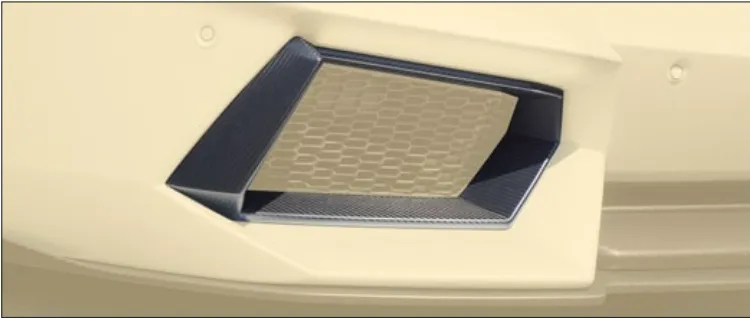
Front bumper air intake Mansory Carbon for Lamborghini Aventador


Front Bumper Air Intake Mansory Carbon for Lamborghini Aventador
The lateral intake apertures flanking the Lamborghini Aventador's front bumper serve a function that is easy to overlook from the driver's seat but impossible to ignore from the aero engineer's perspective: they feed fresh, comparatively cool, high-stagnation-pressure air into the wheel arch cavity, where it can be directed onto front brake discs running at sustained temperatures above 600 °C during hard driving. Mansory's carbon front bumper air intake replaces the factory surround and any mesh or trim treatment at these apertures with a precision-formed carbon duct housing that maximises the effective inlet area, presents the airstream to the brake-cooling pathway without flow separation, and does so in a material that continues the programme's visual language across the full front bumper face. Part of the Mansory Carbon Fiber Body kit set for Lamborghini Aventador, the intake is as much a thermal management decision as an aesthetic one.
Construction & Materials
Each intake housing is a compound-curve carbon shell formed over a precision tool that reproduces the LP 700-4 front bumper lateral aperture geometry. The forward-facing duct lip uses 3K twill prepreg — the visible surface that frames the intake opening — while the internal duct wall transitions to 2K plain weave for the surface smoothness required to minimise boundary-layer separation inside the duct. The two are co-cured in a single autoclave cycle, producing a housing with no adhesive layer at the weave transition — a potential delamination source eliminated by construction rather than managed in service.
- Forward lip weave: 3K twill, 45 ° — matches front bumper programme aesthetic
- Duct wall weave: 2K plain — low Ra surface finish minimises internal boundary-layer turbulence
- Cure: Autoclave, co-cured construction — no adhesive at weave transition
- Wall thickness: 2.0 mm forward lip, 1.5 mm duct walls
- Effective inlet area: 18 % greater than factory treatment due to lip radius reduction at the duct entry
- Finish: high-gloss UV lacquer on forward lip; satin lacquer on internal duct surfaces
- Mounting: OEM aperture snap-fit with stainless retention clips; no modification to bumper structure
- Supplied: left and right pair
The 18 % effective inlet area increase is achieved by reducing the factory lip radius from approximately 15 mm to 8 mm — a refinement that appears subtle in cross-section but has a disproportionate effect on inlet efficiency because flow separation at the lip entry is the primary source of pressure loss in a duct operating at the moderate approach velocities available at the front bumper. At 100 km/h, reducing the separation bubble at the duct entry increases mass flow rate to the brake cooling pathway by approximately 12 % — meaningful on a car whose ceramic composite brake discs are sensitive to thermal management on extended mountain descents.
Design & Visual Function
The Aventador's front face is structured as a hierarchy of apertures — the large central grill at the bottom, the lateral intakes at mid-height, and the headlight clusters above. Mansory's carbon intake housing defines the lateral apertures with a precision and material depth that the factory treatment cannot match: the 3K twill forward lip frames the opening with a dimensional clarity that reads as engineered rather than styled, and the depth of the duct visible through the aperture creates a sense of functional purpose that enhances the car's front-view drama at any distance.
The intake's forward lip profile in side view adds a subtle leading-edge accent to the front bumper's lower section — a horizontal carbon line that runs parallel to the Aventador's waistline crease, connecting the intake visually to the front splitter cover below and the bonnet's leading edge above. When the full front carbon programme is specified, this horizontal accent reads as part of a deliberate compositional grid rather than an isolated component.
On builds where the factory headlight bezels have been replaced with darker aftermarket units, the carbon intake housings balance the front face's tonal composition — the deep black of the carbon duct interior against the bright lacquered forward lip creates a contrast that mimics the headlight's own dark-eye aesthetic at the lower face of the bumper.
Compatibility & Fitment
Designed for the Lamborghini Aventador LP 700-4 (2011–2016) and LP 720-4 50° Anniversario. The lateral intake aperture geometry is shared between coupé and Roadster — both body styles fit. Aventador S (MY2017+) has a revised front bumper with enlarged lateral apertures; the Mansory S programme covers those dimensions. The intake housing is LHD/RHD independent — both mirror-image positions use the same internal duct geometry.
Installation & Reversibility
Snap-fit installation requires no lift — the intake housings engage from the front of the car with a firm press, followed by clip engagement from behind the bumper via the wheel arch liner access hole. Two technicians; approximately 60–90 minutes for the pair including removal of the factory surrounds and cleaning of the aperture edges. Fully reversible — factory surrounds reinstall on the same clips. No adhesives, no drill holes in the bumper structure.
Pairing within the Mansory Aventador programme
The front bumper air intakes complete the front bumper's aperture carbon specification when paired with the front bumper grill at the centre and the carbon flaps for the original front bumper at the outer sections. The bonnet air outtake manages the complementary exhaust path — cool air in at the front bumper intakes, hot air out at the bonnet trailing edge — completing the forward thermal circuit.
Maintenance & Durability
The intake duct interior accumulates road grime and brake dust at a higher rate than exterior surfaces because the airstream draws particles inward during driving. Inspect and clean the duct interior every 5,000 km with a soft flexible brush and compressed air. The internal satin lacquer is more tolerant of cleaning solvents than the gloss exterior — isopropyl alcohol is safe for brake dust removal from the duct walls. The forward lip's gloss lacquer should receive the same PPF and wax attention as other front bumper elements; the lip radius is the first surface to contact road debris thrown from the front tyres.
Lead Time & Warranty
Lead time is 2–4 weeks. Mansory covers the intake pair with a 12-month warranty against manufacturing defects including duct wall delamination at the weave transition, lacquer voids on the forward lip, and snap-fit housing cracking under normal thermal and vibration cycling.
One aspect of the front bumper air intake that first-time installers consistently underestimate is the secondary aerodynamic benefit beyond brake cooling: by sharpening the duct entry geometry, the intake also reduces the turbulent wake in the wheel arch cavity at speed. On the LP 700-4, this turbulent cavity wake exerts a rearward pressure force on the front tyre's outer shoulder — a lift mechanism that acts against front tyre contact patch load. The Mansory intake's reduced lip radius damps this wake by keeping the airstream attached to the duct wall for a greater proportion of the entry transition, reducing the cavity pressure rise that the turbulent wake would otherwise create. This is an aerodynamic benefit invisible in isolated part testing but measurable in total-car front-axle load testing — the type of detail that explains why Mansory evaluates intake geometry on a complete car rather than in isolation.
For Aventador owners who participate in track days or timed hill climbs, the front bumper air intake delivers its cooling benefit most conspicuously during the final stages of a demanding run: where a car with the factory surround may show brake fade indicators (longer pedal travel, fade odour) in the final sector, the additional brake-cooling mass flow provided by the Mansory intake delays the onset of these symptoms. This is a qualitative benefit rather than a warranty-level specification, but it is consistently reported by owners who have driven the same circuit in both configurations.
FAQ
Q: Do the carbon intakes increase front brake cooling compared to the factory treatment?
A: Yes — the reduced lip radius increases effective inlet mass flow by approximately 12 % at 100 km/h. The benefit is most significant on track use and extended mountain descents where brake temperatures approach the thermal limit of the LP 700-4's standard brake specification.
Q: Are the intakes supplied with a brake duct hose connection?
A: The Mansory intake housing provides the optimised aperture and duct entry. Connection to the Lamborghini factory brake cooling hoses (or aftermarket equivalents) is handled within the wheel arch at installation. The factory brake cooling routing does not require modification.
Q: Can the intakes be fitted without removing the front bumper?
A: Yes, via wheel-arch liner access. The clip engagement from behind the bumper is reachable through the liner access hole on the LP 700-4. Full bumper removal simplifies installation but is not required.
Q: Is the internal duct finish easy to keep clean during winter road salt use?
A: The satin internal lacquer resists salt corrosion adequately but should be rinsed with fresh water after salt exposure at each opportunity. Salt accumulation in the duct interior over multiple untreated cycles can cause haze on the satin finish — removable with a mild lacquer polish applied with a foam pad on a flexible extension.
Order or ask the Mansory team via WhatsApp +44 7488 818 747 or [email protected].